How Bangla QR Code Payments Are Changing Everyday Transactions
One QR code now works with every bank app and mobile wallet in Bangladesh. How Bangla QR works, what it costs, the fee fight with merchants, person-to-person QR transfers, and how to stay safe.

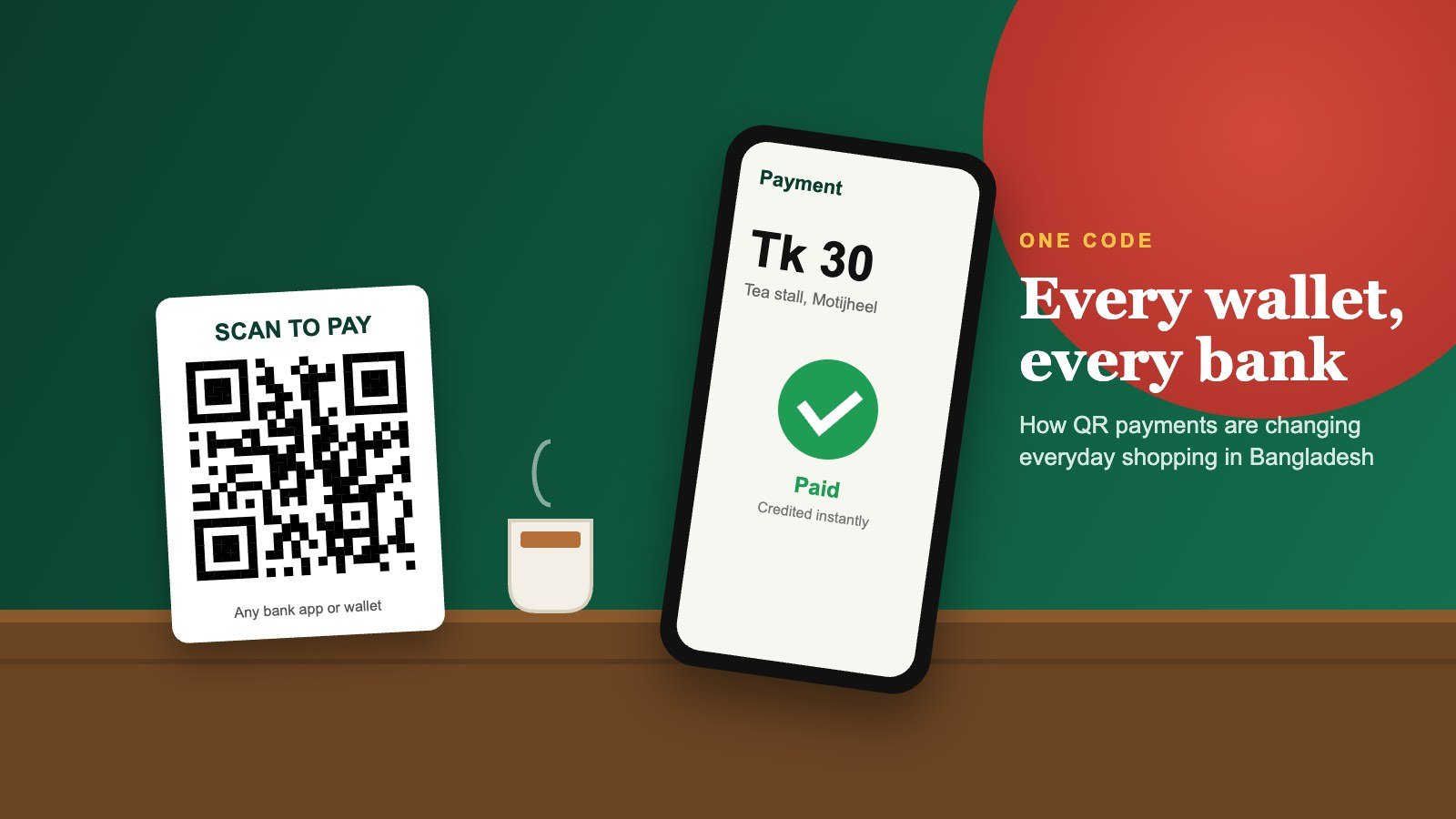
Short answer: Bangla QR is Bangladesh Bank’s single, shared QR code standard. Since 1 July 2026, banks and mobile financial services must use it at every merchant point, so one code at a shop now accepts payments from any bank app or wallet, including bKash and Nagad. Customers pay no fee. Since 1 October, merchants get their money instantly and the old minimum 1% merchant fee has been scrapped, and person-to-person QR transfers were set to start on 1 November. Daily Bangla QR payments rose about fivefold in three months, to around Tk 143.5 crore a day by late September.
Five codes on one counter
Until this summer, Jamal’s tea and snacks stall near Motijheel had a crowded counter. A bKash code, a Nagad code, a Rocket code and two bank codes were taped in a row, curling at the edges. Customers often asked, “Which one is mine?” Some gave up and paid cash. Jamal kept a box of coins for change.
Now there is one sticker. “Everyone scans the same code,” he says. “bKash, bank app, it doesn’t matter. The money shows on my phone straight away.”
What is Bangla QR?
Bangla QR is a common, interoperable QR code standard created by Bangladesh Bank. Payments run through the National Payment Switch Bangladesh (NPSB), the same system behind instant NPSB transfers between banks. A merchant needs only a printed sticker, not an expensive card machine, and a customer can scan it with any participating bank, mobile wallet or payment app.
How did Bangla QR get here?
| When | What happened |
|---|---|
| January 2021 | Bangladesh Bank issues Bangla QR guidelines |
| January 2023 | Pilot with about 1,200 merchants in Motijheel |
| 1 November 2025 | Instant interoperable settlement begins |
| 1 July 2026 | Bangla QR becomes mandatory; proprietary QR codes replaced |
| July 2026 | Minimum 1% merchant fee (including VAT) set |
| 1 October 2026 | Minimum fee scrapped; merchants credited instantly |
| 1 November 2026 | Person-to-person (P2P) QR transfers due to start |
| 1 December 2026 | Dispute-resolution guidelines take effect |
Sources: The Daily Star, The Business Standard, UNB.
How fast is Bangla QR growing?
Very fast since it became mandatory. In the first 48 hours, on 30 June and 1 July, there were 77,165 transactions worth Tk 22.02 crore, UNB reported. By the end of September, Bangladesh Bank said:
| Measure | June 2026 | Late September 2026 |
|---|---|---|
| Daily payment value | About Tk 28 crore | About Tk 143.54 crore |
| Daily transactions | About 1 lakh | Nearly 3.5 lakh |
| Merchant points | 9.63 lakh (end-2025) | About 39 lakh |
bKash alone has deployed Bangla QR at more than 8 lakh merchant points, and Islami Bank onboarded more than one lakh merchants by mid-July, including a record 7,037 in a single day.
How is it changing everyday transactions?
- One code for everyone. Customers no longer hunt for their own bank’s or wallet’s code. “Customers no longer need to search for a specific bank’s or payment service provider’s QR code while shopping,” BRAC Bank’s managing director Tareq Refat Ullah Khan told The Daily Star.
- No change problems. Shops need fewer coins and small notes, and customers pay exact amounts.
- Less cash risk. Shopkeepers carry less cash home, and customers avoid card cloning at machines.
- Cheaper than card machines. A small shop can accept digital payments with a sticker and a phone.
- Instant money for merchants. Since 1 October, payments are credited to merchants immediately.
- A record of sales. Digital receipts can help small businesses show their income when they apply for a loan.
How do you pay with Bangla QR?
- Open your bank app, bKash, Nagad or other wallet, and choose the QR or scan option.
- Scan the Bangla QR sticker at the counter.
- Check that the merchant name shown matches the shop.
- Enter the amount, if it is not already filled in, and confirm with your PIN.
- Show the confirmation screen to the shopkeeper.
Who pays the fees?
Customers pay nothing. When posts on social media claimed a Tk 1,000 payment would cost an extra Tk 10, Bangladesh Bank said the fee applies only to merchants and must not be passed on to customers. Charging more than the listed price for paying by Bangla QR breaks its payment guidelines, and customers can report it to their bank, their mobile wallet or the Directorate of National Consumer Rights Protection, The Business Standard reported.
The fight over the 1% merchant fee
When the mandate began, Bangladesh Bank set a minimum merchant discount rate (MDR) of 1%, including VAT. Small traders objected. On a Tk 1,000 sale, a shopkeeper earning Tk 70 to Tk 80 in profit would lose Tk 10 to the fee, The Daily Star noted, and the Bangladesh Micro and Small Payments Consumers’ Association asked for the fee to be scrapped or capped at 0.25%.
By our calculation, a shop taking Tk 1.5 lakh a month by QR would have paid about Tk 1,725 a month at 1% plus VAT, a real cost for a business working on thin margins.
From 1 October, Bangladesh Bank scrapped the minimum 1% MDR, set the interchange fee between issuing and acquiring institutions at zero, and began paying incentives of 0.10% to acquirers and 0.20% to issuers on merchant payments up to Tk 2,000, UNB reported. Merchants should check with their bank or wallet what charge, if any, now applies to them.
Can you send money to a person with Bangla QR?
That is the next step. Bangladesh Bank set 1 November 2026 for person-to-person (P2P) Bangla QR transfers. Each person gets a QR code that others can scan to send money instantly between bank and mobile wallet accounts in any direction, bank to bank, wallet to wallet, or across the two, The Financial Express reported. Because the recipient’s details are inside the code, there is no need to type an account number, which cuts the risk of sending money to the wrong person. Senders can also upload a saved QR image in their app.
What are the problems?
- Misuse as a cash-out channel. Some merchants hand customers cash against QR “payments” without selling anything, letting them avoid normal cash-out charges and limits. In one reported case, a Tk 10,000 QR payment returned about Tk 9,815 in cash. Some small shops received repeated QR payments of around Tk 5 lakh in short periods, The Financial Express reported. Bangladesh Bank has warned against this.
- Who pays for the system? With the interchange fee at zero, the mobile wallet Upay said it loses about Tk 5 to Tk 8 per Tk 1,000 when its customers pay at another operator’s QR, and wants a cost-recovery fee.
- Fraud and tampering. A fake sticker pasted over a real one can send money to a fraudster.
- Digital literacy and access. Many people still lack smartphones, reliable internet or the confidence to use apps. Cash still made up 35% of formal retail transactions in FY25, and only 28.3% of adults have a bank account, according to figures cited by The Daily Star.
How to stay safe when paying by QR
- Always check the merchant name on your screen before you confirm.
- Look out for stickers pasted on top of other stickers.
- Never share your PIN or OTP, and never scan a QR code to “receive” money; scanning is for paying.
- Shopkeepers should check the payment alert on their own phone, not the customer’s screen.
- Refuse any extra charge for paying by QR, and report it.
What it means for you
For shoppers, Bangla QR means you can pay almost anywhere from whichever account you have. For shop owners, it is a cheap way to accept digital payments and build a record of sales. It also adds to the pressure on slow bank apps, a problem we looked at in why traditional banks are struggling to go digital, and on the wider payments market covered in why Bangladesh needs more financial startups.
Back to the tea stall
Jamal still keeps some coins, but far fewer. “Young customers almost never bring cash now,” he says. “I was worried about the fee. Now I just watch the alerts come in.”
Frequently asked questions
Is there a charge for customers using Bangla QR?
No. Bangladesh Bank says customers pay nothing, and merchants may not add a surcharge for QR payments.
Can I pay a Bangla QR with bKash or Nagad?
Yes. Bangla QR works with participating banks, mobile financial services and payment service providers, including bKash and Nagad.
Is Bangla QR mandatory for shops?
Banks and mobile wallets had to replace their own QR codes with Bangla QR at merchant points by 30 June 2026. Shops that accept QR payments now use Bangla QR.
How fast does the merchant get paid?
Instantly, since 1 October 2026.
What should I do if I pay the wrong QR?
Contact your bank or wallet’s helpline at once with the transaction ID. Bangladesh Bank’s dispute-resolution guidelines for Bangla QR take effect on 1 December 2026.
Key words explained
| Term | What it means |
|---|---|
| Bangla QR | Bangladesh Bank’s single, shared QR code standard for payments. |
| Interoperable | Works across different banks and wallets. |
| NPSB | National Payment Switch Bangladesh, which routes payments between institutions. |
| MDR | Merchant discount rate: the fee a merchant pays on each digital payment. |
| Interchange fee | A fee passed between the customer’s provider and the merchant’s provider. |
| Acquirer | The bank or wallet that serves the merchant. |
| Issuer | The bank or wallet that serves the customer paying. |
| P2P | Person-to-person: sending money directly to another individual. |
How we reported this
We used Bangladesh Bank figures reported by UNB in July and September 2026, The Daily Star’s July 2026 report on the single-QR mandate, The Business Standard’s timeline of Bangla QR policy and its report on customer fees, and The Financial Express’s reports on P2P transfers and QR misuse. The fee example is our own calculation. The featured image is an illustration made by Dhaka Debates.
Editor’s note: Jamal is illustrative, created to show how a small shop owner might experience the switch to Bangla QR. He is not a real person. All data come from the published sources listed with this article.
Sources
- UNB: Bangla QR transactions surge nearly fivefold to Tk 143.54cr daily · unb.com.bd
- UNB: Bangla QR records Tk 22.02 crore transactions in 48 hours · unb.com.bd
- The Daily Star: One QR, every wallet · thedailystar.net
- The Business Standard: Bangla QR, building the foundation for a cash-lite Bangladesh · tbsnews.net
- The Business Standard: BB spokesperson clarifies Bangla QR remains free for customers · tbsnews.net
- The Financial Express: BB set to introduce person-to-person money transfer through Bangla QR · thefinancialexpress.com.bd
- The Financial Express: Bangla QR misuse raises concerns over MFS sustainability · thefinancialexpress.com.bd
- Prothom Alo: Mandatory Bangla QR code marks new phase in digital payments · en.prothomalo.com