The tea stall owner who saved for his daughter’s university, one taka at a time
A Farmgate tea seller, a tin box and a DPS that paid for university. An illustrative story, and a full guide to saving for your child's education on a small, irregular income.

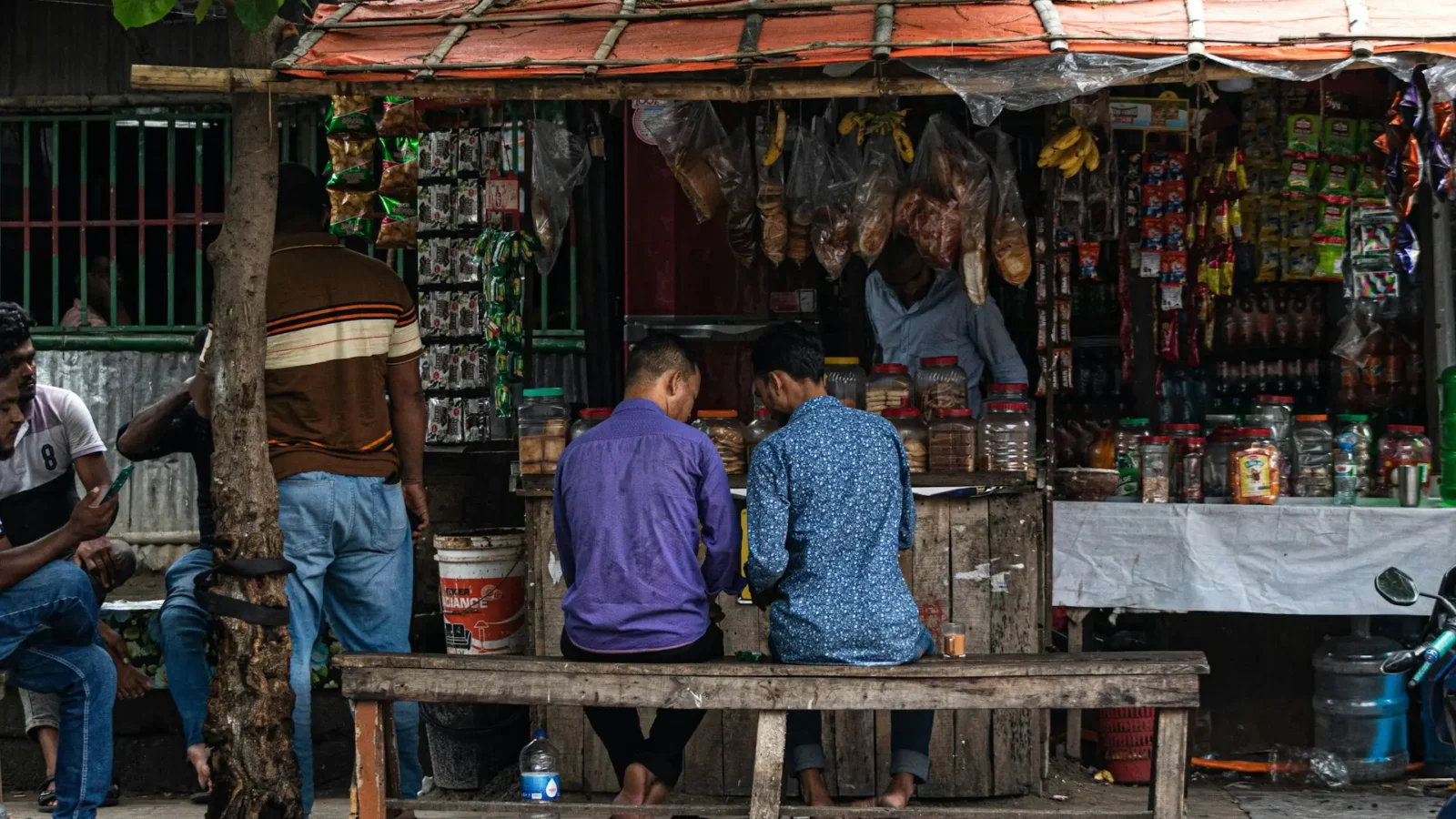
Editor’s note: Abdul Karim and his family are an illustrative portrait, drawn from the habits of the many small traders who save this way in Dhaka. The names and details are representative, not those of one specific person. The practical guide that follows uses real, published figures.
The kettle goes on at 5:30. By the time the first rickshaw pullers arrive, Abdul Karim has already counted yesterday’s coins into two piles: one for stock and rent, and one that goes into a tin box under the counter.
“The box was my wife’s idea,” he says. “If the money is in my pocket, it goes. If it’s in the box, it stays.”
That box became a deposit pension scheme in 2015, after a bank officer who drank tea at the stall every morning walked him through the paperwork. Karim had never opened a bank account before.
Small, boring and every day
Financial planners call it pay-yourself-first. Karim calls it habit. The amount changed with the seasons, smaller during Ramadan, larger in winter when tea sells fastest, but he never skipped a month.
“I didn’t know about interest rates. I only knew that the box had to be heavier at the end of the year.”
When his daughter Rumana passed her HSC exams last year, the scheme matured. It covered her admission fees and her first year’s hostel rent at a public university in Rajshahi.
What he would do differently
Karim’s one regret is the years before the bank account, when the tin box earned nothing and once went missing for a week. “Start in the bank, even if it’s small,” he says. “The box is only for the first step.”
Rumana is studying accounting. She has already opened a mobile banking account and, her father notes with some pride, saves a little from her tuition income every month.
The lessons behind the tin box
Karim’s story is ordinary, and that is the point. He did not earn a big salary, did not read about investing and did not wait for a perfect moment. He did three simple things that almost anyone can copy:
- He separated the savings first. Before spending on anything, a share of the day’s takings went into the box. Savings were not “what is left over”.
- He made it hard to touch. Money in his pocket got spent. Money in the box, and later in the bank, stayed.
- He never stopped. The amount went up and down with the seasons, but he never skipped a month for ten years.
His one mistake, keeping cash in a box for years, is also the most common one. The rest of this guide explains why it matters, and how to do what Karim did, but better and from day one.
Why the tin box is not enough
Cash at home has three problems.
- It earns nothing. A taka in a box is still a taka ten years later.
- It loses value every year. Prices rise. Inflation in Bangladesh was 8.34% in September 2026. If prices rise even 7% a year on average, Tk 100 kept for ten years buys only about what Tk 51 buys today.
- It can be lost, stolen or borrowed. A relative in need, a fire, a thief, or simply the temptation to dip into it on a bad week.
Here is what the same habit looks like in a box versus a bank. Say a family puts aside Tk 1,500 a month, about Tk 50 a day, for ten years.
| Where the money goes | Total put in (Tk) | Value after 10 years (Tk) | Extra earned (Tk) |
|---|---|---|---|
| Tin box at home | 1,80,000 | 1,80,000 | 0 |
| DPS at 9% | 1,80,000 | about 2,81,000 | about 1,01,000 |
| DPS at 10.5% | 1,80,000 | about 3,05,000 | about 1,25,000 |
Our calculation, monthly compounding, after deducting 10% source tax on the interest. Banks also deduct a small yearly excise duty on larger balances, and actual DPS rates vary by bank and tenure.
The same daily habit, the same Tk 50, produces over Tk 1 lakh more just by sitting in the right place. For a family paying for a first year at university, that difference can be the hostel, the books and the bus fare home at Eid.
Smaller amounts work too. Tk 500 a month in a DPS at 9% grows to about Tk 93,700 after ten years, from Tk 60,000 put in. Tk 1,000 a month grows to about Tk 1,87,000.
What a DPS is, in plain words
A DPS (Deposit Pension Scheme) is a savings plan where you deposit a fixed amount every month for a fixed number of years. At the end, the bank pays back everything you put in plus interest. Despite the name, it has nothing to do with pensions; it is simply a disciplined monthly savings account.
Why it suits people like Karim:
- Small amounts are fine. Many schemes start from Tk 500 a month.
- It builds the habit. A fixed monthly amount, ideally debited automatically, means you do not have to decide every month.
- It is hard to break. Closing a DPS early usually means losing some interest, which is a useful barrier against spending the money on impulse.
- It is safe. Bank deposits are covered by Bangladesh’s deposit protection scheme up to a limit, and the amount you get back is known in advance.
What DPS rates look like in 2026
Rates differ a lot between banks, so it pays to compare. As one example, NRB Bank’s deposit rate sheet effective 7 June 2026 listed these rates for its standard DPS:
| Tenure | DPS rate |
|---|---|
| 3 years | 9.00% |
| 5 years | 9.50% |
| 7 years | 10.00% |
| 10 years | 10.50% |
The same sheet showed an ordinary savings account paying just 1.5%. That gap is why a DPS beats leaving money in a savings account for long-term goals. Its student DPS, offered through agent banking, paid 7.5%. Always check the current sheet; rates change, and a few banks offer much less.
The fine print that matters
- Tax on interest. The bank cuts source tax from your interest, usually 10% if you can show proof of a tax return and 15% if you cannot. Our explainer on why your FDR interest is lower than you think covers this in detail, and the same rules apply to DPS.
- Excise duty. A small yearly government charge applies once your balance goes above Tk 4 lakh, under the FY2026-27 budget. Most small DPS accounts stay below this for years.
- Missed instalments. Missing a month can mean a penalty, lost interest for that instalment, or in some cases the scheme being closed early. Ask your bank exactly what happens.
- Breaking it early. If you close a DPS before maturity, you usually get a much lower rate, sometimes close to the savings account rate.
- A nominee. Always name a nominee, so your family can claim the money if something happens to you.
How to open a DPS: three ways
1. At a bank branch
The traditional route, and the one Karim took. You will usually need:
- Your National ID card (NID) and a copy
- Two passport-size photos
- Your nominee’s NID copy and photo
- A savings account at the same bank, for automatic monthly debit (many banks open one alongside)
- Proof of tax return if you have one, to get the lower 10% tax rate
2. Through an agent banking outlet
Many banks run agent banking points in markets, small towns and neighbourhoods far from a branch. You can open accounts and schemes there with the same documents. For small traders who cannot leave the shop during banking hours, an outlet down the road is often easier.
3. From your phone, through bKash
If you already use bKash, you can open a DPS inside the app. According to bKash’s monthly DPS page:
- It starts from Tk 500 a month.
- Tenures are 6, 12, 24, 36 or 48 months.
- The money goes to partner institutions including BRAC Bank, IDLC Finance, Dhaka Bank, Mutual Trust Bank and City Bank’s Islamic arm, which set the interest rate.
- If your bKash balance is short on the debit day, it retries for seven days; after that, the instalment counts as missed and earns no interest.
- You cannot close it in the first 90 days, and closing early may mean losing part of the interest.
The mobile route is fast and needs no branch visit. The trade-off is shorter tenures (up to four years) compared with the 10-year schemes many banks offer. For a goal like university, some families use both: a long bank DPS as the backbone, and a short mobile DPS for nearer costs.
How much does university actually cost?
Knowing the target makes saving easier. Public universities in Bangladesh charge very low tuition, but living costs add up, especially if your child has to move to another city.
Take Rajshahi University, where Rumana studies in our story. A hall seat officially costs very little; Prothom Alo reported an official hall rent of just Tk 100 at one hall. But only around 30% of students get a seat. About 68% live off campus, where one student paid Tk 2,500 a month in rent and about Tk 4,000 a month in total including meals and transport.
A rough first-year budget for a student living off campus might look like this. These are our estimates for planning, built around the Prothom Alo figures.
| Cost | Estimate for first year (Tk) |
|---|---|
| Admission test forms and travel to exams | 10,000 to 20,000 |
| Admission and first-year university fees | 10,000 to 20,000 |
| Rent, food and local transport (about Tk 4,000 a month) | about 48,000 |
| Books, photocopies, stationery, a basic phone or laptop share | 10,000 to 25,000 |
| Trips home at Eid and holidays | 5,000 to 10,000 |
| Total | about 83,000 to 1,23,000 |
Our estimates. Costs are higher in Dhaka and much higher at private universities, where tuition alone can run into several lakh taka over a degree. Check the specific university’s fee notice.
Compare that with the table above: a family saving Tk 1,000 a month in a DPS for ten years would have around Tk 1.87 lakh, enough for the first year and some of the second. That is roughly what Karim achieved in our story.
How much should you save each month?
Work backwards from the goal. If your child is young, time does most of the work.
| Monthly saving | After 5 years at 9% (Tk) | After 10 years at 9% (Tk) |
|---|---|---|
| 500 | about 37,000 | about 93,700 |
| 1,000 | about 74,000 | about 1,87,000 |
| 1,500 | about 1,11,600 | about 2,81,000 |
| 3,000 | about 2,23,000 | about 5,62,000 |
Our calculation, monthly compounding, after 10% source tax on interest. Rounded.
The lesson is simple: starting early matters more than saving a lot. Tk 500 a month started when a child is in Class 1 can do as much as a far larger amount started in Class 9.
Saving on an irregular income
Karim’s income went up and down with the seasons. So does that of rickshaw pullers, shopkeepers, farmers, tailors, drivers and freelancers. A fixed monthly DPS can feel risky when you do not know next month’s earnings. A few ways to handle it:
- Set the DPS at your worst month, not your best. Choose an amount you can pay even in a slow month. Save extra in good months separately.
- Save daily, deposit monthly. Karim’s two piles are a good system. Put aside a little every day, in a separate place, and move it to the DPS once a month.
- Use the good season. In busy months, pay a few instalments ahead if your bank allows it, or top up a separate savings account to cover slow months.
- Consider a weekly DPS. Some banks and bKash offer weekly schemes, which match daily or weekly income better.
- Keep a small emergency cushion. Even Tk 5,000 to 10,000 set aside means a sudden doctor’s bill does not force you to break the DPS.
Teaching the next generation
The quiet ending of Karim’s story is that Rumana now saves too. Children who watch their parents save tend to save as adults. A few ideas:
- Open a student savings account or a small DPS in your child’s name once they are old enough, and let them see the balance grow.
- Talk about money openly: what things cost, why you save, what interest is.
- Encourage students with tuition income to save a fixed share, even 10%, from their first earnings.
For young earners starting out, our guide to the 5 money mistakes every new graduate in Dhaka makes is a good next read. For more everyday saving ideas, see how to save money in Dhaka.
A simple plan you can start this week
- Pick a goal and a date. “University admission in 2036” is clearer than “save for the future”.
- Choose an amount you can pay in your worst month. Even Tk 500 is a real start.
- Compare two or three banks’ DPS rates, or check the bKash partners if you prefer your phone.
- Open the DPS with a nominee, and set up automatic monthly debit.
- Keep saving daily in a separate place, so the monthly instalment is always ready.
- Raise the amount whenever your income rises. Never lower it unless you must.
This article shares general information about savings products using published rates and our own illustrative calculations. It is not financial advice. Interest rates, tax rules and scheme terms change; check the current terms with your bank or provider before you open an account.
Frequently asked questions
What is the minimum amount to open a DPS?
Many banks and the bKash DPS start from Tk 500 a month. Some banks offer lower amounts through agent banking or student schemes.
What interest does a DPS pay in 2026?
It varies by bank and tenure. As one example, NRB Bank’s June 2026 sheet listed 9% for 3 years and 10.5% for 10 years on its standard DPS. Always compare current rates.
What happens if I miss a DPS instalment?
It depends on the bank. You may pay a penalty or lose interest on that instalment, and several missed months can lead to early closure. On bKash, a missed instalment earns no interest.
Is DPS interest taxed?
Yes. The bank cuts source tax from the interest, usually 10% with proof of a tax return and 15% without.
Can I open a DPS without going to a bank?
Yes. You can open one through the bKash app with partner banks and financial institutions, or at an agent banking outlet near you.
Is it safe to keep savings at home?
Cash at home earns nothing, loses value to inflation and can be lost or stolen. A small amount for emergencies is fine, but long-term savings belong in a bank.
Key words explained
| Term | What it means |
|---|---|
| DPS | Deposit Pension Scheme. A fixed monthly savings plan for a set number of years. |
| Maturity | The end of the scheme, when you get your money and interest back. |
| Nominee | The person who can claim the money if the account holder dies. |
| Agent banking | Bank services offered through local outlets run by agents, often in markets and small towns. |
| Source tax | Tax the bank cuts from your interest before paying it. |
| Inflation | The rate at which prices rise, which reduces what your money can buy. |
| Compounding | Earning interest on your interest, which makes savings grow faster over time. |
How we reported this
Abdul Karim’s story is an illustrative portrait based on common saving habits among small traders, not a profile of one person. DPS rates come from NRB Bank’s published rate sheet effective 7 June 2026, and bKash DPS terms from bKash’s product page. University living costs come from Prothom Alo’s reporting on Rajshahi University. Inflation is the September 2026 figure. All savings projections and the first-year university budget are our own calculations and estimates, with assumptions stated. We have no arrangement with any bank or provider mentioned.
Sources
- NRB Bank – Interest Rate on Deposit Products effective 7 June 2026 · nrbbankbd.com
- bKash – Monthly DPS · bkash.com
- Prothom Alo – Accommodation crisis at Rajshahi University: 68pc students live off-campus · en.prothomalo.com
- Dhaka Tribune – Inflation rises in September · dhakatribune.com
- The Daily Star – Excise duty exemption threshold on bank deposits rises to Tk 4 lakh · thedailystar.net