Why Rafiq Stopped Sending Money Home Through Hundi: Legal Remittance vs Hundi, Explained
A Dubai construction worker, a better hundi rate, and the app that changed his mind. What legal remittance really pays once you count the 2.5% incentive, and what hundi really costs.

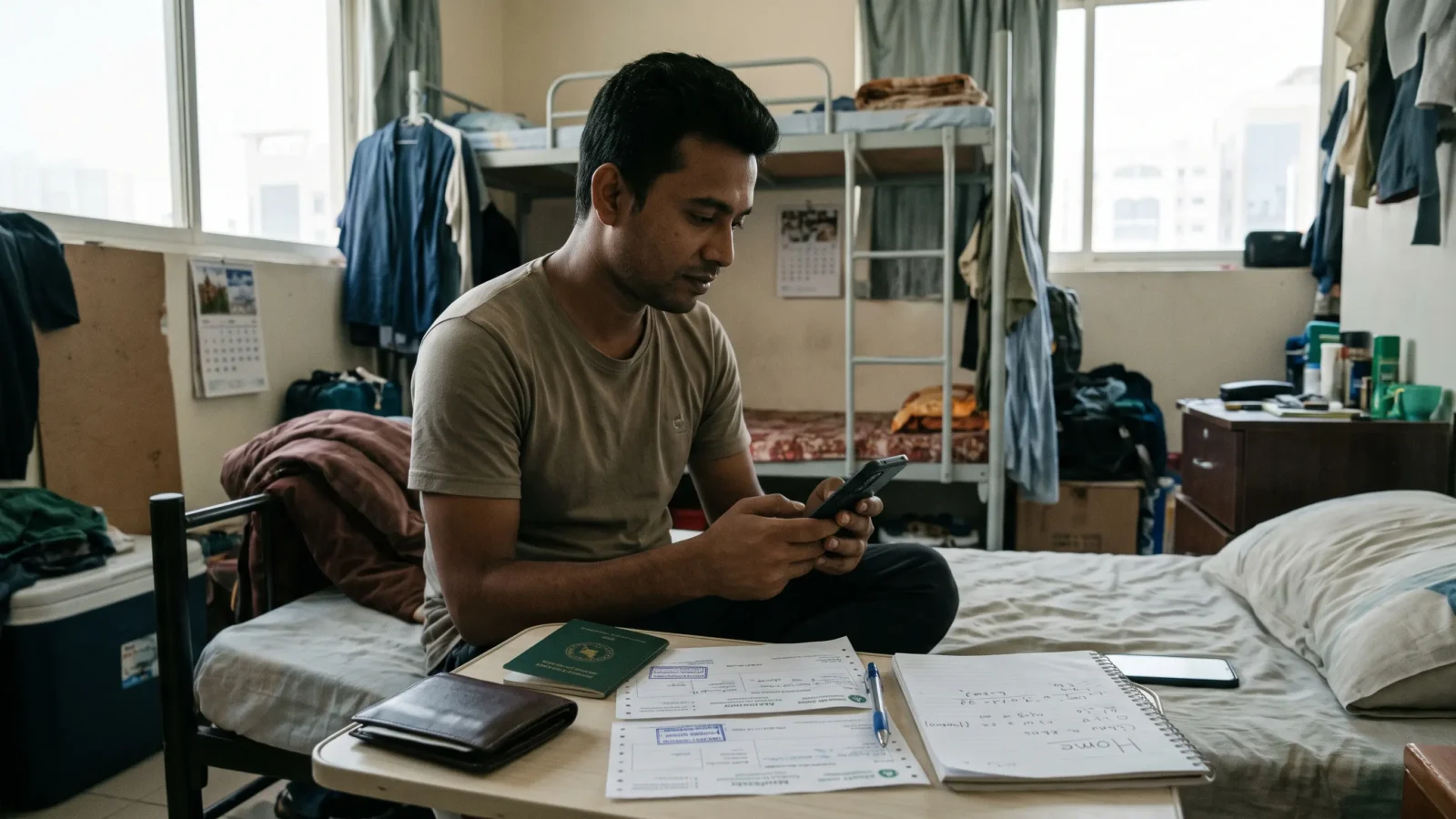
Editor’s note: Rafiq is an illustrative portrait, drawn from the experiences many Bangladeshi migrant workers in the Gulf describe. He is not one specific person. The figures and rules in this article come from published sources and our own clearly labelled calculations.
For six years, Rafiq sent money home the way most men on his construction site did. On payday, a man from his own district would come to the labour camp in Dubai, take the dirhams in cash, and make a phone call. Within an hour, Rafiq’s wife in Cumilla would get a call from a local shopkeeper, or the money would land in her bKash account. No forms, no queue, and a slightly better rate than the exchange house.
Then, one month, the money did not arrive. The middleman said there was a “problem in Dhaka”. It came eleven days later, short by a few thousand taka. Around the same time, a cousin’s wife had her mobile wallet frozen after receiving money through the same network.
A co-worker showed Rafiq a remittance app on his phone. He sent a small amount as a test. It reached his wife’s bKash account the same day, with a government incentive added on top. He has not used hundi since.
Rafiq’s story is the story of a quiet shift happening across the Gulf, Malaysia and beyond. This article explains why hundi tempts so many workers, what it really costs, and how legal channels compare once you count every taka.
Why remittance matters so much
Money sent home by Bangladeshis working abroad is one of the pillars of the economy. In the 2025-26 fiscal year, inflows through official channels reached a record of more than $35.5 billion, up over 17% from the year before, according to Bangladesh Bank’s provisional figures.
Every dollar that comes through a bank or licensed channel strengthens the country’s foreign currency reserves, helps keep the taka stable, and pays for imports like fuel and food. Every dollar that goes through hundi does not, even though the family at home still receives taka.
How hundi actually works
Hundi is an informal money transfer system. No money physically crosses the border. Instead, it works on a network of people balancing accounts with each other.
In a 2022 investigation, Bangladesh’s Criminal Investigation Department (CID) described three layers:
- One group collects foreign currency from workers abroad.
- A second group arranges payment in taka inside Bangladesh, often through mobile financial service agents.
- A third group pays local money into mobile accounts linked to people who want to move money out of the country.
The family gets taka. The worker’s dollars or dirhams stay abroad, where they are often used by people moving wealth out of Bangladesh illegally. CID said at the time that hundi was costing the country about $7.8 billion a year in remittances, and police said the money funded smuggling and other crime.
So when a worker uses hundi, he is not just choosing a rate. He is, without meaning to, helping someone else take money out of the country.
Why workers choose hundi
It would be easy to blame workers. That would be unfair. Hundi survives because it solves real problems:
- A better rate, sometimes. When the open-market dollar rate is higher than the official one, hundi dealers can offer a few taka more per dollar or dirham.
- Convenience. The agent comes to the camp. There is no need to take a day off, travel to an exchange house, or stand in a queue.
- No paperwork. Workers with expired documents, or who are unsure of the rules, feel safer avoiding formal systems.
- Trust in people, not institutions. The agent is often from the same village. Banks feel distant and complicated.
- Delivery to the door. In remote areas, hundi networks can hand cash directly to families with no bank nearby.
Many of these advantages have shrunk in recent years. Remittance apps work from a phone, mobile wallets reach almost every village, and the government pays a bonus for using legal channels. The main remaining pull is the rate, and that is where the maths gets interesting.
The real comparison: AED 1,500 a month
Say Rafiq sends AED 1,500 home every month. The dirham is pegged to the US dollar, and with the interbank dollar rate around Tk 123.20 in mid-2026, one dirham is worth roughly Tk 33.50. (Remittance providers’ actual rates vary; Remitly, for example, advertised a promotional rate of Tk 34.21 per dirham for first-time senders.)
Now compare. The hundi rate gap and the transfer fee below are our assumptions for illustration.
| Item | Legal channel (Tk) | Hundi (Tk) |
|---|---|---|
| AED 1,500 converted | 50,320 (at Tk 33.55) | 51,820 (assuming Tk 1 more per dirham) |
| Government incentive, 2.5% | + 1,258 | 0 |
| Transfer fee (assumed AED 12) | − 403 | 0 |
| Family receives | 51,175 | 51,820 |
| If the bank adds its own extra 2.5% incentive | 52,433 | 51,820 |
Our calculation. Exchange rates, fees and the hundi premium change constantly; this shows the shape of the trade-off, not a quote.
Three things stand out:
- The gap is small. Even if hundi pays a full taka more per dirham, the difference is around Tk 650 a month, about 1%. Many months, especially when the official and open-market rates are close, there is no gap at all.
- The incentive can flip the result. Where a bank or provider adds its own bonus on top of the government’s 2.5%, legal remittance pays more than hundi.
- The hundi “gain” is not guaranteed. One delayed or short payment, like Rafiq’s, can wipe out a whole year of small gains.
The 2.5% incentive, explained
The government pays a cash incentive on remittances sent through legal channels. In the FY2026-27 budget, the finance minister confirmed the 2.5% incentive would continue.
How it works in practice:
- It is paid to the receiver in Bangladesh, added to the amount that arrives.
- It applies to money received through banks, licensed exchange houses, remittance apps and mobile wallets like bKash.
- According to bKash’s remittance page, receivers get the 2.5% government incentive, and in some cases an additional 2.5% bank incentive.
- Hundi pays none of this. The incentive is only for money that enters the country legally.
On Rafiq’s AED 1,500 a month, the 2.5% alone is worth about Tk 15,000 a year, close to a month’s rent for many families back home.
The hidden costs of hundi
The rate is visible. The risks are not. Here is what hundi users can lose:
- Money that never arrives. If the middleman disappears, is arrested or simply cheats, there is no bank to complain to and no record to show the police.
- Frozen accounts. Authorities have repeatedly suspended mobile wallet accounts linked to hundi. In past crackdowns, Bangladesh Bank and its financial intelligence unit suspended hundreds of agent accounts. A family whose wallet is frozen may not be able to reach even its legitimate money for a while.
- No incentive. As shown above, worth thousands of taka a year.
- No record of income. Money received through banks creates a history. Families can use it to show income for a loan, a visa, a child’s education abroad, or a land purchase. Hundi money leaves no trail, and large unexplained cash can raise questions later.
- Legal risk. Hundi breaks foreign exchange and anti-money laundering laws. While enforcement mostly targets organisers, receiving or arranging hundi payments can still create trouble.
- Harm to the country. Every dollar diverted weakens reserves, puts pressure on the taka and makes imports, including the fuel and food families buy, more expensive.
Legal ways to send money home, compared
| Method | How it works | Speed | Good for |
|---|---|---|---|
| Remittance app (Remitly, Wise, WorldRemit and others) | Send from your phone; money goes to a bank account or mobile wallet | Minutes to a day | Workers with a smartphone and a local bank card |
| Exchange house (such as LuLu, Al Ansari) | Pay cash at a counter; family receives in bank, wallet or cash pickup | Same day, often | Workers who prefer cash and a receipt |
| Direct to bKash or other mobile wallet | Sent through a partner provider straight into the family’s wallet | Usually instant | Families without easy bank access |
| Bank transfer | From a bank account abroad to a bank account at home | 1 to 3 days | Larger amounts and savings |
| Cash pickup | Family collects cash at a partner bank or agent with ID | Same day | Families who need cash in hand |
bKash lists partner money transfer operators by country, including Remitly, Wise, WorldRemit, Western Union and MoneyGram. Families receiving into bKash can cash out at certain ATM booths for Tk 7 per Tk 1,000, according to bKash.
How to get the most from every dirham
- Compare the final taka amount, not the rate alone. A provider with a slightly lower rate but no fee can be better than one with a high rate and a high fee. Most apps show exactly how much your family will receive before you send.
- Check for extra incentives. Some banks and providers add their own bonus on top of the government’s 2.5%. Ask.
- Send larger amounts less often. Many providers charge a flat fee per transfer, so one monthly transfer usually costs less than four weekly ones.
- Use first-transfer offers wisely. Many apps give a better rate or no fee on the first transfer. Fine to use, but compare the regular rate too.
- Keep the receipts. Every legal transfer gives you a record. Save them.
- Send to the family’s own account. Use an account in your spouse’s or parent’s name, not an agent’s or shopkeeper’s.
What the family at home can do
Remittance is a family decision. The person receiving the money matters as much as the person sending it.
- Open an account in your own name. A bank account or registered mobile wallet in the wife’s or parent’s name keeps the money safe and creates a record.
- Refuse payments through strangers. If money arrives from an unknown agent’s account rather than a remittance service, it is probably hundi. Ask the sender to use a legal channel.
- Save part of every transfer. Remittance income can stop suddenly if the worker loses a job or falls ill. A DPS or FDR built from each month’s money creates a cushion. Our guide to where to keep your first 1 lakh taka compares the options.
- Plan for the return. Most migrant workers come home one day. Savings built in the family’s name are what make that return comfortable.
What changed Rafiq’s mind
In our illustrative story, it was not a lecture about reserves or the law that changed Rafiq’s mind. It was three practical things: a payment that went missing, a cousin’s frozen wallet, and an app that turned out to be faster and nearly as good on price once the incentive was added.
That is how this shift tends to happen across the migrant community: one worker tries a legal channel, finds it works, and tells the next. If you are still using hundi, the simplest step is the one Rafiq took. Send a small amount through a legal channel once, compare what arrives, and decide for yourself.
For freelancers receiving money from abroad, rather than workers sending it, our guide on getting paid from abroad covers the same questions from the other side.
This article is general information. It is not legal or financial advice. Exchange rates, fees and incentive rules change; check the current terms with your provider before sending money.
Frequently asked questions
Is hundi illegal in Bangladesh?
Yes. It breaks foreign exchange and anti-money laundering laws. Authorities have arrested organisers and frozen mobile wallet accounts linked to hundi networks.
Does hundi really give a better rate?
Sometimes slightly, when the open-market rate is above the official rate. But once you add the 2.5% government incentive on legal remittance, the gap is usually small or gone, and sometimes legal channels pay more.
How much is the remittance incentive?
The government pays 2.5% on money received through legal channels, and the FY2026-27 budget kept it. Some banks and providers add an extra bonus.
Can I send money from the UAE directly to bKash?
Yes. Many exchange houses and apps, including partners listed by bKash, can send directly to a bKash account. The receiver gets the 2.5% incentive too.
What is the safest way to send money home?
Any licensed channel: a bank, a registered exchange house, a regulated remittance app, or a mobile wallet partner. Send to an account in your family member’s own name and keep the receipt.
Key words explained
| Term | What it means |
|---|---|
| Hundi | An informal, illegal system for moving money across borders without using banks. |
| Remittance | Money sent home by people working abroad. |
| Incentive | A government bonus, currently 2.5%, added to legal remittances. |
| Exchange house | A licensed business abroad that converts and sends money home. |
| MTO | Money Transfer Operator, a company like Western Union or Remitly that moves money internationally. |
| Interbank rate | The exchange rate banks use with each other, close to the official market rate. |
| Foreign reserves | The country’s stock of foreign currency, used to pay for imports and keep the taka stable. |
How we reported this
Rafiq is an illustrative portrait based on experiences commonly described by migrant workers, not a profile of one person. Remittance totals come from Bangladesh Bank’s provisional FY2026 figures as reported. The description of how hundi works comes from CID statements reported in 2022. The incentive rules come from the FY2026-27 budget coverage and bKash’s published remittance terms. The exchange rate comparison uses the mid-2026 interbank dollar rate and stated assumptions for fees and the hundi premium. We have no arrangement with any provider mentioned.
Sources
- Asia News Network – Record USD 35.5 billion in remittance inflows into Bangladesh · asianews.network
- bdnews24 – CID: Hundi deprives Bangladesh of billions; MFS agents arrested · bdnews24.com
- bdnews24 – Taka-dollar interbank exchange rate · bdnews24.com
- Remitly – Send money from UAE to Bangladesh: pricing · remitly.com
- The Business Standard – Govt to continue 2.5% cash incentive on remittances · tbsnews.net
- bKash – International remittance (money transfer service) · bkash.com
- The Business Standard – BFIU suspends cash out from 230 MFS accounts over hundi transactions · tbsnews.net
- The Financial Express – BB warns expatriates against hundi, suspends 480 MFS agents' accounts · mail.thefinancialexpress.com.bd
Keep reading
How to Open an nsave Account from Bangladesh (2026): Step-by-Step Guide, Fees, Benefits and Risks
How to Open a Payoneer Account in Bangladesh (2026): Step-by-Step Guide, Fees, Benefits and Drawbacks
Dhaka Freelancers on Getting Paid from Abroad: The Cheapest Ways to Bring Earnings Home