Where Should a Salaried Person in Dhaka Keep Their First 1 Lakh Taka?
Savings account, FDR, DPS, Sanchayapatra, mutual funds or gold? We compare returns, risk, tax and access for a first-time saver in Dhaka, using rates as of October 2026.

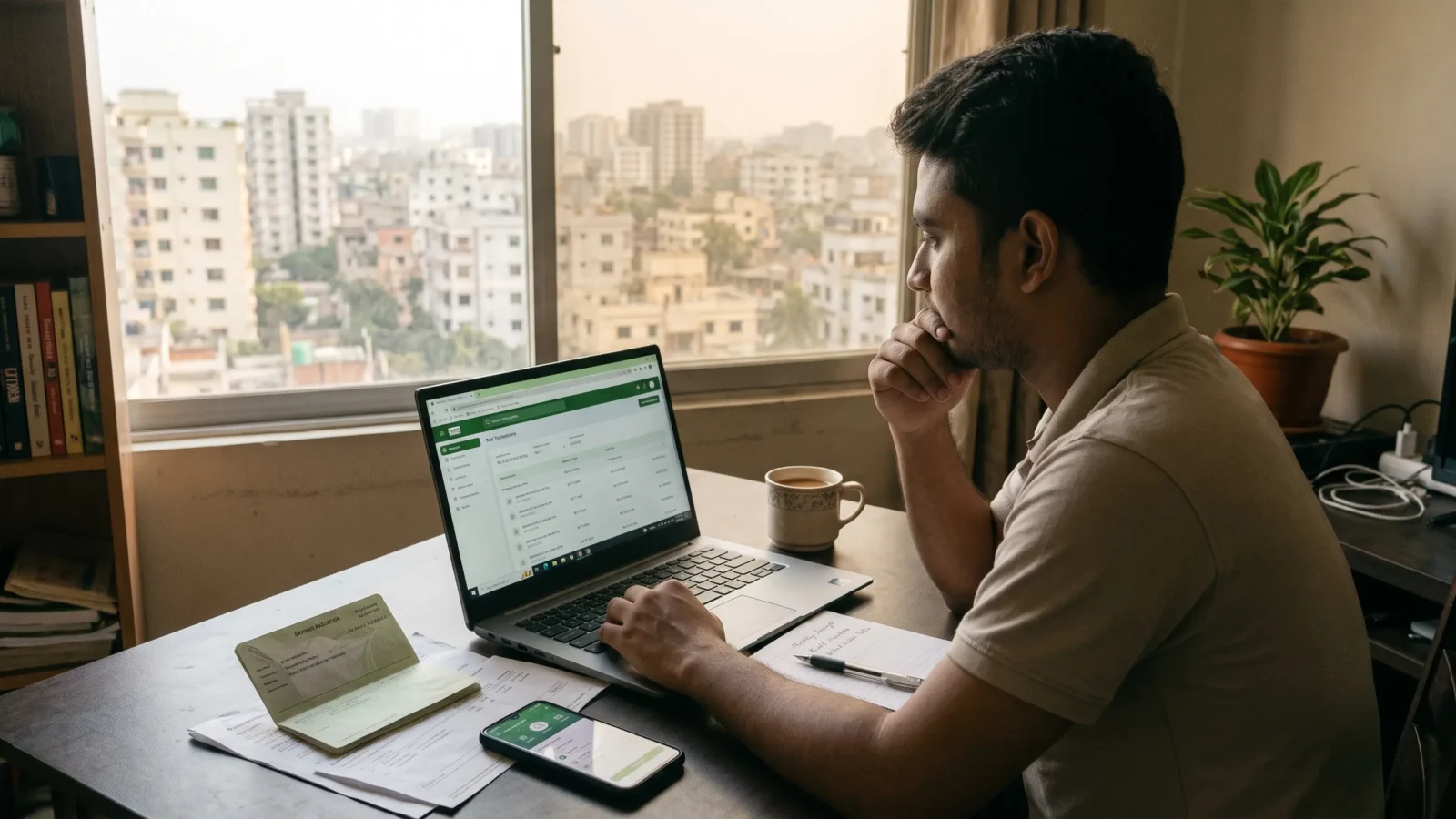
You finally have one lakh taka saved. Your uncle says Sanchayapatra, your colleague says gold, and a YouTube video says mutual funds. Here is how the six most common choices really compare in late 2026.
Saving your first Tk 1 lakh on a Dhaka salary is not easy. Rent, bus fare, family support and rising bazar prices eat most of the month. So when the number finally hits six digits, the question of where to keep it feels big.
There is no single right answer. But there is one number every option must be judged against: inflation. Prices rose 8.34 per cent in the year to September 2026, according to the Bangladesh Bureau of Statistics (Dhaka Tribune). If your money earns less than that after tax, it is quietly shrinking, even if the balance goes up.
The first rule before anything else: keep an emergency fund. A job loss, a hospital bill or a family crisis can arrive without warning. Before locking money away for years, most financial planners suggest keeping enough to cover around three months of basic expenses somewhere you can reach quickly. For many salaried people, that is a big part of the first lakh.
This guide compares a savings account, an FDR, a DPS, Sanchayapatra, mutual funds and gold, using rates published by banks and the government as of 31 October 2026.
The six options at a glance
| Option | Typical return (Oct 2026) | Risk to your money | How fast you can get it | Good for |
|---|---|---|---|---|
| Savings account | Low single digits | Very low | Same day | Emergency fund |
| FDR (1 year) | About 7% to 9% at large banks | Low | Break early and lose some interest | Money you won’t need for months |
| DPS | About 9% to 10% | Low | Locked for years | Building savings monthly from salary |
| Sanchayapatra | About 11.8% | Very low, government-backed | Locked; lower rate if cashed early | Money you can leave for 3 to 5 years |
| Mutual funds | Varies; can be negative | Medium to high | Usually within a week | Long-term growth, small monthly amounts |
| Gold | Moves with world prices | Medium; price swings | Sell anytime, at a loss to the jeweller | Small hedge, not the main plan |
Numbers here are before tax and change often. Always check the latest rate with the bank or the National Savings Directorate before you invest.
What Tk 1 lakh earns in one year, roughly:
- Savings account at 3%: about Tk 3,000, less than inflation takes away.
- FDR at 8%: about Tk 8,000, or about Tk 7,200 after 10% source tax. Still slightly below inflation.
- Sanchayapatra at 11.83%: about Tk 11,830 before tax. This is one of the few safe options that beats inflation today.
Each option, explained simply
1. Savings account: safe, easy, but slowly losing value
This is where your salary probably lands already. Money is available any time through ATM, app or bKash link. The problem is the return. Most banks pay only a few per cent a year on ordinary savings balances, well below inflation (One Bank rate sheet).
One piece of good news from the FY27 budget: no excise duty is charged on bank balances up to Tk 4 lakh, up from Tk 3 lakh (The Daily Star). So a first-time saver with Tk 1 lakh pays no excise duty at all.
Best use: your emergency fund. Not your long-term savings.
2. FDR: fixed rate, fixed time
With a Fixed Deposit Receipt, you lock a lump sum for a set period, from one month to several years, at an agreed rate. Rates have started falling. Bangladesh Bank cut its policy rate from 10 per cent to 9.5 per cent in August 2026, its first cut in six years, and deposit rates usually follow with a delay (VIPB).
To give real examples, Midland Bank’s October 2026 sheet shows 8 per cent for a one-year FDR (Midland Bank), and Bank Asia shows 7.25 per cent (Bank Asia). Some weaker banks advertise much higher rates to attract cash. A higher rate can mean a weaker bank, so check its health first.
Tax: banks deduct 10 per cent source tax on interest if you show proof of tax return submission, and 15 per cent if you don’t.
Best use: money you are sure you won’t touch for 6 to 12 months.
3. DPS: saving a little every month
A Deposit Pension Scheme takes a fixed amount from your account every month, for three to ten years, and pays it back with profit at the end. Rates are often a bit higher than FDRs. Midland Bank, for example, lists 10.25 per cent for a three- or five-year women’s DPS (Midland Bank).
DPS fits salaried people well because it builds discipline. The catch: if you stop paying or break it early, you usually get much less profit. It is also not a home for a lump sum of Tk 1 lakh; it is a way to build the next lakh.
Best use: turning part of each month’s salary into savings automatically.
4. Sanchayapatra: the government’s high-rate option
National savings certificates are backed by the government, so the risk of losing your money is very low. The government kept rates unchanged for July to December 2026 (The Daily Star):
| Scheme | Rate, first slab | Who can buy |
|---|---|---|
| 5-year Bangladesh Sanchayapatra | 11.83% | Any adult citizen |
| 3-monthly profit Sanchayapatra | 11.82% | Any adult citizen; profit paid every 3 months |
| Paribar Sanchayapatra | 11.93% | Women, people with disabilities, and citizens aged 65+ |
| Pensioner Sanchayapatra | 11.98% | Retired government employees |
The finance minister said the government chose not to cut rates to protect middle-class families who rely on these returns (Dhaka Tribune). Rates are reviewed every six months, so the next review is due for January 2027.
Things to know: if you cash it before maturity, you get a lower rate. Source tax is deducted from profit. Purchases are made through banks or post offices with your NID and a bank account, and larger purchases need a TIN.
Best use: money you can genuinely leave alone for three to five years.
5. Mutual funds: growth with ups and downs
A mutual fund pools money from many people and invests it in shares, bonds and other assets, managed by a licensed asset management company. Open-end funds let you buy and sell units directly with the fund. Many allow a monthly SIP from as little as Tk 1,000 (EDGE AMC).
Returns are not guaranteed. In 2026 to mid-October, open-end funds returned 10.5 per cent on average while the DSEX index rose 12.1 per cent. But some fund managers lost more than 10 per cent over the same period (LankaBangla). The gap between good and bad funds is wide.
Some mutual fund investments also qualify for a tax rebate under the Income Tax Act, 2023, which can raise the real return for taxpayers.
Best use: money you can leave for five years or more, added a little at a time.
6. Gold: a feeling of safety, with real costs
Many families trust gold more than any bank. On 31 October 2026, BAJUS set 22-carat gold at Tk 217,592 per bhori, down Tk 5,482 from the day before (Views Bangladesh). Prices had already been changed 126 times this year by late October (TBS).
That shows the problem. Gold swings up and down, and buying jewellery comes with making charges. When you sell gold back to a jeweller, BAJUS rules let them deduct 18 per cent from the price, and 12 per cent when you exchange it. With Tk 1 lakh, you can’t even buy half a bhori of 22-carat gold.
Best use: a small part of long-term savings, not your first lakh.
Three ways people split their first lakh
There is no perfect mix. These three examples show how different situations lead to different choices. They are illustrations, not advice for your situation.
Rahim, 26, single, junior executive, salary Tk 35,000. He has no family to support yet, but his job is new and not secure. He might keep Tk 60,000 in a savings account as an emergency fund and put Tk 40,000 into a one-year FDR. Then he starts a small DPS or mutual fund SIP from each month’s salary to build the next lakh.
Nusrat, 31, married, supports her parents, salary Tk 55,000. Her emergency fund is already in place. She has Tk 1 lakh she won’t need for five years. Because she is a woman, she can buy Paribar Sanchayapatra at 11.93 per cent, among the highest safe rates available. She might put most of it there and keep a small part in an income-focused mutual fund.
Karim, 29, works in a private bank, comfortable with risk. He already has savings and wants growth over ten years. He might split between Sanchayapatra for safety and a mix of mutual funds through a monthly SIP, accepting that some years may show losses.
Notice what they have in common: the emergency fund comes first, and money for the long term goes where it can beat inflation.
Common mistakes first-time savers make
- Locking everything away. Putting the whole lakh in a five-year Sanchayapatra, then breaking it early when an emergency hits, means losing part of the profit.
- Chasing the highest FDR rate. A bank offering far more than everyone else may be in trouble. Deposit protection covers only up to Tk 2 lakh per depositor per bank.
- Trusting “guaranteed” high returns. Any app, Facebook page or person promising fixed monthly profit far above Sanchayapatra rates is a red flag. Many Dhaka savers have lost money to such schemes.
- Buying gold jewellery as an investment. Making charges and the buy-back deduction can wipe out years of price gains.
- Forgetting tax. Compare returns after source tax, not just the headline rate.
- Not checking the rate on the day. Bank rates change monthly and Sanchayapatra rates every six months.
This article is general information, not financial advice. For decisions about your own money, speak to a licensed financial adviser or your bank.
Frequently asked questions
Is Sanchayapatra better than FDR in 2026?
On rate alone, yes. Sanchayapatra pays around 11.8 per cent, while one-year FDRs at large banks pay around 7 to 9 per cent. But Sanchayapatra is locked for longer and pays less if cashed early.
Can I lose money in a mutual fund?
Yes. Fund values go up and down with the share and bond markets. Some funds lost more than 10 per cent in 2026. They suit money you can leave for five years or more.
How much emergency fund should I keep?
A common guideline is enough to cover about three months of essential expenses, kept in a savings account or short FDR you can access quickly.
Do I need a TIN to buy Sanchayapatra?
You need your NID and a bank account. A TIN is required for larger purchases, so check the current threshold at the bank or post office.
Is gold a good investment in Bangladesh?
Gold can protect against long-term inflation, but prices swing often and you lose a large share when selling jewellery back. Most first-time savers keep it to a small portion.
Will I pay excise duty on Tk 1 lakh in the bank?
No. From July 2026, there is no excise duty on balances up to Tk 4 lakh.
Key words explained
| Word | Simple meaning |
|---|---|
| Inflation | How fast prices rise; 8.34% in the year to September 2026 |
| Real return | What you earn after tax minus inflation |
| FDR | Fixed Deposit Receipt; a lump sum locked at a fixed rate for a set time |
| DPS | Deposit Pension Scheme; a fixed monthly deposit for several years |
| Sanchayapatra | Government savings certificate sold through banks and post offices |
| SIP | Systematic Investment Plan; investing a fixed amount in a mutual fund each month |
| NAV | Net asset value; the price of one unit of a mutual fund |
| Source tax | Tax the bank or government deducts from your profit before paying you |
| Excise duty | Yearly charge on bank balances above Tk 4 lakh |
| Bhori | Traditional gold weight in Bangladesh, about 11.66 grams |
How we reported this
We used the finance ministry’s July 2026 Sanchayapatra notification as reported by national newspapers, deposit rate sheets published by Midland Bank, Bank Asia and One Bank, BAJUS gold price notices, Bangladesh Bureau of Statistics inflation data, the FY2026-27 budget, and published mutual fund performance data. Example savers are illustrations, not real people. Rates and prices are correct as of 31 October 2026 and change often.
Sources
- Inflation rises in September · dhakatribune.com
- Govt keeps national savings rates unchanged for Jul-Dec · thedailystar.net
- Govt keeps savings tool interest rates unchanged · dhakatribune.com
- Excise duty exemption threshold on bank deposits rises to Tk 4 lakh · thedailystar.net
- Bangladesh Bank Policy Rate Cut 2026: What It Means for You · vipbamc.com
- Midland Bank deposit rates · midlandbankbd.net
- Bank Asia interest rates · bankasia-bd.com
- One Bank deposit rates · onebank.com.bd
- EDGE AMC mutual funds · edgeamc.com
- Weekly open-end mutual fund review · lankabd.com
- Gold price falls by Tk 5,482 per bhori · viewsbangladesh.com
- Gold prices cut by Tk3,324 per bhori in Bangladesh · tbsnews.net
- Budget FY27: Key measures and takeaways · tbsnews.net
Keep reading

Why Your FDR Interest Is Lower Than You Think

The 5 Money Mistakes Every New Graduate in Dhaka Makes

The tea stall owner who saved for his daughter’s university, one taka at a time