What Is VAT Deduction at Source (VDS)?
VAT deduction at source means certain buyers in Bangladesh keep back part of a supplier's VAT and pay it to the government directly. Here is who must deduct, common VDS rates, how Mushak 6.6 certificates work, the 2025 rule changes, and what suppliers should do.

Why does VDS exist?
Collecting VAT from thousands of small suppliers is hard. Collecting it from a few large buyers is easier. VDS shifts the job of paying VAT to organisations that are easier to monitor and more likely to comply. It protects government revenue, especially in sectors where many suppliers are small or informal. It is similar to tax deducted at source (TDS) in the income tax system.
The short answer: VAT deduction at source (VDS) means that when certain organisations in Bangladesh pay a supplier, they keep back the VAT due on that supply and deposit it with the government themselves, instead of paying it to the supplier. These “withholding entities” include government offices, banks, insurers, NGOs, educational institutions, larger companies and others named in the rules. They must give the supplier a VDS certificate, form Mushak 6.6, as proof. The supplier then shows that amount as a decreasing adjustment in its own VAT return, so the same VAT is not paid twice. Rates depend on the service: for example 15% for security services and audit firms, 10% for construction contractors, and 5% for IT-enabled services, according to PwC. VAT on rent of commercial premises, at 15%, is also handled through this system.
Who must deduct VAT at source?
The VAT law and the VDS guidelines list “VAT withholding entities”. Broadly, they include:
- government, semi-government and autonomous bodies, and local government institutions,
- banks, insurance companies and financial institutions,
- NGOs registered with the relevant authorities,
- educational institutions above a certain level,
- limited companies and other entities above thresholds set in the rules, and
- VAT-registered businesses for certain services, such as when they receive services from abroad or pay rent.
The exact list and thresholds are set by law and NBR orders and change from time to time, so check the current VDS guidelines or ask a VAT adviser whether your organisation is covered.
When does VDS apply?
VDS applies when a withholding entity pays for goods or services covered by the rules, including many services listed in the VDS schedule. Some common examples and rates, according to PwC’s July 2026 summary and the Institute of Chartered Accountants of Bangladesh (ICAB):
| Service | VDS rate |
|---|---|
| Air-conditioned hotels | 15% |
| Non-air-conditioned hotels | 10% |
| Security services | 15% |
| Legal advisers | 15% |
| Audit and accounting firms | 15% |
| Construction contractors | 10% (raised from 7.5% for contracts from July 2025) |
| Credit rating agencies | 15% (raised from 10% in 2025) |
| Community centres | 15% (added in 2025) |
| Information technology-enabled services | 5% |
| Online advertisement | 5% (separate code under the Finance Act 2026) |
| Rent of premises | 15% |
When does VDS not apply?
ICAB’s summary of the VDS Guidelines 2025 lists exceptions, including purchases with invoices issued from approved POS or PKI systems showing the buyer’s name and BIN, purchases of locally manufactured medicines from traders, and certain sales by commercial importers who already paid advance tax at import. Exemptions also apply where the supply itself is exempt.
How does VDS work, step by step?
Our calculation, using an example: a bank hires a security company for a monthly fee of ৳2,00,000 plus 15% VAT of ৳30,000, so the invoice total is ৳2,30,000.
- The supplier issues a Mushak 6.3 invoice for ৳2,30,000, showing ৳30,000 VAT.
- The bank pays the supplier ৳2,00,000 and keeps back the ৳30,000 VAT.
- The bank deposits the ৳30,000 with the government. As a VAT-registered entity, it does this as an increasing adjustment in its own VAT return.
- The bank issues a Mushak 6.6 certificate to the security company, showing the ৳30,000 deducted and deposited.
- The security company reports ৳30,000 output VAT on the sale and a ৳30,000 decreasing adjustment backed by the certificate, so it pays nothing more on this invoice.
What changed in 2025 and 2026?
New VDS Guidelines took effect on 1 July 2025, replacing the 2021 guidelines. According to ICAB’s summary:
| Rule | Before | From July 2025 |
|---|---|---|
| How registered withholding entities pay VDS | Separate deposit within 7 days after the tax period | As an increasing adjustment in their VAT return, paid before filing |
| How unregistered withholding entities pay | Separate deposit | A-challan or e-payment within 15 days of paying the supplier |
| Mushak 6.6 issue time (registered entities) | Within 3 working days of deposit | Within 3 working days of filing the return |
| Supplier’s window to claim the adjustment | The period of payment and next 3 tax periods | The period of payment and next 6 tax periods |
| Construction contractor rate | 7.5% | 10% (old contracts stay at 7.5%) |
The Finance Act 2026 then aligned VAT and VDS payment due dates with the new return deadlines (quarterly by default), and required VAT on rent under VDS to be paid electronically and reported as an increasing adjustment in the return, PwC notes. See what is Mushak 9.1? for the return itself.
What should suppliers do?
- Know which customers deduct VDS, so you expect the reduced payment.
- Always collect the Mushak 6.6 certificate. Without it, you cannot claim the decreasing adjustment, and you may end up paying the VAT twice.
- Claim in time. The adjustment must be claimed within the allowed tax periods.
- Check the certificate: your BIN, invoice number, amount and the buyer’s details must be correct.
What should withholding entities do?
- Identify payments covered by VDS and the correct rate.
- Deduct the VAT when paying the supplier.
- Deposit it on time, through the return or by challan.
- Issue Mushak 6.6 within three working days.
- Keep records for at least five years.
Failing to deduct or deposit VDS is serious. Late deposit carries interest, PwC notes, and practitioners report penalties equal to the amount not deposited. Deducting VAT and keeping it is treated as a grave offence.
Frequently asked questions
Is VDS an extra tax?
No. It is the same VAT, collected by the buyer instead of the supplier. The supplier deducts it from its own VAT liability using the Mushak 6.6 certificate.
What is Mushak 6.6?
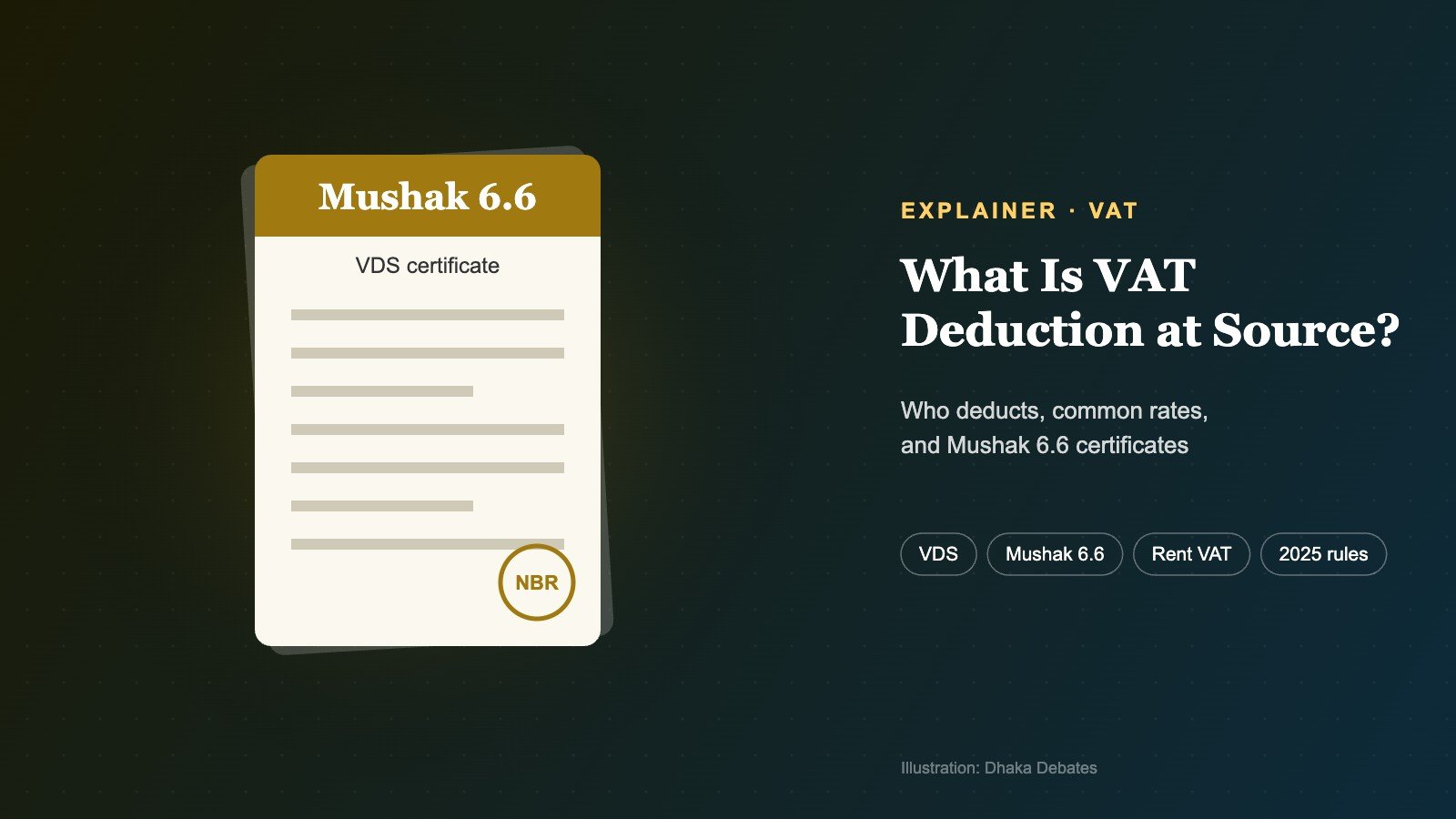
The VAT deduction at source certificate, issued by the withholding entity to the supplier as proof of the VAT deducted and deposited.
Does VDS apply to rent?
Yes. VAT on rent of commercial premises is 15% and is handled by the tenant. From the Finance Act 2026, it must be paid electronically and reported in the VAT return.
What if my customer does not give me a Mushak 6.6?
Ask for it in writing. Without it you may not be able to claim the adjustment. Keep proof of your requests.
Key words explained
| Term | What it means |
|---|---|
| VDS | VAT deduction at source: the buyer withholds and deposits the supplier’s VAT |
| Withholding entity | An organisation required to deduct VAT at source |
| Mushak 6.6 | The VDS certificate given to the supplier |
| Increasing adjustment | An addition to the withholding entity’s VAT payable |
| Decreasing adjustment | A reduction in the supplier’s VAT payable |
| A-challan | Automated challan for depositing tax through banks |
| TDS | Tax deducted at source under income tax, a separate system |
Related guides: what is Mushak 6.3?, how to submit VAT returns online, and how to get a BIN certificate.
How we reported this
We used PwC’s Worldwide Tax Summaries for Bangladesh (reviewed July 2026), PwC’s summary of the Finance Act 2026, and the Institute of Chartered Accountants of Bangladesh’s summary of the VDS Guidelines 2025 (SRO 182, effective 1 July 2025). The withholding entity list is a general summary; check the current rules for your organisation. The security services example is our own calculation. This is general information, not tax advice.
Sources
- PwC Worldwide Tax Summaries: Bangladesh, other taxes · taxsummaries.pwc.com
- PwC: Finance Act 2026 key amendments · pwc.com
- ICAB: Important changes in VAT deduction and collection at source 2025-26 · icab.org.bd
Keep reading
Best Web Hosting Providers for Bangladeshi Businesses
How to Accept International Payments in Bangladesh
How to Cancel VAT Registration in Bangladesh