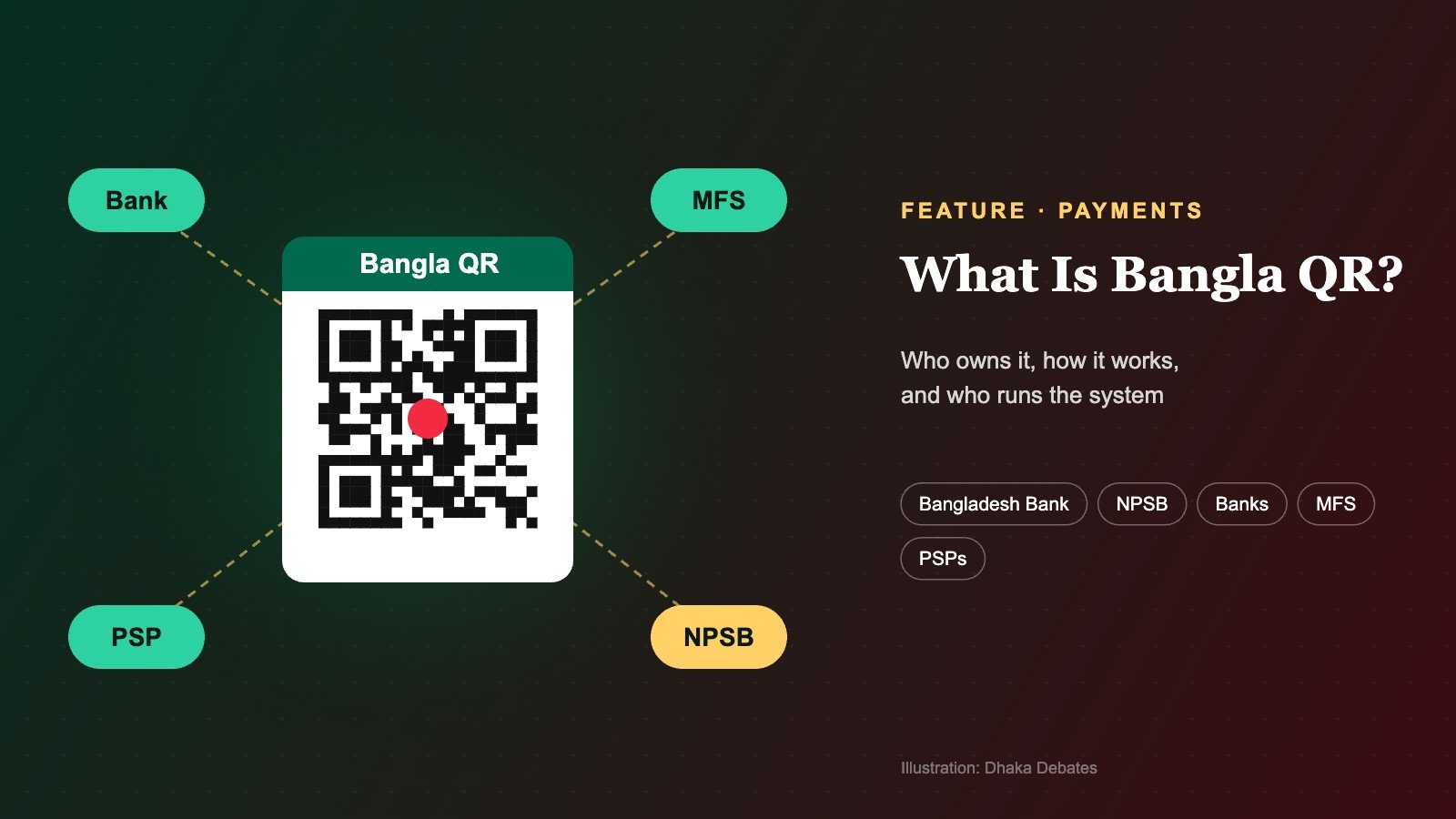
What Is Bangla QR? Who Owns It, How Does It Work, and Who Runs the System?
Bangla QR is now the only QR code allowed at Bangladeshi shops. Who owns it, how a payment travels from scan to settlement, what Bangladesh Bank, NPSB, SSLCOMMERZ, Mastercard, banks and MFS do, who pays, what happens when payments fail, and how it compares with India's UPI.

Jamal runs a tea stall outside a bus counter in Chattogram’s GEC Circle. Until this summer, a row of plastic stands sat beside his kettle: one bKash QR code, one Nagad code, a Rocket code and a bank code his nephew had set up. Customers would squint at the row, find their app and scan. On 1 July 2026 the row disappeared. Now there is one green-and-red sticker with the words “Bangla QR”. Any customer, with any bank or wallet app, scans the same code. The money lands in Jamal’s account within seconds.
That single sticker is the most visible part of one of the biggest changes to Bangladesh’s payment system in years. Yet most people who use it cannot answer basic questions about it. Who owns it? Is it a government system or a private company’s product? Where does the money actually go after you scan? Who pays for it? And what happens if your money is deducted but the shopkeeper says nothing arrived?
This in-depth explainer answers those questions, using Bangladesh Bank’s own circulars and reporting from the national press. For a shorter, practical guide on paying with Bangla QR, see our earlier article on how Bangla QR code payments are changing everyday transactions.
The short answer: Bangla QR is Bangladesh’s national, interoperable QR code standard for payments. It is owned and governed by Bangladesh Bank, not by any private company. Payments made through it between different banks and wallets are switched and settled through the National Payment Switch Bangladesh (NPSB), which Bangladesh Bank runs. Banks, mobile financial service (MFS) providers such as bKash and Nagad, and licensed payment service providers create and hand out the codes to merchants, and their apps are what customers use to scan. Private firms such as SSLCOMMERZ (part of SSL Wireless) and card networks such as Mastercard helped build early Bangla QR acceptance, but they do not own the standard. Since 1 July 2026, Bangla QR is the only QR code allowed at merchant points; customers pay nothing extra, small merchants pay no fee, and from 1 October 2026 merchants must receive their money instantly. By late September 2026 the system was handling about Tk 143.5 crore a day.
What is Bangla QR, and why was it introduced?
A QR (quick response) code is a square barcode that a phone camera can read. In payments, a merchant’s QR code holds the information your app needs to send money to that merchant: who they are, which account to pay into and, sometimes, how much to pay.
Before Bangla QR, every provider had its own codes. A bKash code could only be paid with the bKash app; a Nagad code only with Nagad; a bank’s code only with that bank’s app. Shopkeepers had to display several codes, customers had to find the right one, and a customer of a small bank often had no code to scan at all. It was the digital version of every shop needing a different cash register for each brand of banknote.
Bangla QR was introduced to fix this. The idea is simple: one code per merchant, payable from any participating app. That is called interoperability. It should make digital payments easier for customers, cheaper and simpler for merchants, and help Bangladesh move away from cash. Bangladesh Bank has set a target of 75% of transactions being cashless by 2027, The Financial Express reported in April 2026.
How did Bangla QR develop, step by step?
Bangla QR did not arrive in one day. It has been built in stages over almost six years.
| Date | Step |
|---|---|
| 6 January 2021 | Bangladesh Bank issues the Bangla QR guidelines (PSD Circular No. 01), setting a national QR standard |
| August 2021 | Mastercard, SSLCOMMERZ and Mutual Trust Bank launch a “mass-level” Bangla QR acquiring platform for micro merchants |
| 18 January 2023 | Interoperable Bangla QR pilot launches with about 1,200 merchants in Motijheel, Dhaka |
| February 2023 | Bangladesh Bank directs institutions to replace their own QR codes with Bangla QR |
| February 2024 | Daily transaction limits for retail Bangla QR payments removed |
| November 2025 | Instant interoperable settlement begins; small merchants must be credited instantly |
| 1 April 2026 | Bangladesh Bank orders all banks, MFS providers, PSPs and PSOs to switch to Bangla QR by 30 June, with penalties |
| 1 July 2026 | Bangla QR becomes mandatory at all merchant points |
| August 2026 | Minimum merchant fee scrapped; interchange fee set to zero from 1 October; Tk 100 crore fund to support small merchants |
| 27 September 2026 | Incentives extended to all trade-licensed merchants; dispute resolution guideline issued, effective 1 December |
| 1 October 2026 | All Bangla QR payments must be credited to merchants instantly |
| 1 November 2026 | Person-to-person (P2P) Bangla QR transfers between banks and MFS scheduled to begin |
Who owns Bangla QR? Is it owned by Bangladesh Bank or a private company?
This is the question that causes the most confusion, so let us be precise.
Bangla QR is owned by Bangladesh Bank. More exactly, Bangladesh Bank created and owns the Bangla QR standard, the set of rules that says what information a code must contain, how it must be formatted, and how participants must process it. Bangladesh Bank introduced it as the national QR code standard for retail payments, based on international specifications published by EMVCo, the global body that sets standards for card and QR payments. The name, the logo and the rules belong to the central bank, and it alone can change them.
What causes confusion is that several private companies have used the “Bangla QR” name in their marketing. SSLCOMMERZ, for example, lists “launched Bangla QR” among its 2021 milestones on its parent company’s website. That refers to its own commercial platform for helping merchants accept Bangla QR payments, launched with Mastercard and Mutual Trust Bank, not to ownership of the standard. Think of it this way: Bangladesh Bank designed the national road rules; several companies built and sold vehicles and services that use those roads.
| Part of the system | Who owns or controls it |
|---|---|
| The Bangla QR standard, name and rules | Bangladesh Bank |
| The interoperable switch and settlement (NPSB) | Bangladesh Bank |
| Each merchant’s QR code and account | The bank, MFS provider or PSP that onboarded the merchant |
| The app the customer scans with | The customer’s bank, MFS provider or PSP |
| Merchant acquiring platforms and gateways | Banks and licensed private firms such as SSLCOMMERZ |
| The money in each account | The account holder, held by their bank or MFS provider |
How does a Bangla QR payment work, from scanning to settlement?
Let us follow a ৳50 cup of tea and a biscuit from a customer’s phone to Jamal’s account. In payments language, the customer’s provider is the issuer (it “issues” the account the money comes from), and Jamal’s provider is the acquirer (it “acquires” the payment for the merchant).
- Scan. The customer, who banks with, say, Pubali Bank, opens the Pubali app and scans Jamal’s Bangla QR. Jamal’s code was issued by bKash. The code contains Jamal’s merchant ID, his name, the acquirer (bKash) and other details set by the standard.
- Check. The app shows Jamal’s registered merchant name. The customer types ৳50 (with a static code) or sees the amount already filled in (with a dynamic code generated for that sale), checks the name, and confirms with a PIN or fingerprint.
- Authorise. Pubali Bank, the issuer, checks the customer’s balance and limits and blocks ৳50.
- Switch. Because the customer and merchant use different providers, the payment message goes through the National Payment Switch Bangladesh (NPSB), which routes it to bKash, the acquirer.
- Credit. bKash credits ৳50 to Jamal’s merchant account. Since 1 October 2026, this must happen instantly. Both sides receive a confirmation message.
- Settle. Behind the scenes, Pubali Bank owes bKash ৳50. These amounts between providers are added up and settled through accounts held at Bangladesh Bank. The customer and merchant never see this part.
If the customer and merchant both use the same provider, for example both on bKash, the payment can be handled inside that provider’s own system without going through NPSB.
What is the difference between static and dynamic QR?
A static QR code is the printed sticker on Jamal’s counter. It never changes, and customers type in the amount. A dynamic QR code is generated for each sale, usually on a shop’s screen or point-of-sale system, and already includes the amount. A user guide published by the microfinance apex body PKSF describes both: with a dynamic code, the customer only scans and confirms. Dynamic codes reduce typing mistakes and are harder to tamper with, but need a device; static codes are cheap and suit small stalls.
Who creates, issues and distributes Bangla QR codes?
Bangladesh Bank does not print codes or sign up shops. That job belongs to the institutions that hold merchants’ accounts:
- Banks generate Bangla QR codes for merchants with business or retail accounts. Many now issue a code automatically when a small business opens an account; some, such as BRAC Bank, made QR onboarding mandatory for new SME accounts, The Daily Star reported.
- MFS providers such as bKash, Nagad, Rocket and Upay generate codes for their merchant accounts and converted their old proprietary codes to Bangla QR.
- Payment service providers (PSPs) licensed by Bangladesh Bank can also onboard merchants.
Each institution must check the merchant’s identity, link the code to a genuine account, and, under the April 2026 directive, ensure the code is visibly displayed and monitored. Banks have also been asked to appoint a Bangla QR branding officer in each branch, according to The Business Standard.
The conversion was huge. Prothom Alo reported in July 2026 that around 9 lakh bKash codes, 4.5 lakh Nagad codes, 2.7 lakh Dutch-Bangla Bank (including Rocket) codes and 1.9 lakh Pubali Bank codes had been converted to Bangla QR. By late September, Bangladesh Bank said nearly 39 lakh merchant points nationwide accepted Bangla QR, UNB reported.
| Institution | Approximate codes converted to Bangla QR |
|---|---|
| bKash | 9,00,000 |
| Nagad | 4,50,000 |
| Dutch-Bangla Bank (including Rocket) | 2,70,000 |
| Pubali Bank | 1,90,000 |
| Islami Bank | 80,000 |
| Sonali Bank | 54,000 |
| Mutual Trust Bank | 50,000 |
| City Bank | 38,000 |
Who maintains the technology and payment infrastructure?
Bangla QR is not one computer system. It is a set of connected systems, each maintained by a different party:
- The central switch and settlement: NPSB, run by Bangladesh Bank, routes payments between different institutions and settles the amounts they owe each other.
- The issuers’ systems: each bank, MFS provider and PSP maintains its own app, core banking or wallet system, and its connection to NPSB. When your app crashes, that is usually your provider’s system, not NPSB.
- The acquirers’ systems: the institutions that onboard merchants maintain the merchant accounts, QR generation, notifications and, for larger shops, point-of-sale or soundbox devices.
- Technology vendors: many banks hire software firms and payment processors to build and run their QR acquiring platforms. These vendors work under contract to the licensed institutions and must follow Bangladesh Bank’s rules.
This split matters for accountability. If a payment fails because NPSB is down, Bangladesh Bank is responsible for fixing the switch. If it fails because a bank’s app or server is down, that bank is responsible. Either way, your first point of contact is always your own provider.
What is the role of Bangladesh Bank and the National Payment Switch Bangladesh (NPSB)?
Bangladesh Bank plays four roles at once:
- Standard setter. It wrote and owns the Bangla QR specification.
- Regulator. It licenses banks, MFS providers, PSPs and payment system operators, and issues binding circulars on fees, settlement times, disputes and penalties under the Payment and Settlement Systems Act 2024.
- Operator. It runs NPSB, the national switch that connects participants.
- Funder and promoter. It created a Tk 100 crore fund to subsidise merchant charges for small traders and pays incentives on small transactions.
NPSB itself is older than Bangla QR. Bangladesh Bank set it up to connect banks’ ATMs, cards and online transfers, so that a card from one bank works at another bank’s ATM and money can move between banks instantly. We explain it in detail in What is NPSB? and compare it with the older batch system in BEFTN vs NPSB. For Bangla QR, NPSB acts as the central clearing house: when a customer of one institution pays a merchant at another, NPSB passes the message and records what each institution owes. Bangladesh Bank says it settles Bangla QR transactions instantly through NPSB, Prothom Alo reported.
One criticism worth noting: Bangladesh Bank is both the referee and a player. It sets the rules, runs the central infrastructure and enforces penalties. In many countries, a separate operator runs the switch, as NPCI does for UPI in India. That separation can improve accountability and investment in the system. It is a question Bangladesh may need to revisit as volumes grow.
What is SSL Wireless’s involvement?
SSL Wireless is a Bangladeshi technology company best known for SSLCOMMERZ, the payment gateway that many online shops use to accept cards, mobile wallets and bank payments. Its involvement with Bangla QR is real, but it is often misunderstood.
Here is what the public record shows:
- 2016: the company received a payment system operator (PSO) licence from Bangladesh Bank, according to its milestones page.
- 2017: it says it launched QR payments in Bangladesh.
- August 2021: SSLCOMMERZ, Mastercard and Mutual Trust Bank launched what they called the first “white label” QR acquiring platform to provide “mass-level” Bangla QR for micro merchants, The Business Standard reported at the time. A Bangladesh Bank Payment Systems Department official attended as chief guest.
- 2022: it says it received Bangladesh Bank’s no-objection to operate as a white label merchant acquirer.
In plain words, SSLCOMMERZ built technology that lets banks sign up merchants and accept Bangla QR payments without building everything themselves. “White label” means the platform can carry the bank’s own brand. That made SSLCOMMERZ one of the earliest and most visible commercial players in Bangla QR acceptance, and its milestone list describes the 2021 launch as “Bangla QR”.
What the record does not show is that SSL Wireless owns, controls or runs the Bangla QR standard or the national switch. Those belong to Bangladesh Bank. We found no Bangladesh Bank document naming any private company as owner of Bangla QR. If you see claims online that a single private company “owns Bangla QR”, treat them with caution and ask for the official document.
What roles do SSLCOMMERZ, Mastercard, banks, MFS providers and PSPs play?
| Player | Main role in Bangla QR | Example |
|---|---|---|
| Bangladesh Bank | Owns the standard, regulates, runs NPSB, sets fees and penalties | April 2026 mandate; August 2026 fee changes |
| NPSB | Central switch and clearing for payments between institutions | Routing a Pubali Bank customer’s payment to a bKash merchant |
| Banks | Issue accounts and apps to customers; onboard merchants as acquirers | Islami Bank onboarded over 1 lakh merchants by July 2026 |
| MFS providers | Issue wallets and apps; onboard merchants | bKash, Nagad, Rocket, Upay |
| PSPs and PSOs | Licensed non-bank firms that provide payment services or run payment systems | Wallet and gateway providers |
| SSLCOMMERZ (SSL Wireless) | Payment gateway and white label QR acquiring technology for banks and merchants | 2021 launch with Mastercard and Mutual Trust Bank |
| Mastercard and other card networks | Card schemes whose cardholders could pay at Bangla QR merchants through bank apps; technology partners | “Scan to pay” with a Mastercard via a bank app |
| Merchants | Display the code, check incoming payments, pay any agreed merchant fee | Shops, restaurants, service centres, online businesses |
| Customers | Scan, check the merchant name and amount, confirm | Anyone with a participating app |
By the end of 2025, 46 banks, 7 MFS providers and 4 PSPs had joined Bangla QR, The Daily Star reported. Mastercard’s role is worth a note: because Bangla QR follows EMVCo specifications, the same family of standards card networks use for QR payments, it was designed so that card schemes could connect too. In the 2021 launch, Mastercard cardholders could pay at Bangla QR merchants through their bank’s app. Today, though, most Bangla QR volume runs bank-to-bank and wallet-to-wallet through NPSB rather than over card networks.
Who pays for the service, and how do merchants receive their money?
Do customers pay anything?
No. Customers pay no additional charge for paying with Bangla QR, Prothom Alo reported. Bangladesh Bank has also said that merchant fees should not be passed on to customers, according to The Business Standard.
Do merchants pay?
This has changed several times in 2026, which is part of why many shopkeepers are confused:
- Before July 2026: merchant fees varied by provider and were often around 1% of the payment.
- July 2026: Bangladesh Bank set a minimum MDR of 1% (including VAT) for NPSB transactions. Small traders and a consumer group protested; one association demanded the fee be scrapped or capped at 0.25%, The Daily Star reported.
- August 2026: the central bank withdrew the 1% minimum, so acquirers can negotiate fees with merchants or waive them entirely. It also set the interchange reimbursement fee, the fee an acquirer pays the customer’s provider, to zero from 1 October, down from 0.35% to 0.70%. Merchant fees for small shopkeepers, street vendors and small businesses were waived, backed by a Tk 100 crore fund, The Daily Star reported.
- From 1 October 2026: for purchases of up to ৳2,000 through NPSB, acquirers receive an incentive of 0.10% and issuers 0.20% of the transaction value, subject to conditions. Split, failed, refunded, reversed or disputed transactions do not qualify. In late September the incentive was extended to all trade-licensed merchant points.
Our calculation: on 1,000 tea sales of ৳50 each in a month (৳50,000 total), a 1% fee would have cost Jamal ৳500. Under the current rules, as a small merchant he should pay nothing, and his acquirer earns an incentive of about ৳50 from Bangladesh Bank’s scheme on those sales. Larger merchants may still pay a negotiated fee, so they should ask their bank or wallet provider for the exact rate in writing.
| Fee or payment | Who pays | Current rule (from October 2026) |
|---|---|---|
| Charge to customer | Customer | None |
| Merchant discount rate (MDR) | Merchant to acquirer | No minimum; negotiable; waived for small merchants |
| Interchange reimbursement fee | Acquirer to issuer | Zero |
| Incentive on payments up to ৳2,000 | Bangladesh Bank scheme | 0.10% to acquirer, 0.20% to issuer |
How and when do merchants receive their money?
Since 1 October 2026, every Bangla QR payment must be credited to the merchant’s account immediately, under a directive issued on 17 September, according to The Business Standard. Small and marginal merchants already had this right from November 2025. Money arrives in the merchant’s bank or MFS account, not in a separate Bangla QR account. A merchant on bKash can then use it, transfer it to a bank, or cash it out under normal bKash rules and charges.
Who pays the cost of running the system?
With customers paying nothing, small merchants paying nothing and interchange at zero, the cost falls mainly on banks, MFS providers and Bangladesh Bank’s subsidy fund. That has created tension. Upay told The Financial Express in September 2026 that it incurs about ৳5 to ৳8 per ৳1,000 when its customers pay a merchant on another network, and warned that smaller operators may struggle to sustain the model. India faced the same problem with UPI and, in 2026, moved to allow fees on some larger merchant payments. We covered that debate in why India is leading the digital payments revolution.
What happens when a payment fails or money is deducted incorrectly?
It happens: the app shows “processing”, the money leaves your account, but the shopkeeper’s phone shows nothing. Usually the issue resolves itself within minutes, either completing or reversing automatically. When it does not, Bangladesh Bank’s dispute resolution guideline for Bangla QR applies. According to bdnews24.com’s report on the guideline sent to banks on 27 September 2026, effective 1 December 2026:
- A customer must raise a dispute within 45 days.
- The institution must tell the customer within 2 working days whether the complaint is accepted or rejected.
- The issuer has 5 days to start arbitration with the other institution, and arbitration must be completed within 30 working days.
What to do, step by step:
- Do not pay again straight away. Wait a few minutes and check your transaction history.
- Take screenshots of the transaction, the time, the amount and the merchant name. Ask the merchant to show their history.
- Complain to your own provider, the bank or wallet you paid from, through its app, hotline or branch. Note the complaint number.
- Escalate to Bangladesh Bank’s hotline 16236 if your provider does not respond within the set time, UNB reported.
If you paid the wrong merchant by mistake, for example because you scanned the wrong code, that is not a system failure. Your provider may help contact the other side, but recovery is not guaranteed. Always check the merchant name before you confirm.
What are the security, fraud and consumer-protection concerns?
Fake or replaced QR codes
A fraudster can stick their own code over a shop’s printed code, so payments go to the fraudster. The protection is simple but often skipped: check that the name shown in your app matches the shop before you confirm. Merchants should check their codes regularly and use dynamic codes where possible.
Misuse of merchant QR as a cash-out channel
Some merchants have been accused of letting customers “pay” through Bangla QR and then handing them cash, keeping a cut, without any sale. The Financial Express reported in September 2026 that one customer paid ৳10,000 and received about ৳9,815 in cash, cheaper than a normal MFS cash-out of roughly ৳13 to ৳18.50 per ৳1,000. Small shops with modest turnover reportedly received repeated payments of around ৳5 lakh in short periods. This can inflate transaction figures, distort merchants’ credit records, help people avoid limits and, at worst, aid money laundering. Bangladesh Bank’s April directive says a merchant’s QR facility must be cancelled immediately if it is used for cash-out.
Scams and social engineering
Fraudsters may send a QR code claiming it will “send” you money, or call pretending to be from a bank asking for your PIN or OTP. Remember: you never need to scan a code or enter a PIN to receive money, and no genuine bank or wallet will ask for your PIN.
Data and privacy
Digital payments create detailed records of where and when people spend. That data can help merchants get loans, but it must be protected. Bangladesh’s personal data protection framework is still developing, and clear rules on how payment data can be used and shared will become more important as Bangla QR grows.
Outages
The more payments depend on one switch, the more an outage hurts. India learned this in 2025 when UPI went down several times. Bangladesh will need strong backup systems, clear public updates during outages, and providers that can process payments within their own networks if the central switch fails.
How is the government making Bangla QR adoption mandatory?
For its first few years, Bangla QR was optional, and adoption was slow. In 2026 the approach changed from encouragement to obligation.
- The April 2026 circular. On 1 April, Bangladesh Bank ordered all scheduled banks, MFS providers, PSPs and payment system operators to replace proprietary QR codes at every merchant point with Bangla QR by 30 June. “Merchant point” covers shops, restaurants, service centres and online platforms, The Financial Express reported.
- Penalties. Under Section 37(5) of the Payment and Settlement Systems Act 2024, institutions that fail to comply face fines of up to ৳30 lakh, imprisonment of up to three years, or both. Magistrates of the National Consumer Rights Protection Directorate can be asked to start proceedings, The Daily Star reported.
- Trade licences. QR payment facilities are already compulsory for obtaining or renewing a trade licence nationwide, The Financial Express reported. In May 2026 banks were told to onboard retail account holders who hold trade licences, under what is now called the Bangla QR Implementation Initiative.
- Account holders. Banks were given until 31 October 2026 to enable Bangla QR payments in mobile apps for savings and current account holders, according to The Business Standard.
- Government payments. Bangladesh Bank plans to make Bangla QR mandatory for government payments too, Prothom Alo reported.
The mandate came with carrots as well as sticks: the fee waivers, the zero interchange, the Tk 100 crore subsidy fund and the incentives described above. The government also sold about 30,000 smartphones to low-income users on instalments to help them go digital, Prothom Alo reported.
Has the mandate worked?
The early numbers show a sharp rise. Bangladesh Bank said average daily Bangla QR transaction value rose from about ৳28 crore in June 2026 to ৳143.54 crore by late September, nearly five times higher, and daily transactions rose from about 1 lakh to nearly 3.5 lakh, UNB reported. For comparison, the whole of 2025 saw about 66 lakh transactions worth over ৳2,700 crore across 9.63 lakh merchants, The Daily Star reported.
Our calculation: at ৳143.54 crore a day, Bangla QR is now handling roughly ৳4,300 crore a month, more in one month than in the whole of 2025. The average transaction is about ৳4,100, which suggests many payments are larger purchases rather than tea and snacks, and part of the jump may reflect the cash-out misuse described earlier.
| Measure | Figure | Source |
|---|---|---|
| Merchants enrolled, end of 2025 | 9.63 lakh | The Daily Star |
| Transactions in 2025 | About 66 lakh, worth over ৳2,700 crore | The Daily Star |
| Participants, end of 2025 | 46 banks, 7 MFS providers, 4 PSPs | Prothom Alo |
| First 48 hours of mandate | Over 77,000 transactions worth over ৳22 crore | The Daily Star |
| Daily value, June 2026 | About ৳28 crore | UNB |
| Daily value, late September 2026 | ৳143.54 crore | UNB |
| Daily transactions, late September 2026 | Nearly 3.5 lakh | UNB |
| Merchant points accepting Bangla QR | Nearly 39 lakh | UNB |
What about person-to-person (P2P) Bangla QR?
From 1 November 2026, Bangladesh Bank scheduled the launch of person-to-person Bangla QR. Each user can generate a personal QR code in their app. Anyone else can scan it and send money instantly, whether bank to bank, wallet to wallet, or bank to wallet and back. Because the recipient’s details come from the code, there is no need to type an account or phone number, which Bangladesh Bank says removes the risk of sending money to a wrong number, The Financial Express reported. This could finally make it easy to send money from a bank account to someone’s bKash or Nagad wallet, and the other way round, a long-standing frustration covered in our bKash vs Nagad comparison.
How does Bangla QR compare with India’s UPI and other international QR payment systems?
Many countries have built national QR or instant payment systems. Bangla QR is closest in spirit to Singapore’s SGQR and Thailand’s Thai QR, which standardise the code, and to India’s UPI and Brazil’s Pix, which link a national code to a central instant payment system.
| Feature | Bangla QR (Bangladesh) | UPI (India) | Pix (Brazil) | PayNow and SGQR (Singapore) |
|---|---|---|---|---|
| Started | Standard 2021; interoperable 2023; mandatory 2026 | 2016 | 2020 | PayNow 2017; SGQR 2018 |
| Owner of rules | Bangladesh Bank | NPCI (not-for-profit owned by banks, under RBI) | Central Bank of Brazil | Banking association and MAS |
| Central switch | NPSB (Bangladesh Bank) | NPCI | Central Bank of Brazil | FAST network |
| Wallets included | Yes, MFS providers | Yes, apps on bank accounts | Yes, banks and fintechs | Yes, banks and some wallets |
| Customer fee | None | None | None for individuals | None for individuals |
| Merchant fee | Negotiable; waived for small merchants | Zero, with a new fee planned on some larger payments | Low fees set by providers | Varies by provider |
| Mandatory for merchants? | Yes, since July 2026 | No | No | No; one code encouraged |
| Recent scale | About ৳143.5 crore a day (September 2026) | About ₹1 lakh crore a day (October 2026) | Used by most adults | Widely used |
Our calculation: at roughly ৳1.4 per Indian rupee, UPI’s daily value in October 2026 was in the region of ৳1.4 lakh crore, around a thousand times Bangla QR’s daily value, while India’s population is only about eight and a half times Bangladesh’s. The gap shows how early Bangladesh still is.
Three differences stand out. First, India built UPI on top of bank accounts and made it free from the start, while Bangladesh’s digital payments grew through MFS wallets with their own fees, so Bangla QR must bring two worlds together. Second, India gave the switch to a separate operator, NPCI, while in Bangladesh the central bank both regulates and runs the switch. Third, Bangladesh made the code mandatory, an approach most other countries avoided, preferring to let usage grow. A mandate can speed up acceptance, but it cannot by itself make customers choose to pay digitally. We look at Singapore’s wider banking lessons in what Bangladesh can learn from Singapore’s banking system.
What are the opportunities for small businesses, retailers and financial startups?
For small businesses and retailers
- One code, every customer. No customer is turned away because they use a different app.
- Less cash risk. Less cash in the drawer means less theft, fewer fake notes and no shortage of change.
- Instant money. Funds arrive immediately and can pay suppliers the same day.
- A record of sales. Digital receipts build a history that banks and lenders can use to judge creditworthiness. That could help solve the problem we described in why small businesses struggle to access finance.
For financial startups
- Merchant tools: soundboxes that announce payments, simple bookkeeping apps, inventory and invoicing tools built around QR sales.
- Embedded lending: small working capital loans based on QR sales records, of the kind we explained in what is embedded finance.
- Acquiring and onboarding: helping banks sign up and support millions of micro merchants.
- Analytics and fraud prevention: spotting misuse, fake codes and unusual patterns for banks and regulators.
Our feature on whether Bangladesh can become South Asia’s next fintech hub looks at the wider opportunity.
What challenges could prevent Bangladesh from becoming a cashless economy?
- Account ownership. According to BBS data cited by The Daily Star, 28.3% of adults hold a bank account and 47.8% an MFS account. Many people still have neither, or use their account only to receive money and cash out. See our report on why millions still lack formal banking.
- Cash habits. Cash still made up about 35% of formal retail transactions in FY25. Wages for many workers are paid in cash, and so are many supplier payments.
- Smartphones and internet. Bangla QR currently needs a smartphone and data connection. Bangladesh Bank is working on QR payments without internet, Prothom Alo reported, but they are not yet available.
- Tax fears. Some traders worry that digital records will expose their income to tax authorities and prefer cash.
- Business model. With zero interchange and waived merchant fees, providers have weak incentives to invest unless the subsidy and future fees are sustainable.
- Misuse and fraud. Cash-out abuse and fake codes could undermine trust and regulators’ confidence.
- Trust in banks. With about a third of bank loans in default in mid-2026, some people are wary of keeping money in banks at all.
- Digital skills. Older people, many women and rural users need help and confidence to pay digitally.
We explored this question in depth in can Bangladesh become a cashless economy?
What should Bangladesh do next?
- Settle the fee model for the long term. Keep payments free for customers and small merchants, but agree a transparent, predictable fee for larger merchants so that banks and wallets can cover costs without relying on subsidies.
- Publish data regularly. Monthly public figures on Bangla QR volume, value, participants, failures and disputes, as India publishes for UPI, would build trust and help researchers spot problems.
- Strengthen the switch. Invest in NPSB capacity and backups, and consider whether a separate operator under central bank oversight would improve accountability.
- Crack down on misuse without punishing honest merchants. Use data analytics to detect cash-out abuse and fake codes, and act against offenders.
- Make P2P and offline payments work well. Smooth person-to-person transfers and payments without internet would bring in people who are now left out.
- Protect consumers clearly. Enforce the new dispute timelines, publicise the 16236 hotline, and require apps to show the merchant name and dispute options clearly.
- Use the data for credit, with consent. Build rules that let merchants share their QR sales history with lenders to get loans, while protecting privacy.
- Reassure traders on tax. Clear, simple tax rules for small businesses would reduce the fear that going digital means being punished.
- Link abroad. In time, connecting Bangla QR with systems such as India’s UPI or Singapore’s PayNow could help travellers, students, patients and border traders.
Back in Chattogram, Jamal likes having one sticker instead of four. He likes that the money arrives instantly. But at the end of the day, most of his takings are still notes and coins in a tin. Bangla QR has solved the problem of too many codes. The harder problem, persuading people to choose digital money over cash every day, is only beginning.
Frequently asked questions
Is Bangla QR owned by Bangladesh Bank?
Yes. Bangladesh Bank created and owns the Bangla QR standard and runs NPSB, the switch that handles payments between institutions. Private companies provide apps and acquiring technology, but they do not own the standard.
Does SSL Wireless own Bangla QR?
No public Bangladesh Bank document says so. SSL Wireless’s SSLCOMMERZ was an early commercial player that launched a Bangla QR acquiring platform with Mastercard and Mutual Trust Bank in 2021.
Is there a charge for paying with Bangla QR?
Not for customers. Small merchants’ fees have been waived; larger merchants may pay a negotiated fee.
How fast does a merchant get paid?
Instantly. Since 1 October 2026, all Bangla QR payments must be credited to merchants immediately.
Can I pay a bKash merchant from my bank app?
Yes. That is the whole point of Bangla QR: any participating bank or wallet app can pay any Bangla QR merchant.
Where do I complain if a payment goes wrong?
First to the bank or wallet you paid from, within 45 days. If it is not resolved, call Bangladesh Bank’s hotline 16236.
Is it illegal for a shop not to have Bangla QR?
The 2026 mandate places penalties on banks and payment providers that fail to switch merchants to Bangla QR. For merchants, QR payment facilities are required to obtain or renew a trade licence.
Key words explained
| Term | What it means |
|---|---|
| Bangla QR | Bangladesh’s national interoperable QR code standard for payments |
| Interoperable | Working across different banks, wallets and apps |
| NPSB | National Payment Switch Bangladesh, Bangladesh Bank’s central payment switch |
| EMVCo | The global body that sets technical standards for card and QR payments |
| Issuer | The bank or wallet the customer pays from |
| Acquirer | The bank, wallet or PSP that holds the merchant’s account |
| Settlement | The final transfer of money between institutions |
| Static QR | A fixed printed code; the customer enters the amount |
| Dynamic QR | A code generated for each sale with the amount included |
| MDR | Merchant discount rate, the fee a merchant pays to accept digital payments |
| Interchange fee | A fee the acquirer pays the issuer; set to zero for Bangla QR |
| PSP / PSO | Payment service provider / payment system operator, licensed by Bangladesh Bank |
| White label | Technology built by one company and branded by another |
| P2P | Person-to-person transfers |
How we reported this
We used Bangladesh Bank circulars and statements as reported by The Financial Express, The Daily Star, Prothom Alo, UNB, bdnews24.com and The Business Standard between April and October 2026, including the April mandate, the August fee changes, the September settlement, incentive and dispute rules, and the P2P launch plans. Information on SSLCOMMERZ comes from The Business Standard’s 2021 report of its launch with Mastercard and Mutual Trust Bank and from SSL Wireless’s own published milestones, which we describe as the company’s claims. The PKSF Bangla QR user guide informed the explanation of static and dynamic codes. Monthly value, average transaction, fee and UPI comparisons are our own calculations. We did not find any official document naming a private company as owner of Bangla QR; if one exists, we will update this article.
Editor’s note: Jamal, the tea stall owner in this story, is an illustrative character based on the common experience of small merchants in Bangladesh. He is not a real person, and his sales figures are examples only.
Sources
- Bangla QR: Building the foundation for a cash-lite Bangladesh (The Business Standard) · tbsnews.net
- BB mandates Bangla QR for all digital payments (The Financial Express) · thefinancialexpress.com.bd
- Banks, MFS providers asked to adopt Bangla QR by June or face penalties (The Daily Star) · thedailystar.net
- What is Bangla QR? (The Daily Star) · thedailystar.net
- Mandatory Bangla QR code marks new phase in Bangladesh's digital payments (Prothom Alo) · en.prothomalo.com
- BB waives merchant fees to boost Bangla QR adoption (The Daily Star) · thedailystar.net
- Bangla QR transactions surge nearly fivefold to Tk 143.54cr daily (UNB) · unb.com.bd
- One QR, every wallet (The Daily Star) · thedailystar.net
- Bangla QR misuse raises concerns over MFS sustainability (The Financial Express) · thefinancialexpress.com.bd
- BB set to introduce person-to-person money transfer through Bangla QR (The Financial Express) · thefinancialexpress.com.bd
- Bangla QR dispute resolution guideline (bdnews24.com, Bangla) · bangla.bdnews24.com
- Mastercard, SSLCOMMERZ and MTBL launch Bangla QR (The Business Standard) · tbsnews.net
- Milestones and achievements (SSL Wireless) · sslwireless.com
- Bangla QR user guide (PKSF) · pksf.org.bd
Keep reading
How Artificial Intelligence Is Changing Banking
What Bangladesh Can Learn From Singapore’s Banking System
What Is Embedded Finance? Explained With Real Examples