Why Do Small Businesses Struggle to Access Finance?
Bangladesh has more than 1.1 crore small economic units, and most say they are short of capital. Yet banks lend them far less than the central bank's target. We look at collateral, defaults, paperwork, gender and what could finally change.

Rokeya Khatun runs a small garment workshop on the second floor of a rented building in Keraniganj. She has 14 sewing machines, 16 workers and steady orders from three wholesalers in Gulistan. Last winter a buyer offered her a contract big enough to double her output. She needed about Tk 8 lakh to buy fabric and six more machines.
She went to three banks. The first asked for land documents she does not have. The second asked for two years of audited accounts. The third said her business was “too small” for its SME desk and too large for its micro-loan product. In the end she borrowed from a local lender at a rate she does not like to talk about, and took only half the order.
Rokeya’s story is common in Bangladesh. Small businesses are the backbone of the economy. They employ millions, supply big factories and keep neighbourhoods running. Yet they are the businesses least able to borrow from banks. Why?
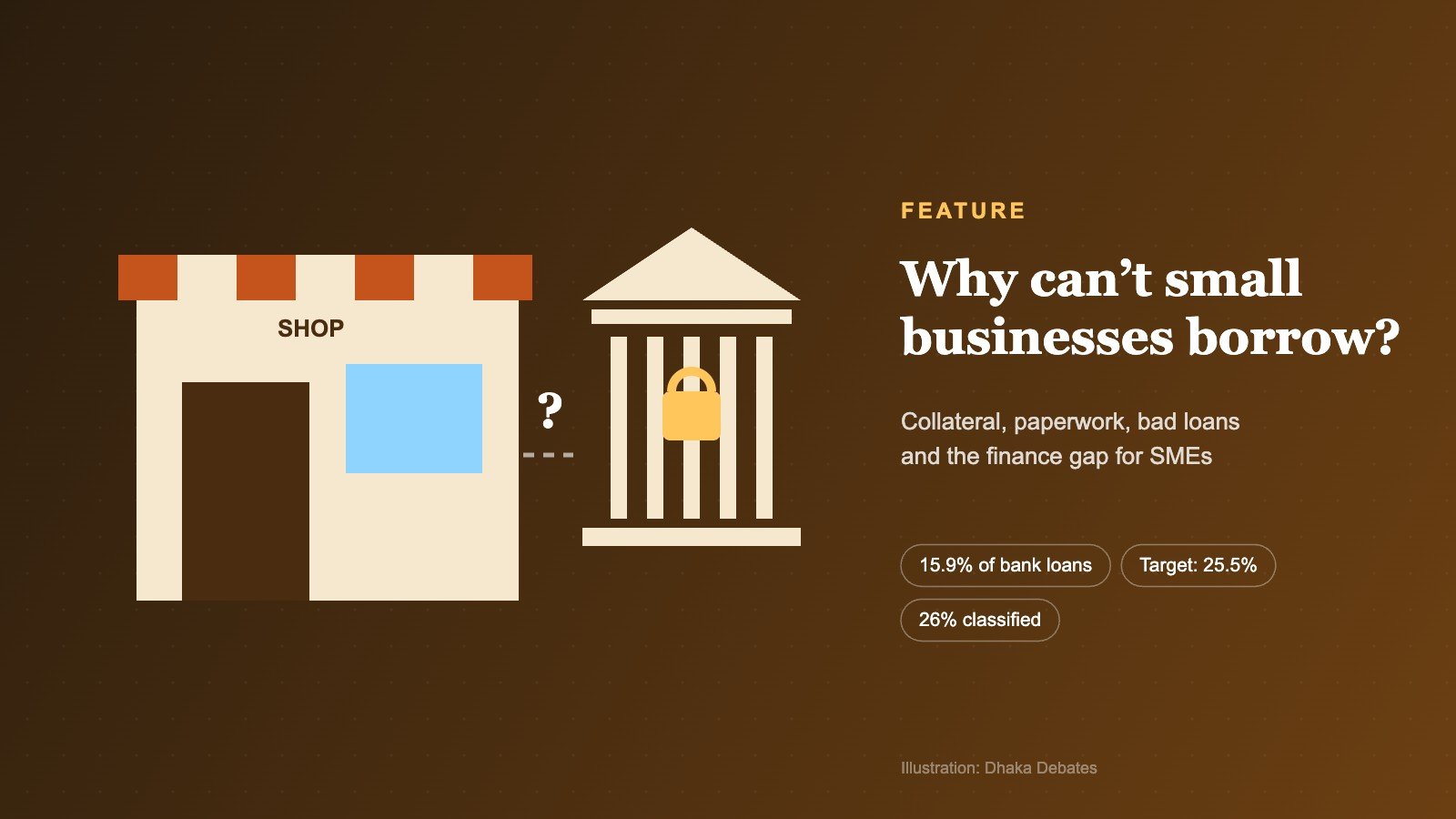
The short answer: Small businesses in Bangladesh struggle to get finance for six linked reasons. Banks still lend mainly against land, which most small owners, especially women, do not have. Many businesses keep few formal records, so banks cannot see their real income. Small loans cost banks almost as much to process as big ones but earn far less. A banking sector carrying a very high level of bad loans has become more cautious. Loan products are poorly matched to what businesses need, with digital loans too small and bank loans too slow. And policy support, such as refinance funds and lending targets, has not changed how banks judge risk. As a result, cottage, micro, small and medium enterprises (CMSMEs) received only 15.9% of bank lending in March 2026, against a target of 25.5%. Digital payment data, movable-asset lending and risk-sharing schemes could change that, but only if banks and regulators use them at scale.
We looked at Bangladesh Bank data, the 2024 Economic Census as reported in the press, research by LightCastle Partners and The Asia Foundation, and reporting by The Financial Express, The Business Standard, bdnews24.com and others. This is what we found.
How important are small businesses to Bangladesh?
Very. According to the Bangladesh Bureau of Statistics’ Economic Census 2024, as cited in The Business Standard, the country has about 1.17 crore economic units outside farming. Of these, 95.41% are micro or cottage enterprises: tea stalls, tailoring shops, small workshops, grocery shops, home-based producers and service businesses.
A separate study by LightCastle Partners for The Asia Foundation, reported by bdnews24.com in September 2026, estimated about 71.6 lakh micro, small and medium enterprises (MSMEs), employing roughly 1.9 crore people. Definitions differ between studies, but the message is the same: millions of small firms, and tens of millions of jobs.
Yet they contribute less to the economy than in many peer countries. LightCastle Partners estimates that SMEs make up about 27% of Bangladesh’s GDP, compared with about 60% in China and 61% in Indonesia. One major reason is that small firms here find it hard to grow, and lack of finance is near the top of the list of reasons.
How big is the finance gap?
Big, though estimates vary widely depending on how they are measured.
| Measure | Figure | Source |
|---|---|---|
| Units reporting insufficient capital | 85.89% | BBS Economic Census 2024, via The Business Standard |
| Units citing difficulty getting bank loans as a major constraint | 34.42% | BBS Economic Census 2024, via The Business Standard |
| Surveyed MSMEs facing financial shortages | 95.2% | LightCastle Partners / The Asia Foundation, via bdnews24.com |
| MSME financing gap (IFC estimate) | $73.5 billion, nearly three-quarters of potential demand | IFC, cited by LightCastle Partners |
| MSME financing gap (narrower study estimate) | $2.8 billion | LightCastle Partners / The Asia Foundation, via bdnews24.com |
| CMSME share of bank lending, March 2026 | 15.9% (target 25.5%) | LightCastle Partners |
The lending target figure is the clearest sign of the problem. Bangladesh Bank requires banks and finance companies to raise CMSME loans to at least 25.5% of their total outstanding loans, and its 2025 master circular sets a goal of 27% by 2029. In March 2026, the actual share was 15.9%, LightCastle Partners reported.
Roughly speaking, if CMSME loans of about Tk 2.98 lakh crore make up 15.9% of the total, then hitting 25.5% would need around Tk 1.8 lakh crore more in CMSME lending (our calculation, a rough estimate since the two figures may use slightly different bases). That is the scale of the shortfall.
Is SME lending growing or shrinking?
Recent data is mixed and mostly worrying. According to Bangladesh Bank figures reported by The Financial Express in August 2026:
| CMSME indicator | January to March 2026 |
|---|---|
| Outstanding loans, 31 March 2026 | Tk 2.98 lakh crore (down 5.15% from December 2025) |
| Disbursed in the quarter | Tk 52,108 crore to 3,86,453 enterprises (up 8.98% by amount from a year earlier) |
| Classified (bad) loan ratio | 26.04%, up from 24.03% in December 2025 |
| Recovery rate | 55.48% of amounts due |
So banks are still making new small business loans, but the total book is shrinking, more than a quarter of it is classified as bad, and banks are recovering only a little over half of what falls due. In a wider economy where private sector credit growth fell below 5% in April 2026, The Business Standard reported, small firms are being squeezed hardest.
Reason 1: Banks still lend against land
The single biggest barrier is collateral. Most banks still want land or a building as security for a business loan. But many small firms work from rented shops, shared workshops or homes. They may have machines, stock, orders and steady customers, but nothing a bank can mortgage.
In a July 2026 column in The Business Standard, Saba El Kabir, founder of Cultivera, described how a stressed bank’s “safest decision is often to reject an active business whose file is thin.” She noted that 4.02 million households were absolutely landless in the 2019 Agriculture Census, and that urban landlessness stood at 28.79%. For these families, a land-based lending system simply has no door.
The problem is even sharper for technology and service businesses. “Most IT and ITES firms struggle to get conventional bank loans because they often lack tangible collateral,” said Rashad Kabir, managing director of Dream71 Bangladesh, quoted by The Daily Star. A software company’s value lies in its people and contracts, not in land.
There is a legal fix on paper. The Secured Transactions (Movable Property) Act, 2023 allows machinery, inventory, receivables and work orders to be used as security. But as the same TBS column pointed out, it only works if there is a reliable asset registry, trusted valuation, quick lien searches and confidence that banks can enforce their claims. Those pieces are still being built.
Reason 2: Banks cannot see small firms’ real income
Banks lend to businesses they understand. Large companies have audited accounts, tax returns and bank statements showing their income. Most small businesses do not. Many sell for cash, keep handwritten books or no books at all, and mix business and family money.
To a loan officer, a profitable small shop with no records looks the same as an unprofitable one. The safe choice is to say no. Even when owners try, the paperwork is confusing. The TBS column described Tahmina Akter of Saraah Fashion, who struggled to borrow because every bank she approached asked for different documents.
This is why the shift to digital payments matters so much. When a shop takes payments by Bangla QR, bKash or card, it builds a record of its sales. That record can show a bank, or a fintech lender, how much the business really earns. We explain what banks look for in our guide on what banks check before giving a business loan.
Reason 3: Small loans do not pay for banks
Processing a loan costs time and money: visiting the business, checking documents, assessing risk, monitoring repayment and chasing late payments. These costs are much the same for a Tk 5 lakh loan as for a Tk 5 crore loan. But the bigger loan earns far more interest.
So banks naturally prefer large borrowers. The LightCastle and Asia Foundation study found that micro enterprises make up 92.6% of MSMEs but receive only 14% of disbursed MSME loan amounts. LightCastle’s research also lists “improve the commercial viability of small-ticket lending” as one of its four priorities, because without it, banks will keep avoiding the smallest firms.
Credit also flows unevenly between sectors. In early 2025, trading businesses received 59% of CMSME credit and manufacturing just 24%, according to figures cited by The Business Standard. Traders turn stock over quickly and are easier to assess, but manufacturing is where more jobs and exports are created.
Reason 4: A banking system under stress
Bangladesh’s banks are carrying a huge load of bad loans, much of it from large borrowers and politically connected groups. Defaulted loans reached Tk 5.88 lakh crore, or 32.26% of all outstanding loans, by the end of March 2026, according to figures cited by The Business Standard. Several banks are being restructured or merged.
Banks in this state become cautious. They protect capital, focus on recovering old loans and avoid new risk. Small businesses, seen as risky and hard to assess, are among the first to be turned away. It is a painful irony: a crisis caused mainly by big defaulters ends up hurting small, honest borrowers most. We looked at the wider problems in our feature on why traditional banks struggle to go digital.
Interest rates add to the pressure. Bangladesh Bank cut its policy rate from 10% to 9.5% in August 2026 to support private credit, The Financial Express reported. But lending rates remain high compared with a few years ago, when they were capped at 9%. For a small firm with thin margins, high borrowing costs can make a loan pointless even when it is available.
Reason 5: Loan products do not match what businesses need
Small businesses often find themselves stuck between two kinds of finance, neither of which fits:
- Digital and micro loans are too small. Most digital loan products are capped at about Tk 50,000 with short repayment periods, the LightCastle and Asia Foundation study found. Yet about 60% of MSMEs said they want loans above Tk 3 lakh, and 85% want terms longer than six months.
- Bank SME loans are too slow and demanding. They need collateral, documents and weeks of processing, which suits established firms better than growing ones.
Rokeya’s Tk 8 lakh need falls into exactly this gap. It is too big for a nano-loan or most microfinance products, and too small and too unsecured for many bank SME desks.
Working capital is the biggest need. It makes up 57% of MSME borrowing, according to the same study. Firms need money to buy stock before a busy season, pay workers while waiting for buyers to pay, or fill a big order. Long, slow loan processes do not fit that kind of need.
Reason 6: Women face extra barriers
Women-owned businesses face every barrier above, and more. Land is usually in men’s names. The World Bank found that among rural agricultural landowners, 13% of women had sole or joint ownership compared with 70% of men, according to figures cited by The Business Standard. Without land, collateral-based lending shuts women out.
Bangladesh Bank data shows women’s share of household loan accounts fell to 18.4% in March 2026, from 20% a year earlier, The Financial Express reported. Women also often run home-based or informal businesses that are even harder for banks to assess.
Yet when given a chance, women entrepreneurs often repay well. The TBS column described Hasina Mukta, a home-based producer who got a collateral-free SME loan, grew to 18 employees and repaid almost in full. The LightCastle study found that 83.1% of women with no prior knowledge of digital credit were interested in it, making women-led businesses a strong starting point for new lending models.
What has the government and central bank done?
Policy makers have tried many tools. The main ones are:
| Measure | What it does | Limits |
|---|---|---|
| CMSME lending targets | Requires banks to raise CMSME loans to 25.5% of their total, and 27% by 2029 | Banks are far below target; few penalties |
| Tk 5,000 crore revolving refinance fund (June 2026) | Bangladesh Bank lends to banks at 4%; banks lend to CMSMEs for working capital at up to 9%, with a 3 to 6 month grace period | Banks bear full risk, so they still pick safe borrowers; defaulters excluded |
| Wider stimulus (Tk 60,000 crore) | Liquidity support, including Tk 10,000 crore for agriculture and the rural economy | Does not change how banks assess small firms |
| Secured Transactions (Movable Property) Act, 2023 | Allows machines, stock and receivables as collateral | Registry and enforcement still developing |
| SME Foundation partnerships | Credit wholesaling and support through partner banks | Small scale compared with need |
The refinance fund is a good example of both the promise and the problem. On paper, 9% working capital for small firms is attractive. But because banks must repay Bangladesh Bank whether or not the borrower repays, they still apply their usual caution. “Liquidity support may not alter how banks evaluate smaller firms,” the TBS column argued. Money is available; the risk assessment is not changing.
Filip Graovac of The Asia Foundation summed it up at a seminar in September 2026: “We are not short of capital, we are not short of policy intent, we are short of the working connection between the two.”
Can digital lending close the gap?
Digital lending is the most promising new tool, and Bangladesh has a strong base for it. The LightCastle and Asia Foundation study found that 87% of MSMEs have a digital footprint and 97% use mobile financial services. But only 11.55% had ever accessed digitally enabled credit.
The best-known example is the nano-loan partnership between City Bank and bKash. By July 2026, it had disbursed over $811 million across 3.19 crore loans to about 35 lakh customers, with non-performing and written-off amounts of about 0.5% of disbursements, LightCastle Partners reported. The average loan was about $24.
Those numbers show something important: small borrowers, assessed using their transaction data, can repay very well. But a $24 loan is not business finance. As LightCastle’s Bijon Islam wrote, nano-loans “are not a substitute for long-term SME investment.” The challenge is to take the same data-driven approach and use it for loans of Tk 3 lakh to Tk 30 lakh, the range where small businesses actually grow.
Several building blocks are coming together: mandatory Bangla QR at shops, the new instant payment system, digital banks approved in September 2026, and growing use of mobile wallets by businesses. Together, these could give lenders a far clearer view of small firms’ cash flow. We explored this in our story on whether Bangladesh can become South Asia’s next fintech hub.
What else could make a difference?
Based on the research and the experience of other countries, these changes would help most. This is our analysis.
- Make movable-asset lending real. Finish the collateral registry for machines, stock and receivables, and train bank staff to value and lend against them.
- Use cash-flow data. Let businesses share their digital payment records with lenders, with consent, so banks can judge them on sales rather than land.
- Share the risk. Credit guarantee schemes, where a public or donor fund covers part of losses, would let banks take more chances on small firms. LightCastle recommends blended finance and patient capital for this reason.
- Standardise documents. One simple, common checklist for small business loans across banks would save owners from starting again at every bank.
- Fix the banks. Cleaning up bad loans from big defaulters would free banks to lend to productive small firms again.
- Help businesses become bankable. Simple bookkeeping apps, digital payments and financial training can turn an “invisible” business into one a bank can assess. As LightCastle’s Bijon Islam put it, “Finance alone will not be enough.”
- Target women directly. Collateral-free products, women-focused loan officers and digital credit pilots aimed at women-led businesses.
What can a small business owner do today?
Waiting for the system to change is not a plan. These steps can make a business more likely to get a loan now:
- Separate business and personal money. Open a business bank account and run all sales and expenses through it.
- Take digital payments. Use Bangla QR, a merchant wallet or card payments, so your sales leave a record.
- Keep simple books. Even a basic monthly record of sales, costs and profit helps a loan officer.
- Get your papers in order. Trade licence, TIN and, where relevant, VAT registration. Our guide on setting up a company in Bangladesh covers the basics.
- Ask about refinance schemes. Ask your bank directly whether you qualify for the CMSME refinance fund or women entrepreneur schemes.
- Keep your credit record clean. Pay any existing loans and credit cards on time. A default on the CIB report can block you from schemes.
- Look beyond banks carefully. Microfinance institutions, finance companies and, for young tech firms, investors can fill gaps, but compare costs. Our guide to funding a first startup covers equity options.
Frequently asked questions
Why do banks reject small business loans in Bangladesh?
Mainly because of lack of land collateral, weak financial records, the high cost of handling small loans, and banks’ caution after very high levels of bad loans.
What share of bank loans goes to small businesses?
CMSMEs received 15.9% of bank lending in March 2026, against Bangladesh Bank’s target of 25.5%, according to LightCastle Partners.
Is there a low-interest loan scheme for small businesses?
Yes. Bangladesh Bank’s Tk 5,000 crore revolving refinance fund, launched in June 2026, lets banks lend working capital to CMSMEs at up to 9%. Approval still depends on the bank’s assessment.
Can I use machines or stock as collateral?
The Secured Transactions (Movable Property) Act, 2023 allows it, but in practice many banks still prefer land. Ask your bank whether it accepts movable assets.
Can digital payments help me get a loan?
Yes, increasingly. Digital sales records show lenders your real income. Some banks and wallets already offer small loans based on transaction history.
Key words explained
| Term | What it means |
|---|---|
| CMSME | Cottage, micro, small and medium enterprises. |
| Collateral | An asset pledged as security for a loan, which the lender can take if the loan is not repaid. |
| Movable collateral | Assets such as machines, stock and receivables used as security, instead of land. |
| Classified loan | A loan the bank considers at risk of not being repaid, often called a bad or defaulted loan. |
| Refinance fund | Central bank money lent to banks at a low rate so they can lend to target groups cheaply. |
| Working capital | Money a business needs for day-to-day costs, such as stock, wages and rent. |
| Nano-loan | A very small, short-term digital loan, often approved through a mobile wallet. |
| CIB | Credit Information Bureau, Bangladesh Bank’s record of borrowers’ loan history. |
| Credit guarantee | A scheme that covers part of a lender’s loss if a borrower defaults. |
| Policy rate | The central bank’s main interest rate, which influences what banks charge. |
How we reported this
We drew on Bangladesh Bank data reported by The Financial Express, the BBS Economic Census 2024 and other figures cited in The Business Standard, research by LightCastle Partners (including its study with The Asia Foundation, SME Foundation and Visa reported by bdnews24.com), and reporting by The Daily Star and The Daily Ittefaq. Different studies define small businesses and the financing gap differently, which is why estimates range from $2.8 billion to $73.5 billion; we show both and explain the difference. The case examples of named business owners other than Rokeya are taken from published reporting. Figures marked “our calculation” are our own rough arithmetic. The list of changes that would help is our analysis.
Editor’s note: Rokeya Khatun is an illustrative character created for this story. Her experience is based on problems small business owners commonly describe, but she is not a real person.
Sources
- LightCastle Partners: Financing Bangladesh’s SMEs: Bridging the capital gap · lightcastlepartners.com
- bdnews24.com: Digital lending could help narrow Bangladesh’s MSME financing gap · bdnews24.com
- The Financial Express: CMSME asset quality worsens with 26pc classified loan ratio · thefinancialexpress.com.bd
- The Financial Express: Women’s share in bank lending continues to fall · thefinancialexpress.com.bd
- The Financial Express: BB cuts repo rate by 50 bps to 9.50pc · thefinancialexpress.com.bd
- The Business Standard: Funding the unfundable: What Bangladesh’s banks still cannot see · tbsnews.net
- The Daily Star: IT sector experts call for extended tax holiday · thedailystar.net
- The Daily Ittefaq: BB launches Tk 5,000cr revolving refinance fund · en.ittefaq.com.bd