Why Millions of Bangladeshis Still Don’t Have Access to Formal Banking
Bangladesh has more than 23 crore mobile wallet accounts, yet the World Bank puts account ownership at only around half of adults. We explain who is left out, why, and what would bring them in.

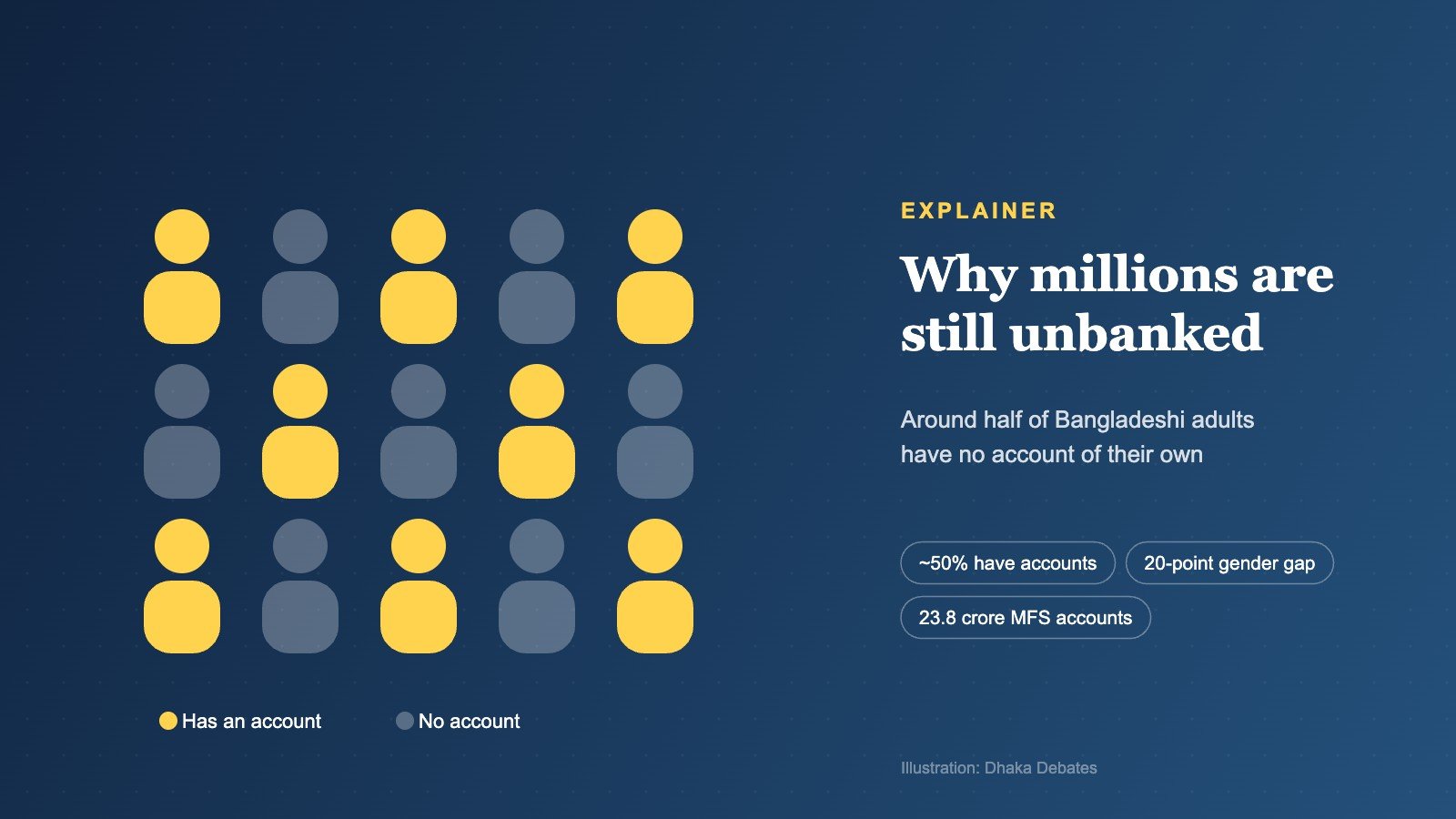
Short answer: Around half of Bangladeshi adults still do not have an account at a bank, financial institution or mobile money provider, according to the World Bank’s Global Findex 2025 survey, putting Bangladesh among eight countries that together hold more than half of the world’s unbanked adults. That sounds strange in a country with more than 23 crore mobile wallet accounts, but those accounts are registrations, not people: many users hold several, many accounts are dormant, and many families share one phone and one wallet in a man’s name. The main barriers are low and irregular incomes, missing documents, distance from banks in rural and remote areas, low digital and financial skills, social norms that limit women’s control over money, distrust of banks and the cost and complexity of formal services. Bangladesh Bank aimed to bring all adults into the financial system by June 2026, but its own report lists all these gaps as unresolved.
Shefali Begum lives on a char in Kurigram, an island of sand in the Brahmaputra that floods most years. She is 41 and has never been inside a bank. The nearest branch is a boat ride and a long walk away. Her husband, a day labourer, has a bKash account on his phone, and when her son in Dhaka sends money home, it goes to that phone. Shefali does not know the PIN.
In official statistics, Shefali’s household is “financially included”. It has a mobile wallet. But Shefali herself has no account, no savings in her own name and no way to borrow except from a local moneylender or her neighbours. She is one of the millions of Bangladeshis still outside the formal financial system, even in a country famous for mobile money.
How many Bangladeshis are unbanked?
It depends on how you count, and the different numbers can be confusing.
| Measure | Figure | Source |
|---|---|---|
| Adults with an account (bank, financial institution or mobile money) | Around 50% | World Bank Global Findex 2025, via The Financial Express |
| Gender gap in mobile account ownership | 20 percentage points between men and women | Global Findex 2025, via The Financial Express |
| MFS accounts, end of 2024 | 23.86 crore | Bangladesh Bank Financial Inclusion Report 2024, via The Daily Star |
| No-frills (Tk 10, Tk 50, Tk 100) accounts, December 2025 | 3.42 crore | Bangladesh Bank, via The Financial Express |
| Women with a bank deposit account, December 2024 | 37.7% | Bangladesh Bank, via The Daily Star |
| Microfinance accounts | Over 4.2 crore | Bangladesh Bank, via The Daily Star |
The key point is the difference between accounts and people. Bangladesh has about 18 crore people, so 23.86 crore MFS accounts might suggest everyone is covered. But the World Bank’s survey asks individuals whether they personally own an account, and around half of adults say no. The gap comes from people holding several wallets, accounts that are no longer used, and households where one person’s account serves the whole family.
According to The Financial Express’s report on the Findex data, Bangladesh is one of eight countries, along with China, India, Pakistan and others, that together are home to more than 650 million unbanked adults, 53% of the world total. China and India have about 90% account ownership but huge populations; Bangladesh is on the list because a much larger share of its adults are still outside.
Who is left out?
Bangladesh Bank’s Financial Inclusion Report 2024, summarised by The Daily Star in January 2026, lists the groups most likely to be excluded:
- low-income households
- women
- rural communities, especially in chars, haors, coastal belts and the hill tracts
- informal workers and small businesses
- farmers and micro-entrepreneurs seeking formal credit
- people with less education and people with disabilities
These groups overlap. A poor, rural, less-educated woman like Shefali faces almost every barrier at once.
Why don’t they have accounts?
1. Not enough money, and irregular income
For many families, the honest answer is “we have nothing to put in it.” When income barely covers food and rent, and arrives irregularly, a bank account seems pointless. The World Bank’s survey found irregular income among the key barriers in Bangladesh, along with lack of documents and low mobile phone access, The Financial Express reported.
2. Missing documents
Opening an account needs a national ID card, and sometimes proof of address, a photo, a nominee and more. People without an NID, or whose NID has errors, are stuck. Bangladesh Bank’s own report lists lack of documentation, collateral and formal registration as a barrier.
3. Distance and cost of reaching services
Bank branches cluster in towns. For people on chars, in haors or in the hill tracts, a bank visit can cost a day’s wages in travel and lost work. Agent banking helps: there were 21,248 agent outlets at the end of 2024, 85.6% of them in rural areas, Bangladesh Bank reported. But the central bank also lists infrastructure gaps and high operating costs in remote and disaster-prone areas as unsolved problems.
4. Low digital and financial skills
Many people do not understand how accounts, interest or apps work, and are afraid of making mistakes. Bangladesh Bank notes that services are often offered mainly in English with technical jargon, which shuts out people who read only Bangla or cannot read at all. Bangladesh is also the only Asian country among the 18 with the most basic mobile phone users, the Findex report noted, and basic phones make many app-based services hard to use.
5. Social norms that hold women back
Women face the steepest barriers. The gender gap in mobile account ownership is 20 percentage points, according to the Findex data reported by The Financial Express. Bangladesh Bank’s report cites “socio-cultural norms, mobility restrictions, lack of documentation, limited control over financial resources” as reasons women are left out. In many households, the phone, the SIM and the wallet belong to the husband.
There is progress. Female-owned deposit accounts rose from 3.35 crore in 2019 to 5.53 crore in 2024, and women’s share of commercial bank loan accounts doubled from 8.31% to 16.49%, The Financial Express reported. But women still hold a minority of accounts and loans.
6. Distrust of banks
Recent banking crises have hurt confidence. Panic withdrawals at troubled banks and the record level of cash held outside banks, about Tk 3.8 lakh crore in July 2026 according to Bonik Barta, show that many people prefer cash they can see. For poor families, losing even a small deposit is a disaster, so caution is rational. Bangladesh Bank’s report also lists cultural and religious beliefs, reliance on informal lenders and fear of debt as reasons people stay away.
7. Fees and services that do not fit
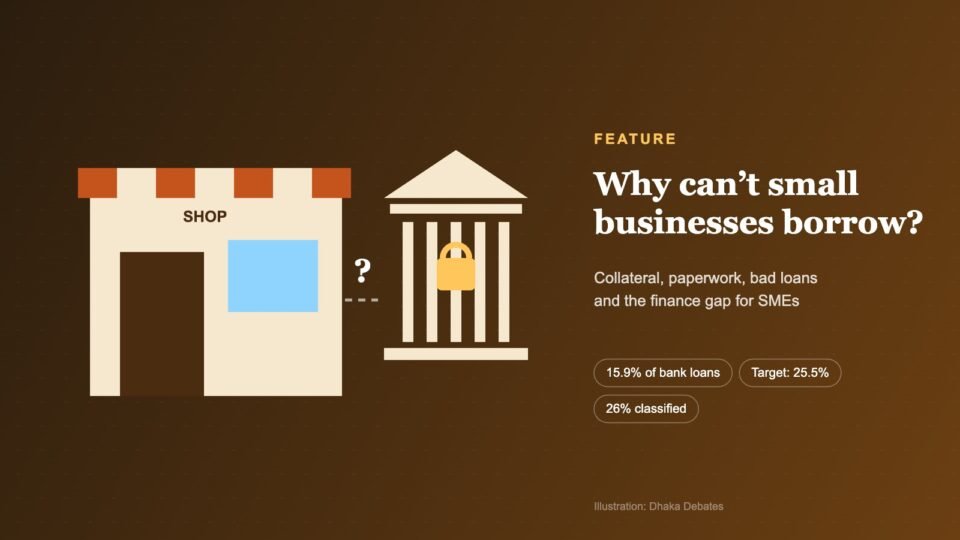
Bank accounts can carry maintenance fees, minimum balances and card charges. Mobile wallets charge for cash out, which costs between Tk 12.99 and Tk 18.50 per Tk 1,000. For someone receiving small amounts, these fees eat a real share of their money. And many products, such as loans needing land as collateral, simply do not fit poor households’ lives. We looked at this in our feature on why small businesses struggle to access finance.
8. Accounts opened but never used
Even when people get accounts, many go quiet. Bangladesh Bank’s report highlights high dormancy, especially among accounts opened to receive social safety net payments. A family may open a Tk 10 account to receive an allowance, withdraw the money in cash the same day, and never use the account for anything else. On paper they are included; in practice they are not.
What has been done so far?
| Initiative | What it does | Scale |
|---|---|---|
| No-frills accounts | Bank accounts opened with Tk 10, Tk 50 or Tk 100 for farmers, safety net recipients, students and others | 3.42 crore accounts, Tk 7,260 crore in deposits (December 2025) |
| Mobile financial services | Phone-based wallets for sending, receiving and paying | 23.86 crore accounts; Tk 1.64 lakh crore in transactions in 2024 (as reported) |
| Agent banking | Bank services through local agents, mostly in rural areas | 21,248 outlets; over 2.4 crore accounts; 50% held by women |
| School banking | Accounts for students | 43.8 lakh accounts |
| Microfinance | Small loans and savings through NGOs | Over 4.2 crore accounts |
| National Financial Inclusion Strategy | Government plan with targets | 69% of targets fully achieved and 28% partly met by December 2024 |
Bangladesh Bank set a goal of including all adults in the financial system by June 2026, The Daily Star reported. The infrastructure numbers show real progress, but the World Bank’s survey shows the job is far from done.
Why does it matter?
Being outside formal finance is expensive. People without accounts:
- keep savings at home, where they can be lost, stolen or spent, and lose value to inflation of more than 8%
- borrow from moneylenders at very high rates when emergencies hit
- cannot build a credit history, so can never get cheaper formal loans
- pay more to send and receive money
- have no protection, such as insurance, against illness or disaster
For the country, a large unbanked population means more cash, a bigger informal economy, lower tax collection and slower growth. It also makes it harder to send help quickly during floods, cyclones or pandemics.
What would bring more people in?
Bangladesh Bank’s report and international experience point to several steps. This is our analysis.
- Make accounts truly free and simple. No fees, no minimum balance, and opening by NID and a photo on the spot through an agent.
- Accounts in women’s own names. Pay safety net benefits, wages and remittances to women’s own accounts, and help women get their own SIMs and NIDs.
- Speak the user’s language. All apps and forms in clear Bangla, with voice options for people who cannot read.
- Reach remote areas. Support agents and mobile banking units in chars, haors and hill tracts, where costs are high and banks see little profit.
- Connect everything. Interoperability between banks and wallets, now coming through Bangla QR and the new instant payment system, means people need fewer accounts and money moves more cheaply.
- Give people a reason to use accounts. Small savings products, micro-insurance and small loans based on transaction history make an account useful, not just a place to collect an allowance.
- Rebuild trust. Protect depositors, resolve weak banks quickly and handle complaints and fraud fast.
- Teach money skills. Simple financial education through schools, NGOs, mosques, TV and mobile messages.
How can you help someone get started?
If someone in your family, such as a parent, a domestic worker or a relative in the village, has no account, you can help:
- help them get or correct their national ID card
- open a mobile wallet or a no-frills bank account in their own name
- teach them to keep their PIN secret and never share OTPs
- send money to their own account rather than someone else’s
- help them start a small savings habit, even Tk 200 a month
Our guides on choosing a first bank account, bKash vs Nagad and saving your first Tk 1 lakh can help.
Frequently asked questions
What share of Bangladeshi adults have a bank or mobile account?
Around 50%, according to the World Bank’s Global Findex 2025 survey as reported by The Financial Express.
Why are there more MFS accounts than people?
Because many people hold several wallets, many accounts are dormant, and the count is of registrations, not individuals.
Can I open a bank account with Tk 10?
Yes. Many banks offer no-frills accounts for farmers, safety net recipients, students and others with an opening deposit of Tk 10, Tk 50 or Tk 100.
Why are women less likely to have accounts?
Bangladesh Bank cites social norms, mobility restrictions, lack of documents and limited control over money. The gender gap in mobile account ownership is 20 percentage points.
Key words explained
| Term | What it means |
|---|---|
| Unbanked | A person with no account at a bank, financial institution or mobile money provider. |
| Financial inclusion | Access to and use of useful, affordable financial services such as accounts, payments, savings, credit and insurance. |
| Global Findex | The World Bank’s global survey of how adults save, borrow, pay and manage risk. |
| No-frills account | A basic bank account opened with a very small deposit, often Tk 10. |
| Agent banking | Banking services offered through local agents instead of branches. |
| Dormant account | An account that has not been used for a long time. |
| Safety net programme | Government support such as allowances for the elderly, widows and the poor. |
How we reported this
We used the World Bank’s Global Findex 2025 survey as reported by The Financial Express, Bangladesh Bank’s Financial Inclusion Report 2024 as reported by The Daily Star, and Bangladesh Bank data reported by The Financial Express and Bonik Barta. Account counts and survey percentages measure different things, and we explain the difference. The steps that could help are our analysis.
Editor’s note: Shefali Begum is an illustrative character created for this article. Her situation reflects the barriers described in official reports, but she is not a real person.
Sources
- The Financial Express: BD among top eight countries with largest unbanked population · today.thefinancialexpress.com.bd
- The Daily Star: Many left out as govt eyes full adult financial inclusion by June · thedailystar.net
- The Daily Star: Financial inclusion in rural areas improves: BB · thedailystar.net
- The Financial Express: NFAs surpass 34m with deposits exceeding Tk 72.6b · today.thefinancialexpress.com.bd
- The Financial Express: Women’s financial inclusion rises notably in five years · thefinancialexpress.com.bd
- Bonik Barta: Cash outside Bangladesh’s banks hits record · en.bonikbarta.com
- World Bank: Global Findex Database 2025 · worldbank.org