Best Accounting Software for Small Businesses in Bangladesh
From cloud tools like Accoru, Zoho Books and QuickBooks to TallyPrime and local apps built for bKash and VAT, here is how to choose accounting software for a small business in Bangladesh.

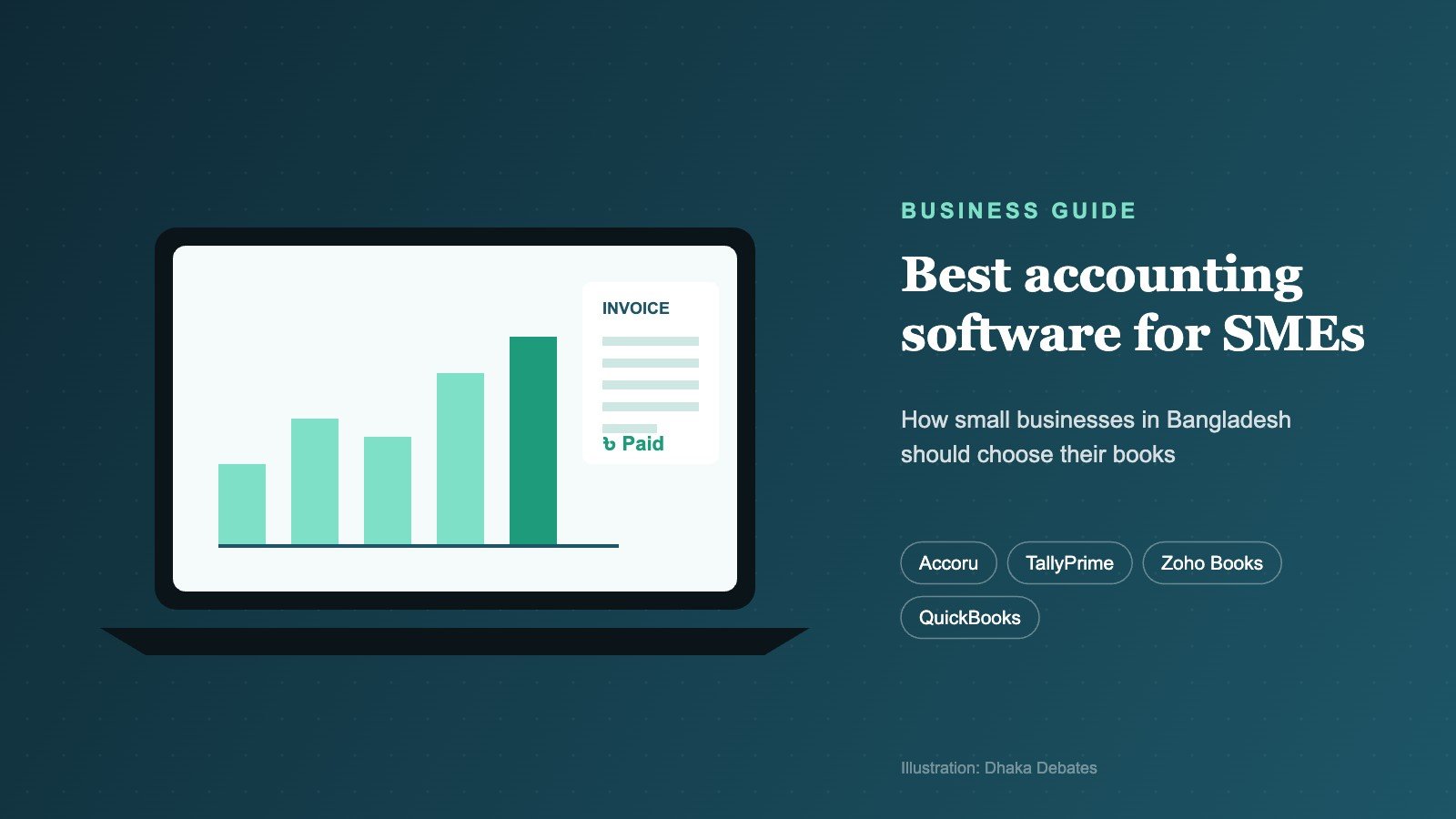
Short answer: The best accounting software depends on how your business works. For freelancers, agencies, consultants and service exporters who want simple cloud accounting with invoicing, expenses, bank reconciliation and reports at one flat price, Accoru is a strong choice. Businesses that need inventory and work with accountants who already know it often stay with TallyPrime, the desktop software widely used in Bangladesh. Zoho Books and QuickBooks Online are mature global cloud options. Shops and restaurants that need point-of-sale, NBR-style VAT invoices and bKash or Nagad tracking should look at local tools such as HisabPlus, while very small shopkeepers who only need a credit ledger can start free with TallyKhata.
Disclosure: Accoru is owned by the same group that publishes Dhaka Debates. We have listed it first because we know it well, and we have tried to describe its limits as honestly as the others’. Dhaka Debates does not receive payment from any other company in this list.
Most small businesses in Bangladesh still keep their accounts in a khata, a notebook, or a spreadsheet that only the owner understands. That works until it does not: when a bank asks for financial statements before a loan, when a foreign client wants a proper invoice, when the VAT office asks questions, or when the owner simply cannot tell whether the business made money last month. Good accounting software solves these problems, and it no longer has to be expensive or complicated.
What should a small business look for?
- Invoicing: professional invoices in taka and, if you export, in foreign currencies.
- Expenses and bank reconciliation: recording what you spend and matching it with your bank statement.
- Reports: profit and loss, balance sheet and cash flow. Banks ask for these before lending. Our guide on what banks look for before a business loan explains why.
- Inventory: essential for shops, distributors and manufacturers; less important for service firms.
- VAT: whether the software can produce invoices and records in the format the National Board of Revenue expects.
- Local payments: tracking bKash, Nagad and Bangla QR receipts.
- Cloud or desktop: cloud software works from any device and backs up automatically; desktop software works offline but ties you to one computer.
- Price and users: whether you pay per user, per month, or a one-time licence.
Which accounting software options are there?
| Software | Type | Best for | Price model |
|---|---|---|---|
| Accoru | Cloud (web, Android, iOS) | Freelancers, agencies, consultants, service exporters | Flat-rate subscription, all features included |
| TallyPrime | Desktop | Traders, distributors, firms with inventory and an accountant | One-time licence (about Tk 18,000 to Tk 25,000+ for a single user, per a vendor comparison) |
| Zoho Books | Cloud | Growing businesses wanting a broad global tool | Monthly subscription (about Tk 1,650 a month cited in a vendor comparison) |
| QuickBooks Online | Cloud | Businesses with international clients or advisers | Monthly subscription (about Tk 3,850 a month cited in a vendor comparison) |
| HisabPlus | Cloud POS and accounting | Shops, restaurants, mobile phone shops | Subscription; free trial |
| TallyKhata | Mobile app (Bangla) | Very small shopkeepers tracking credit (baki) | Free to start |
1. Accoru
Accoru is cloud-based accounting software built for small businesses, freelancers, consultants, retailers, e-commerce sellers and service teams. According to its listings on Capterra and G2, it covers invoicing with automatic payment reminders, expense tracking with receipt capture, bank reconciliation, profit and loss, balance sheet and cash flow reports, and a real-time dashboard. It supports more than 150 currencies, which is useful for Bangladeshi businesses that bill clients abroad, and connects with tools such as Stripe, PayPal, Shopify, Zapier and Google Sheets. It runs in a web browser and on Android and iPhone.
Its main selling point is simplicity in pricing: one flat subscription with every feature and unlimited invoices, clients and team members, rather than charging more for each user or each extra feature. You can try a demo account before signing up.
- Good for: freelancers and IT or design firms invoicing foreign clients, consultants, agencies and online sellers who want clean books and reports without an accountant on staff.
- Limits: it is a global product, so it does not produce NBR-specific VAT forms or track bKash and Nagad as built-in payment types, and Capterra’s listing does not show inventory control. Shops that need stock management or a point-of-sale counter should look at other options or combine tools.
If you invoice in dollars, pair it with the right payment channel. Our guide on how to receive international payments as a Bangladeshi business explains the options.
2. TallyPrime
Tally is the name many Bangladeshi accountants learned on, and TallyPrime remains widely used by traders, distributors and manufacturers. Tally’s own Bangladesh site highlights invoicing, more than 400 business reports, credit and cash flow management, inventory, bank reconciliation and user access controls.
- Good for: businesses with stock and a dedicated accountant; firms whose auditors already use Tally.
- Limits: it is mainly desktop software, so access from phones or multiple locations takes extra setup. A one-time licence for a single user costs roughly Tk 18,000 to Tk 25,000 or more, according to a comparison by HisabPlus, and costs rise with more users. It has a learning curve for non-accountants.
3. Zoho Books
Zoho Books is a full-featured global cloud accounting tool from Zoho, which also makes CRM, HR and inventory apps. It suits growing companies that want accounting connected to other business software.
- Good for: companies already using other Zoho apps or planning to add inventory, CRM and HR tools later.
- Limits: not tailored to Bangladesh’s VAT system or local payment habits; pricing is per plan and can rise as you add users and features.
4. QuickBooks Online
QuickBooks is one of the world’s best-known accounting brands. Its online version offers invoicing, expenses, reports and a huge network of add-ons and advisers.
- Good for: businesses with foreign owners, investors or accountants who already use QuickBooks.
- Limits: among the more expensive options, priced per plan in foreign currency, and not localised for Bangladesh.
5. HisabPlus and other local POS-accounting tools
Several Bangladeshi companies offer cloud software that combines point-of-sale with accounting, built around local needs. HisabPlus, for example, says its software covers inventory, double-entry accounting, a due (baki) ledger, bKash and Nagad tracking, NBR VAT invoices and Bangla support, with a free trial. Other local options named in the same comparison include Shohoz Software, E-Hishab and PridePOS for smaller businesses, and Mediasoft and Akij iBOS’s Managerium for larger retailers.
- Good for: shops, restaurants and retailers that need a sales counter, stock tracking and VAT invoices.
- Limits: features and support vary widely between vendors, and many do not publish prices. Ask for a demo and a written quote.
6. TallyKhata
TallyKhata, from Bangladeshi fintech Progoti Systems, is a simple Bangla app that replaces the shopkeeper’s credit notebook. Entries are recorded as money received or given, without accounting jargon, and the app shows receivables, payables, income and expenses. The company says it has more than a million monthly active users, mostly rural and small-town shopkeepers, and offers a QR code for each shop that accepts Bangla QR payments.
- Good for: very small shops that mainly need to track who owes them money.
- Limits: it is a digital ledger, not full accounting software. It will not produce the financial statements a bank or investor expects.
Which one should you choose?
| Your business | Start with |
|---|---|
| Freelancer, agency, consultant or IT exporter | Accoru |
| Online seller with simple stock | Accoru for accounts, plus your store platform for stock; or a local POS tool |
| Shop, restaurant or retailer | HisabPlus or another local POS-accounting tool |
| Trader, distributor or manufacturer with an accountant | TallyPrime |
| Growing company wanting CRM and HR too | Zoho Books |
| Business with foreign investors or advisers on QuickBooks | QuickBooks Online |
| Very small shop tracking credit | TallyKhata |
How do you switch from a notebook or Excel?
- Pick a start date, ideally the first day of a month or of the financial year in July.
- Enter opening balances: cash, bank balances, money customers owe you and money you owe suppliers.
- Add your customers, suppliers and products or services.
- Open a separate business bank account if you have not already, and connect or import its statements.
- Record every sale and expense from the start date, and reconcile with your bank once a month.
- Review your profit and loss report every month. That habit alone changes how most owners run their business.
Good books also make it easier to get finance. We explained why in our feature on why small businesses struggle to access finance. If you are just registering your business, start with our guide on how to set up a company in Bangladesh.
Frequently asked questions
What is the best accounting software for a freelancer in Bangladesh?
A simple cloud tool with multi-currency invoicing, such as Accoru, suits most freelancers and small service businesses.
Is Tally still used in Bangladesh?
Yes. TallyPrime remains popular with traders, distributors and accountants, especially where inventory matters.
Which software handles Bangladesh VAT?
Some local tools, such as HisabPlus, say they produce NBR-format VAT invoices. Global tools generally do not. Confirm with the vendor and your tax adviser.
Is there free accounting software?
TallyKhata is free to start for simple credit tracking. Full accounting software usually needs a subscription or licence, though many offer free trials or demos.
Key words explained
| Term | What it means |
|---|---|
| Cloud software | Software you use through the internet, with data stored online. |
| Bank reconciliation | Matching your records with your bank statement to catch errors. |
| Profit and loss statement | A report showing income, expenses and profit over a period. |
| Balance sheet | A snapshot of what a business owns and owes. |
| POS | Point of sale: the system used at the counter to record sales. |
| Baki khata | A credit ledger recording what customers owe. |
| Double-entry accounting | Recording each transaction in two accounts so the books balance. |
How we reported this
We used product listings on Capterra and G2 for Accoru, Tally’s Bangladesh website for TallyPrime, TallyKhata’s own website, and a July 2026 comparison published by HisabPlus, which is itself a vendor, for local options and indicative prices. We did not run paid trials of every product. Prices and features change often, so check with each provider. As disclosed above, Accoru shares ownership with Dhaka Debates.
Sources
- Capterra: Accoru · capterra.com
- G2: Accoru · g2.com
- Tally Solutions: How to choose the best accounting software for small businesses in Bangladesh · tallysolutions.com
- TallyKhata: Million shopkeepers using TallyKhata · tallykhata.com
- HisabPlus: Top 10 POS software in Bangladesh · hisabplus.com
Keep reading
Why Do Small Businesses Struggle to Access Finance?
How to Receive International Payments as a Bangladeshi Business
Can Bangladesh Become South Asia’s Next Fintech Hub?