How Do Payment Gateways Work in Bangladesh?
What happens in the few seconds between "Pay now" and "Payment successful": how payment gateways in Bangladesh connect cards, bKash, Nagad and banks, who gets paid what, how settlement and refunds work, and how to choose one.

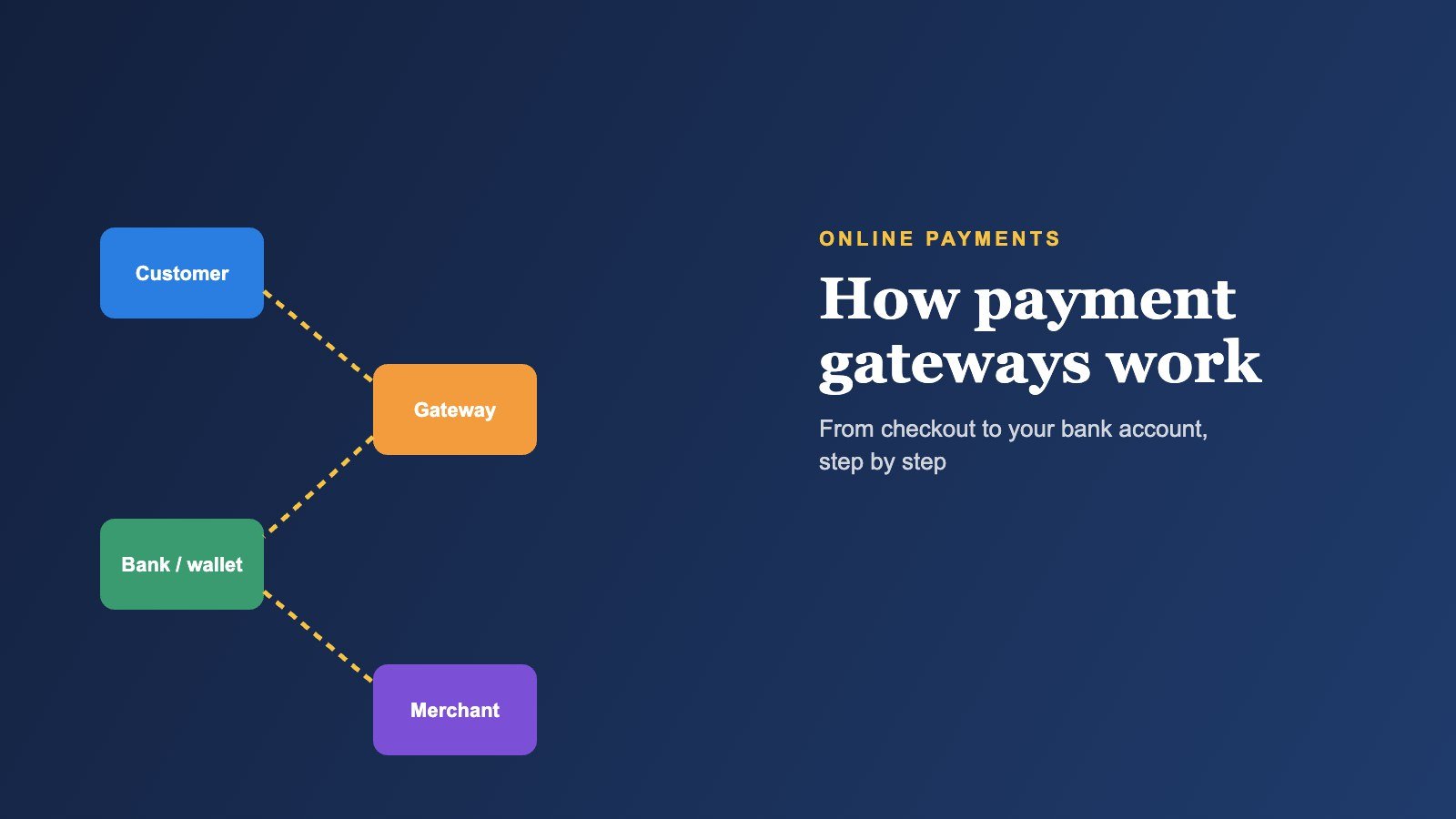
Short answer: A payment gateway is the service that sits between an online shop and the banks and mobile wallets its customers use. When a customer clicks “Pay”, the gateway securely sends the payment details to the customer’s bank, card network or wallet (such as bKash or Nagad), gets approval, usually after an OTP or PIN, tells the shop the payment succeeded, and later settles the money into the shop’s bank account minus a fee. In Bangladesh, gateways are licensed by Bangladesh Bank, typically as Payment System Operators. Fees are usually around 1.4% to 2.5% per successful payment, sometimes with a setup fee, and settlement takes from one day to a week depending on the plan.
From screenshots to a real checkout
Mahi, 27, sells handmade jewellery from Sylhet through Facebook and a small website. For two years customers sent money to her personal bKash number and messaged a screenshot. Some screenshots were fake, some payments were short, and matching payments to orders took hours. “I didn’t need more customers,” she says. “I needed to know who had actually paid.” A payment gateway solved that.
Who is involved in an online payment?
| Party | Role |
|---|---|
| Customer | Pays with a card, mobile wallet or internet banking |
| Merchant | The shop or business selling the product |
| Payment gateway | The secure checkout that routes the payment and confirms the result |
| Issuer | The customer’s bank or wallet, which approves or declines the payment |
| Acquirer | The bank that receives card payments on the merchant’s behalf |
| Card networks | Visa, Mastercard, Amex and others that connect banks for card payments |
| Bangladesh Bank | Licenses gateways and sets the rules |
What happens when you click “Pay now”?
- Checkout: the shop’s website or app sends the order amount and an order ID to the gateway.
- Choose a method: the customer sees the gateway’s payment page and picks a card, bKash, Nagad, another wallet or internet banking.
- Secure details: card numbers are encrypted and handled by the gateway, not the shop. For wallets, the customer is sent to the wallet’s own page.
- Verification: the customer confirms with an OTP, PIN or app approval. For cards, this is usually the 3D Secure step.
- Authorisation: the issuer checks the balance or credit limit and approves or declines the payment.
- Confirmation: the gateway tells the shop’s system that the payment succeeded, so the order is marked paid automatically, with no screenshot needed.
- Settlement: later, the gateway collects the funds from the different banks and wallets and pays the merchant’s bank account in one batch, minus its fee.
Steps 1 to 6 usually take a few seconds. Settlement takes longer.
Which payment methods do gateways accept in Bangladesh?
- Cards: local and international Visa, Mastercard and Amex debit and credit cards, and on some gateways UnionPay and JCB.
- Mobile wallets: bKash, Nagad, Rocket, Upay and others.
- Internet banking: direct payment from a customer’s bank account through participating banks.
- EMI: instalment plans on partner banks’ credit cards, on some gateways and plans.
In shops, Bangla QR now plays a similar role for in-person payments: one QR code accepts any bank app or wallet. See how Bangla QR is changing everyday transactions.
How much do payment gateways cost?
Gateways mainly earn a percentage of each successful payment, sometimes called the merchant discount rate (MDR), and some charge a setup fee. Published examples, from our comparison of payment gateways in Bangladesh:
| Gateway | Published fee | Setup | Settlement |
|---|---|---|---|
| SSLCOMMERZ | 2.5% per successful transaction (3.5% for Amex) | Tk 25,500 one-time (Basic plan) | Per contract |
| PayStation | About 1.4% to 2.25% depending on method and package (Amex about 3%) | Package fee from Tk 1,999 (promotional) | Weekly to daily, depending on package |
| EPS | 1.5% to 2.2%, by its own claim | Quote on request | Typically within days |
| shurjoPay, aamarPay and others | Quote on request | Quote on request | Per contract |
Prices as published or claimed by the gateways and compiled in our earlier comparison; many gateways negotiate rates with larger merchants.
By our calculation, a shop taking Tk 3 lakh a month online pays about Tk 6,000 at a 2% fee, or Tk 7,500 at 2.5%. Across a year, half a percentage point is worth about Tk 18,000 to this shop, so the rate is worth negotiating.
What is settlement, and why does it take time?
When a customer pays, the money does not go straight to your bank. The gateway first receives it from many banks and wallets, reconciles it, deducts its fee and then pays you in batches. Depending on the gateway and plan, this can be the next working day, every few days, or weekly. Faster settlement helps cash flow, so check the settlement cycle in your contract, not just the fee.
How do refunds and disputes work?
- Refunds: the merchant starts a refund through the gateway dashboard, and the money goes back to the customer’s card or wallet, usually within days. The gateway fee may not be returned.
- Chargebacks: a card customer can dispute a payment with their bank, for example if goods never arrived. The merchant must show proof of delivery or the money is taken back.
- Failed but debited payments: sometimes a customer is charged but the order is not confirmed. Gateways usually reverse these automatically; the merchant should check the gateway’s report before asking the customer to pay again.
How safe are payment gateways?
Choose a gateway licensed by Bangladesh Bank and certified under PCI DSS, the international card-data security standard. With a proper gateway, the shop never sees or stores full card numbers, and customers confirm payments with OTPs or wallet PINs. Customers should still only pay on pages with the correct website address and never share an OTP or PIN with anyone who calls or messages them.
How does a business get a payment gateway?
- Prepare your documents: gateways usually ask for a trade licence, e-TIN, NID of the owner or directors, a business bank account and, for companies, incorporation papers. See how to set up a company in Bangladesh.
- Get your website ready: clear product prices, contact details, and refund, delivery and privacy policies.
- Compare offers: fees per method, setup fee, settlement cycle, methods supported and support quality.
- Sign up and pass verification, then test in the gateway’s sandbox.
- Integrate: use a ready-made plugin for WordPress, WooCommerce or Shopify, the gateway’s API, or simple payment links and QR codes if you sell through social media.
- Go live and reconcile your sales reports with settlements every week.
Gateway, Bangla QR or cash on delivery?
| Method | Best for | Drawbacks |
|---|---|---|
| Payment gateway | Websites and apps; cards and all wallets in one checkout | Per-transaction fee; paperwork to sign up |
| Bangla QR | Shops and in-person sales | Not a full online checkout |
| Personal wallet number | Very small, informal sellers | Fake screenshots, manual matching, not meant for business |
| Cash on delivery | Customers who don’t trust online payment | Returns, refused deliveries and cash handling |
Back to Mahi
Mahi registered her business, opened a business bank account and added a gateway plugin to her website. Orders now show “Paid” automatically, and money arrives in her account twice a week. “I pay about 2% in fees,” she says. “I used to lose more than that to fake screenshots.”
This article is general information. Gateway fees, settlement terms and requirements change and are often negotiated; confirm with each provider.
Frequently asked questions
What is a payment gateway?
A secure online checkout that connects a shop to customers’ banks, cards and mobile wallets, confirms payments and settles the money to the shop.
How much does a payment gateway charge in Bangladesh?
Usually around 1.4% to 2.5% per successful payment, higher for Amex, sometimes plus a setup or package fee.
How long does it take to receive money from a gateway?
From the next working day to about a week, depending on the gateway and your plan.
Can I accept bKash and cards in one checkout?
Yes. Aggregator gateways show cards, bKash, Nagad, other wallets and internet banking on one payment page.
Do I need a trade licence for a payment gateway?
Usually yes, along with an e-TIN and a business bank account.
Key words explained
| Term | What it means |
|---|---|
| Payment gateway | The secure checkout that processes online payments. |
| PSO | Payment System Operator, a Bangladesh Bank licence held by many gateways. |
| MDR | Merchant discount rate: the fee taken from each payment. |
| Authorisation | The bank or wallet approving a payment. |
| Settlement | When the gateway pays the collected money into the merchant’s account. |
| Chargeback | A card payment reversed after a customer disputes it. |
| PCI DSS | The global security standard for handling card data. |
| 3D Secure | The extra verification step, such as an OTP, for card payments. |
How we reported this
We drew on our own comparison of payment gateways in Bangladesh, which compiled published prices from SSLCOMMERZ, PayStation, EPS and others, and our reporting on Bangla QR. The fee example is our own calculation. The featured image is an illustration made by Dhaka Debates.
Editor’s note: Mahi is illustrative, created to show how a small online seller might start using a payment gateway. She is not a real person.
Sources
- Dhaka Debates: Best payment gateways in Bangladesh compared · dhakadebates.com
- UNB: Renowned online payment gateways in Bangladesh · unb.com.bd
- The Business Standard: Bangladesh Bank sets 1% minimum MDR for NPSB merchant payments · tbsnews.net
- UNB: Bangla QR transactions surge nearly fivefold · unb.com.bd