Can Bangladesh Become South Asia’s Next Fintech Hub?
Bangladesh moves about Tk 6,000 crore a day through mobile wallets and has one of the world’s biggest mobile money markets. But startup funding has collapsed, digital banks are years late and cash still rules. We look at the data, the rivals and what it would really take.

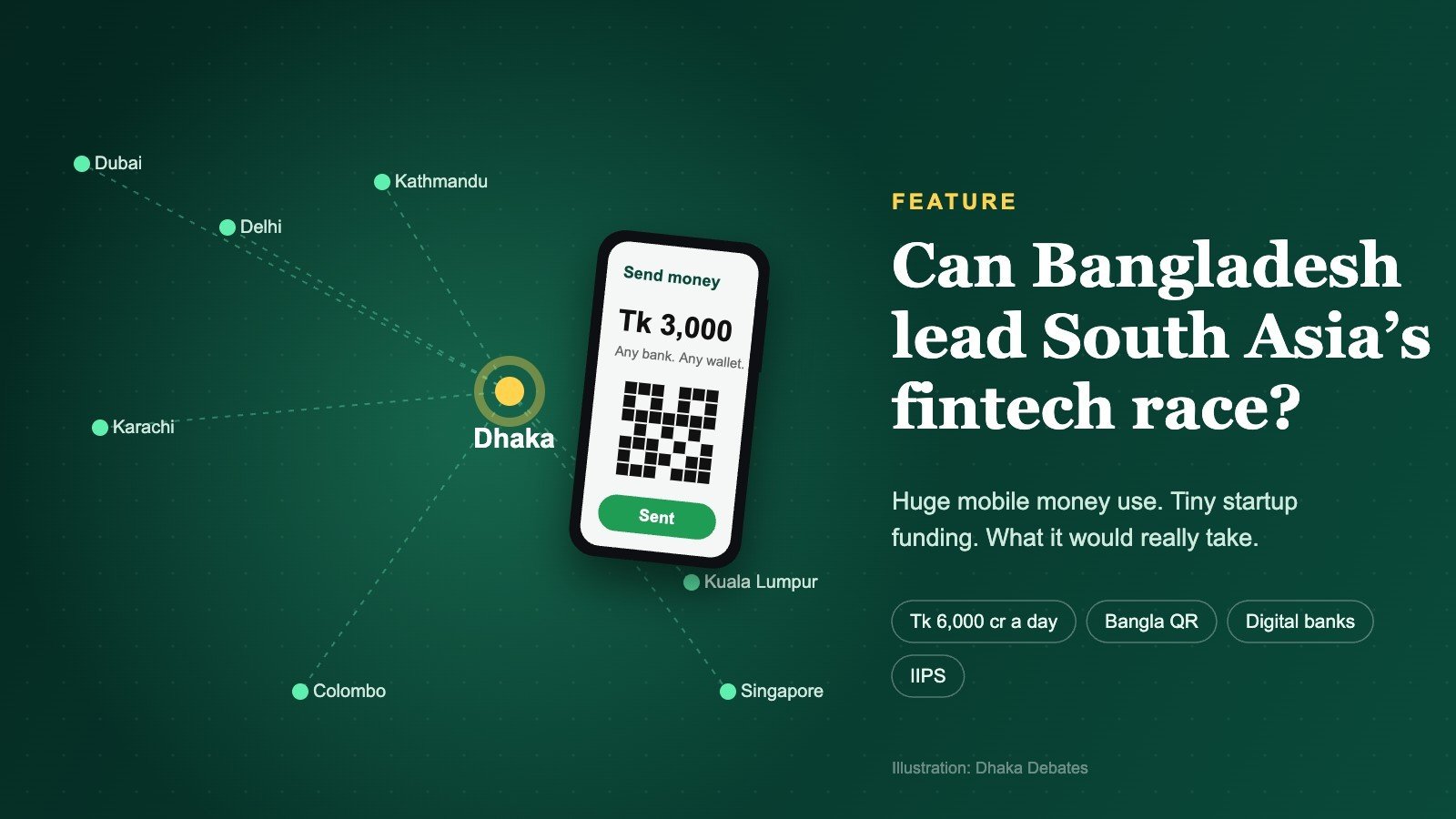
At half past seven on a weekday morning, Rupa Akter is already at work. She is a 29-year-old freelance designer who works from a rented room in Mirpur, and her clients are in Melbourne, Toronto and Berlin. By lunchtime she has sent two invoices in US dollars. By evening she has paid her rent through bKash, bought rice from a shop that shows a Bangla QR code, and sent Tk 3,000 to her mother in Rangpur in under a minute.
Her money moves fast inside Bangladesh. Getting it into the country is another story. Her client payments take days to arrive, pass through two or three companies and lose a slice to fees and exchange rates on the way. When a client in Canada asked her to accept PayPal, she had to say no. PayPal still does not let people in Bangladesh receive payments the normal way.
Rupa’s day is a small picture of a big question. Bangladesh has built one of the largest mobile money markets in the world. Tens of millions of people who never had a bank account now pay, save and receive money on their phones. Yet investors are pulling back, new digital banks are years behind schedule, and cash still pays for a large share of everyday shopping. So can Bangladesh really become South Asia’s next fintech hub? Or is it a big mobile wallet market that the rest of the region will overtake?
The short answer: Bangladesh can become a fintech hub, but not yet, and not by size alone. It already has the users: mobile wallets move close to Tk 6,000 crore a day, bKash alone has 47 million active customers, and Bangla QR is now mandatory at every shop. What it lacks is capital, steady rules and trust. Startup funding fell to just $6 million in the first half of 2026, down 95% from a year earlier. Digital bank licences first approved in 2023 have still not produced a working bank. If the new interoperable payment system goes live on time by July 2027, digital banks finally open, PayPal-style cross-border tools arrive and the central bank keeps its rules stable, Bangladesh could become the region’s leader in mobile-first finance for ordinary people. If not, India will stay the giant and Pakistan, which has moved faster on digital banks and instant payments, will pull ahead.
We spent several weeks reading Bangladesh Bank data, company reports, investment reports and coverage from national and international news organisations. We compared Bangladesh with India, Pakistan, Sri Lanka and Nepal on the things that matter most: users, payment systems, money for startups and how regulators behave. This is what we found.
What does it mean to be a “fintech hub”?
The phrase “fintech hub” gets used loosely, so it helps to be clear. A country is not a hub just because many people use mobile money. Kenya has had very high mobile money use for more than a decade, but most people would not call Nairobi a global fintech centre in the way they would call Singapore, London or Bengaluru one.
Looking at places that are widely seen as fintech hubs, six things tend to show up together:
- Users: a large number of people and businesses who use digital financial services every day, not just once.
- Public payment rails: shared, cheap, instant systems that any bank, wallet or startup can plug into, such as India’s UPI or Pakistan’s Raast.
- Capital: enough local and foreign investment for startups to grow from an idea to a large company.
- Clear and stable rules: a regulator that licenses new players on time, explains its decisions and does not change course every year.
- Talent: engineers, product people, compliance experts and risk managers who can build and run financial products.
- Reach beyond borders: companies that serve customers in other countries, and money that can move in and out of the country easily.
Bangladesh scores very well on the first point, is catching up on the second, and is weak on the other four. That mix explains most of the story that follows.
How big is Bangladesh’s digital money market today?
By some measures, it is very big. According to Bangladesh Bank data reported by The Daily Star, mobile financial services (MFS) moved an average of Tk 5,883 crore a day in 2025. That is roughly eight times the average daily turnover of the Dhaka Stock Exchange in the last fiscal year, which was Tk 722 crore. The same report says transaction volumes grew at about 26% a year between 2018 and 2025.
Monthly figures tell the same story. A Daily Star analysis of central bank data published in October 2026 shows MFS transactions rose from Tk 98,307 crore in July 2023 to Tk 2,01,337 crore in April 2026. That is more than double in under three years. Spread over 30 days, April’s figure works out to about Tk 6,700 crore a day (our calculation). Internet banking grew even faster over the same period, from Tk 46,243 crore to Tk 1,58,917 crore a month.
| Measure | Figure | Source |
|---|---|---|
| Average daily MFS transactions, 2025 | Tk 5,883 crore | Bangladesh Bank, via The Daily Star |
| MFS transactions, April 2026 (one month) | Tk 2,01,337 crore | Bangladesh Bank, via The Daily Star |
| Internet banking, April 2026 (one month) | Tk 1,58,917 crore | Bangladesh Bank, via The Daily Star |
| Registered MFS accounts | About 255 million (registrations, not people) | Bangladesh Bank, via The Daily Star |
| Licensed MFS providers | 14 | The Daily Star |
| Internet subscribers, June 2026 | 135.94 million (120.84 million mobile) | BTRC, via Xinhua |
| Bangla QR merchants, end of 2025 | 9.63 lakh | The Daily Star |
A word of caution is needed here. The 255 million MFS accounts are not 255 million people. Bangladesh has about 18 crore people, and many hold two or three wallets, while some accounts are dormant. The Daily Star’s analyst SM Mohidul Islam makes another important point: MFS totals include cash-in and cash-out. When someone deposits Tk 5,000 at an agent and then withdraws it in another town, both steps count. So a big digital total does not always mean a shop purchase made without cash. “A payment recorded by a digital system is not necessarily a purchase made without cash,” he writes.
Even with that caution, the scale is real. Very few lower-middle-income countries have this many people sending money on their phones every day.
How did bKash become so big?
Any honest look at fintech in Bangladesh has to start with bKash. It is the country’s best-known fintech company and one of the most successful mobile money businesses outside Africa.
The idea goes back to 2008, when entrepreneur Kamal Quadir approached BRAC founder Fazle Hasan Abed. In 2010, Quadir’s company Money in Motion and BRAC Bank formed a joint venture. Bangladesh Bank issued its first MFS guidelines in 2011. Dutch-Bangla Bank’s mobile banking, now Rocket, actually launched first, in March 2011. But bKash grew faster, mainly because it built a huge agent network and kept its app simple. “bKash captured the market mostly through innovation,” a central bank official told The Daily Star.
Later investors include the International Finance Corporation (part of the World Bank Group), the Gates Foundation, Ant International and Japan’s SoftBank. In November 2021 bKash was valued at more than $1 billion, making it Bangladesh’s first unicorn.
Its latest numbers, reported by Bonik Barta in June 2026, show a company that is now both large and profitable:
| bKash, 2025 | Figure |
|---|---|
| Revenue | Tk 6,565 crore |
| Net profit | Tk 661 crore (up from Tk 316 crore in 2024) |
| Profit as share of revenue | About 10% (our calculation) |
| Verified registered customers | 82 million |
| Active customers (used in last 3 months) | 47 million |
| Agent points | More than 3.5 lakh |
| Merchant payment outlets | Nearly 10 lakh |
| Foreign direct investment received | $381 million |
BRAC Bank’s managing director Tareq Refat Ullah Khan told Bonik Barta that bKash’s value would now be more than $1.2 billion. That matters for the hub question. One reason investors avoid a country is that they cannot see how they will ever make money there. bKash shows that a Bangladeshi fintech company can reach tens of millions of users and earn a real profit.
Nagad, launched in 2019 under the Bangladesh Post Office, is the second big player. It reported Tk 1,11,355 crore in transactions in the first quarter of 2026, up 21% from a year earlier, and claims 2.82 crore active users. But Nagad has been run by an administrator appointed by Bangladesh Bank since the political changeover of 2024, after corruption allegations against its former management. Its future ownership is still unsettled. We return to what that means for trust later in this story.
How did mobile money change everyday life?
Before mobile money, sending Tk 2,000 from Dhaka to a village meant a trip to a courier office, a long bus ride or trusting someone travelling home. Garment workers often kept cash under mattresses or with relatives. Today a worker in Gazipur can send money home in seconds, and the family can withdraw it at an agent shop down the road.
Over time, mobile wallets added more services:
- Bill payments: electricity, gas, water and internet bills paid from a phone instead of a bank queue.
- Salary payments: many factories now pay workers through MFS, which was pushed hard during the Covid-19 lockdowns.
- Government payments: allowances, stipends and social safety net payments sent straight to wallets, which cuts out middlemen.
- Remittances: money from Bangladeshis working abroad can now land directly in a family member’s wallet.
- Small loans and savings: some wallets now offer tiny digital loans and savings schemes in partnership with banks.
- Shopping: payments at shops, online stores and ride-hailing apps.
This is real progress. It is also the reason international reports often describe Bangladesh as a “mobile money leader”. The Fintech Times, a UK-based industry publication, wrote in March 2026 that Bangladesh had built its fintech scale “quietly” through infrastructure and inclusion. It estimated that the country has more than 300 fintech companies.
What public payment systems does Bangladesh have?
For years, the biggest weakness of Bangladesh’s system was that each wallet and bank was its own island. Sending money from bKash to Nagad, or from a Nagad wallet to a bank account, was slow, costly or impossible. That is now changing, and this part of the story is more hopeful than most people realise.
NPSB: the bank-to-bank switch
The National Payment Switch Bangladesh (NPSB), run by Bangladesh Bank, connects banks for card payments, ATM withdrawals and online transfers. According to The Fintech Times, it links 57 banks. Because of NPSB, you can use one bank’s card at another bank’s ATM, and transfer money between bank accounts through internet banking.
Binimoy: a first attempt that struggled
In 2022 the then government launched Binimoy, an “interoperable digital transaction platform” meant to let money flow between banks and MFS providers. It was announced with big promises of a cashless country within a few years. In practice, uptake was limited. Many large providers were slow to join, and most people kept using the old routes.
IIPS: the new instant payment system
The more serious effort is the Interoperable Instant Payment System (IIPS). Bangladesh Bank introduced it under NPSB on 1 November 2025, with support from the Gates Foundation. It runs on Mojaloop, open-source payment software that the foundation backs and that several countries use for instant payments.
The plan, as former governor Ahsan H Mansur set it out, is for every bank, MFS provider, insurer, finance company and microcredit organisation to connect within about 18 months, with full operation targeted for July 2027. “We need to build our entire transaction system as cashless,” Mansur said at the launch, as reported by Bonik Barta. At launch, most institutions, including bKash, had not yet joined.
If IIPS works as promised, it would do for Bangladesh roughly what UPI did for India: let any person send money instantly to any other person, whichever bank or wallet each one uses. That is the single most important building block for a fintech hub, because it lets small startups build products on top of shared rails instead of negotiating separately with every bank.
Bangla QR: one code for every shop
Bangla QR is a national QR code standard. Bangladesh Bank first published its guidelines in January 2021 and ran a pilot with 1,200 merchants in Motijheel from January 2023. Before it, a shopkeeper often displayed five or six separate codes, one for each wallet or bank. With Bangla QR, a single code works with any participating bank, MFS provider or payment service provider.
According to The Daily Star, by the end of 2025, 46 banks, seven MFS providers and four payment service providers had joined. Some 9.63 lakh merchants were onboarded, and more than Tk 2,700 crore moved across 66 lakh transactions during the year. That works out to about Tk 4,100 per transaction (our calculation). Instant settlement between providers began on 1 November 2025, and a single Bangla QR code became mandatory at all merchant points on 1 July 2026, with penalties for shops that refuse.
The next step is person-to-person payments. The Financial Express reported in August 2026 that Bangladesh Bank planned to let every individual have a personal Bangla QR code from 1 November 2026, so friends and family can pay each other by scanning, across banks and wallets. Bangla QR transactions were already averaging about Tk 235 crore a day, the paper said. We explain how it works for shoppers in our guide to Bangla QR code payments.
| System | What it does | Status |
|---|---|---|
| NPSB | Connects banks for cards, ATMs and online transfers | Running; about 57 banks |
| Binimoy | Early attempt to link banks and MFS | Launched 2022; limited use |
| IIPS | Instant payments between any bank, wallet or institution | Launched Nov 2025; full rollout targeted July 2027 |
| Bangla QR (merchant) | One QR code for every shop, any app | Mandatory since 1 July 2026 |
| Bangla QR (person to person) | Personal QR codes for transfers between people | Planned from 1 Nov 2026 |
On paper, Bangladesh now has most of the pieces of a modern payment system. The question is whether they will all be switched on, used and trusted at scale. Bangladesh Bank says it wants 80% of transactions to be digital within a decade. In FY25, cash still made up 35% of formal retail transactions, according to The Daily Star.
How does Bangladesh compare with India, Pakistan, Sri Lanka and Nepal?
To be a regional hub, Bangladesh does not need to beat Singapore. It needs to be clearly ahead of most of its neighbours on the things that attract companies and capital. So how does it stack up?
India: the giant next door
India is in a different league. Its Unified Payments Interface (UPI), launched in 2016, handled 2,366 crore transactions in July 2026 alone, the highest monthly volume in its history, according to YourStory. In the year to March 2026, UPI moved about Rs 314 lakh crore. Any bank customer can pay any other bank customer instantly, for free, by scanning a QR code or typing a phone number.
India also has the capital. Indian fintech startups raised $2.4 billion in 2025, according to the market data firm Tracxn, as reported by IANS in January 2026. That put India third in the world for fintech funding, behind only the United States and the United Kingdom. India created three new fintech unicorns in 2025 and saw four fintech companies list on the stock market.
Compare that with Bangladesh, where startups in every sector together raised $124 million in 2025. Indian fintech alone raised roughly 19 times that amount (our calculation). India is not a rival Bangladesh can catch in the next decade. The realistic goal is to be strong in areas India does not focus on, and to work with Indian and global firms rather than compete head-on.
Pakistan: the closest comparison
Pakistan is the most useful comparison for Bangladesh. Both are large, young, lower-middle-income countries with big diasporas and strong mobile money histories. And on several measures, Pakistan has recently moved faster.
Its central bank, the State Bank of Pakistan, launched the Raast instant payment system in 2021. In the October to December 2025 quarter alone, Raast handled 645.7 million transactions worth Rs 18.5 trillion, Dawn reported. In the same quarter, 92% of Pakistan’s 3.4 billion retail payments were digital, up from 88% a year earlier.
Pakistan also got its digital banks moving earlier. In January 2023 it gave initial approval to five digital bank applicants. In January 2025, Easypaisa Bank, formerly Telenor Microfinance Bank, became the country’s first licensed digital retail bank and was allowed to begin commercial operations, Dawn reported. Bangladesh gave its first digital bank approvals in October 2023, but as we explain below, no digital bank is yet open to the public.
Sri Lanka and Nepal: smaller, but linking up
Sri Lanka and Nepal are much smaller markets, but they are showing something Bangladesh has not yet done: connecting their payment systems across borders. On 12 May 2026, Sri Lanka’s LankaPay and Nepal Clearing House launched a link that lets Nepali travellers pay at more than 4 lakh LankaQR merchants in Sri Lanka using their home apps, the Daily FT reported. Sri Lanka has also opened its QR system to Chinese tourists using Weixin Pay. These are small steps, but they are exactly the kind of cross-border plumbing a regional hub needs.
| Country | National instant payment system | Digital banks | Fintech or startup funding | Big strength |
|---|---|---|---|---|
| Bangladesh | IIPS launched Nov 2025; full rollout targeted July 2027 | Approvals since 2023; none open yet | All startups: $124m (2025); $6m (H1 2026) | Mass mobile money use; bKash |
| India | UPI since 2016; 2,366 crore transactions in July 2026 | Payments banks and neobanks working with banks | Fintech alone: $2.4bn (2025) | Scale, capital, talent |
| Pakistan | Raast since 2021; 645.7m transactions in one quarter | Easypaisa licensed Jan 2025; more in pipeline | Smaller than India | Fast regulator; 92% digital retail payments |
| Sri Lanka | LankaPay and LankaQR | Limited | Small | Cross-border QR links |
| Nepal | connectIPS and national QR | Limited | Small | Cross-border QR with Sri Lanka |
The picture is clear. Bangladesh is among the leaders in South Asia for how many ordinary people use mobile money. It is behind India on almost everything else, and behind Pakistan on instant payments and digital banks. The good news is that the gap with Pakistan is a matter of a few years, not a generation, and Bangladesh’s own instant payment system is already being built.
Why has startup funding dried up?
If users are Bangladesh’s strength, capital is its biggest weakness. The numbers from LightCastle Partners, a Dhaka-based consulting firm that tracks startup investment, are stark.
In 2025, Bangladeshi startups raised $124 million across 12 deals, The Financial Express reported. That looked like a strong year, three times the $42 million of 2024. But one deal made up almost all of it. The merger of ShopUp, a Bangladeshi business-to-business commerce and lending startup, with Saudi Arabia’s Sary created SILQ Group, valued at $110 million. That single deal was about 89% of the year’s money. Without it, only about $14 million was invested in all Bangladeshi startups for the whole year.
Then it got worse. In the first half of 2026, startups raised just $6 million across six deals, down 95% from $120 million in the first half of 2025, according to LightCastle’s mid-year report covered by The Financial Express in August 2026. The average deal was about $1 million. Financial services took 29% of that money, behind software and technology at 35%.
| Period | Total raised by Bangladeshi startups | Deals | Note |
|---|---|---|---|
| 2024 | $42 million | Not stated | Weak year |
| H1 2025 | $120 million | 14 | Includes ShopUp-Sary deal |
| Full 2025 | $124 million | 12 (as counted in annual report) | About $14m without the SILQ deal |
| H2 2025 | $4 million | Not stated | Sharp slowdown |
| H1 2026 | $6 million | 6 | Down 95% year on year |
To put it in perspective, startup investment in Bangladesh was equal to about 0.03% of GDP in 2025, LightCastle found. And almost none of the money is local. Global investors supplied about 99% of the capital in 2025 and 100% in the first half of 2026. Local investors put in less than $1 million in 2025.
Why is local money missing?
LightCastle points to “a structural shortage of domestic growth capital” and “the absence of domestic institutional participation”. In plain words, Bangladesh’s pension funds, insurers, banks and wealthy families rarely invest in startups. There are several reasons:
- Easy returns elsewhere: government savings certificates, treasury bills and fixed deposits have paid high interest in recent years, so there is little reason to take startup risk.
- Few exits: very few Bangladeshi startups have listed on the stock market or been bought at a good price, so investors cannot see how they will get their money back.
- Money is hard to move: foreign investors worry about taking profits and capital back out of Bangladesh, especially after dollar shortages in 2022 and 2023.
- Political and policy risk: changes of government and leadership at Bangladesh Bank have led to big policy reversals, as the digital bank story shows.
- Weak banks: a large share of bank loans are in default, which keeps banks focused on their own problems rather than on funding new businesses.
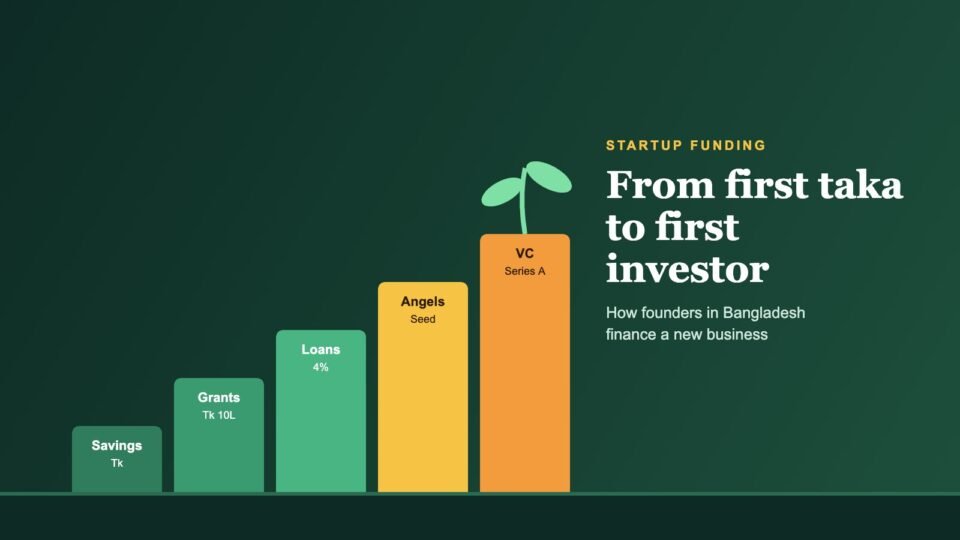
There are some signs of change. The $35 million BSIC ONKUR Fund I launched in May 2026, and the FY27 national budget included measures aimed at startups, The Financial Express reported. But $35 million is tiny next to the money flowing into Indian fintech. We explain the options open to founders in our guide on how to fund your first startup in Bangladesh, and we looked at the wider problem in why Bangladesh needs more fintech startups.
What happened to Bangladesh’s digital banks?
Nothing shows the difference between Bangladesh’s ambitions and its delivery better than the digital bank saga. A digital bank is a full bank with no branches. It takes deposits and gives loans entirely through an app. In many countries, digital banks have pushed old banks to cut fees and improve their apps.
Here is how the story has unfolded so far, based on reports by The Financial Express, The Business Standard and Prothom Alo:
| When | What happened |
|---|---|
| June to August 2023 | Bangladesh Bank takes applications. 52 applications arrive, representing nearly 500 companies. Minimum capital: Tk 125 crore. |
| October 2023 | Board gives initial approval to eight proposals. Nagad Digital Bank and ACI’s Kori Digital Bank get letters of intent; three existing banks (including BRAC Bank with bKash) are allowed digital windows. Both were expected to open by April 2024. |
| August 2024 onwards | After the political changeover, the new governor puts Nagad’s licence under review. Kori gets a six-month extension over compliance issues. |
| 2025 | Revised rules raise minimum capital to Tk 300 crore and bar existing banks from sponsoring. A new window runs from 1 September to 2 November 2025; 12 to 13 applicants apply, including bKash, Banglalink with Square, and Robi’s parent Axiata. |
| Interim period | No approvals, amid protests by central bank officials and internal debate. |
| 24 September 2026 | Under new governor Mostaqur Rahman, the board approves four: bKash Digital Bank, Nova Digital Bank (VEON and Square Group), Boost Digital Bank (Axiata) and Digital Banking of Bhutan (DK Bank). It also decides to issue a letter of intent to Kori. |
Three years after the first approvals, Bangladesh still has no digital bank serving customers. The approved banks “will be able to begin operations after completing the remaining formalities”, Prothom Alo quoted the central bank as saying. Even if everything goes smoothly from here, setting up systems, hiring staff, passing inspections and launching an app usually takes many months.
For a would-be fintech hub, this kind of delay is costly. Foreign investors watch how long it takes to get a licence and whether a licence given by one governor will survive the next. A process that restarted twice and changed its capital requirement from Tk 125 crore to Tk 300 crore sends a message of uncertainty. Still, the September 2026 decision is a real step forward, and the group of approved sponsors includes serious players with deep pockets and existing customers. We looked at what these banks could mean for ordinary customers in the future of digital banking in Bangladesh.
Are Bangladesh’s rules helping or holding fintech back?
Bangladesh Bank deserves credit for some bold moves: forcing interoperability through Bangla QR, building IIPS and pushing banks to digitise. But several rules make life hard for new fintech companies.
The bank-led model
Bangladesh follows a “bank-led” model for mobile financial services. A bank must hold at least 51% of an MFS company. bKash, for example, is a subsidiary of BRAC Bank. The idea is to keep customer money safe under banking supervision. But critics say it shuts out technology companies that want to build payment businesses without being owned by a bank. A letter in The Financial Express in November 2025 called it a regulatory “Catch-22” that “could stifle the very innovation the central bank is trying to promote.” Nagad, which grew under the Post Office rather than a bank, has been the main exception.
A sandbox that has not taken off
A regulatory sandbox lets a startup test a new product with real customers under close supervision before it gets a full licence. Countries such as Singapore, Malaysia and Brunei have used sandboxes to bring new ideas to market faster. Bangladesh Bank has talked about a sandbox for years, but commentators in The Business Standard and The Financial Express say its potential has not been realised. Long approval times mean a startup can lose its first-mover advantage before it gets permission to launch.
Heavy capital requirements
At Tk 300 crore, the minimum capital for a digital bank is out of reach for most startups. That limits digital banks to big groups: telecom operators, large conglomerates and existing MFS giants. This may be sensible for safety, but it means the next wave of banking competition will come mostly from established players, not young founders.
Fees and limits that keep people in cash
Cash-out fees are one of the biggest obstacles to a truly cashless economy. Taking cash out of a mobile wallet costs between Tk 12.99 and Tk 18.50 per Tk 1,000, The Daily Star reported. Cashing out Tk 10,000 can cost nearly Tk 200, compared with about Tk 29 through a bank. The paper says the same amount costs about Tk 92 in Myanmar and Tk 142 in Pakistan. “It is a burden for general users,” One Bank’s managing director Muhit Rahman told the paper.
High cash-out fees cut both ways. They make MFS companies profitable. But they also push people to keep their money in cash and use wallets only for sending money, not for storing it or spending it in shops. A fintech hub needs money to stay digital, moving from one app to another, not to keep jumping back into cash. Merchants pay too: the minimum merchant discount rate for Bangla QR is 1%, including VAT, according to The Daily Star. For small shops on thin margins, that is not nothing.
Can people trust digital money in Bangladesh?
Trust is the quiet foundation of every financial system. People use a fintech app only if they believe their money will be there tomorrow, their data will not be misused and the company will not disappear. Bangladesh has had several shocks to that trust.
The Nagad question
Nagad is the country’s second-largest MFS provider and was once seen as bKash’s main challenger. After the political changeover in 2024, Bangladesh Bank appointed an administrator to run it amid corruption allegations against its previous management. That appointment was challenged in court, and the case went back and forth between the High Court and the Appellate Division before the courts allowed the administrator to continue, The Financial Express and Prothom Alo reported. Nagad’s privatisation and long-term ownership are still undecided. Meanwhile, the company keeps reporting record transactions, which suggests users have stayed. But for investors, an unsettled ownership fight at the number two player is a warning sign.
Cyber security
Bangladesh is remembered internationally for the 2016 cyber heist, when hackers stole $81 million from Bangladesh Bank’s account at the Federal Reserve Bank of New York using the SWIFT network. A decade later, the country’s payment systems are far bigger, and so is the risk. Fraud through fake calls, SIM swaps and phishing links is common, and wallet users are often targeted. A fintech hub needs strong cyber defences at the central bank, at every bank and wallet, and among ordinary users.
Data protection
For years Bangladesh had no proper data protection law. In 2025 the interim government approved the Personal Data Protection Ordinance and a National Data Governance Ordinance. Supporters say a law was badly needed. Critics, including writers in The Daily Star, have warned that some provisions give the state wide powers over data and could create costs and uncertainty for businesses. For fintech companies, the details matter: where data must be stored, who can access it and how cross-border data flows are handled will decide whether global companies are comfortable setting up regional operations in Dhaka.
Why is cash still so strong?
Walk through any kitchen market in Dhaka and you will still see most people paying in notes. The Fintech Times estimated that about 60% of Bangladeshis are still unbanked or underbanked, and the World Bank has repeatedly listed Bangladesh among the countries with the largest number of adults without an account. Cash made up 35% of formal retail transactions in FY25, according to The Daily Star, and an even larger share of informal trade.
There are good reasons for this. Cash has no fee. It does not need a charged phone or a working network. It is private, which matters to small traders who prefer to keep income out of the tax net. And many people, especially older and rural customers, find banking apps confusing. We wrote about this gap in our feature on why traditional banks struggle to go digital.
For the hub question, cash matters because it limits the data fintech companies can use. Digital lending, insurance and savings products depend on transaction history. If a shopkeeper’s sales are all in cash, a lender cannot see his income and will not lend to him. Moving everyday trade onto Bangla QR is therefore not only about convenience. It builds the data trail that lets fintech companies offer credit to millions of small businesses that banks ignore.
Are banks part of the problem or part of the answer?
It is tempting to tell the fintech story as one of nimble wallets against slow banks. The reality is more mixed. Banks still hold most of the country’s deposits, run the card networks and own most MFS companies. And on some measures, they are digitising faster than wallets.
The Daily Star’s October 2026 analysis of Bangladesh Bank data found that internet banking value rose 244% between July 2023 and April 2026, compared with 105% for MFS. The number of internet banking transactions rose even faster, by 333%, while the average size of each transaction fell from about Tk 59,232 to about Tk 47,042. That suggests more ordinary customers, not just companies, are now using their bank apps for everyday transfers.
Card payments grew more slowly. Total card transaction value rose 33% over the same period, and card spending on e-commerce rose 57%, the analysis found. Cards remain a product mainly for the urban middle class.
Yet many bankers admit they were late. “Not only our bank, but most banks introduced MFS merely as an ornamental feature,” Mercantile Bank’s managing director Mati Ul Hasan told The Daily Star. Smaller banks say they could not afford to compete. “As a small-sized bank, it was difficult to invest heavily in the MFS wing,” said Syed Mizanur Rahman, managing director of Meghna Bank.
For a fintech hub, banks matter in three ways. First, startups need bank partners to hold customer money, issue cards and connect to the payment switch. Second, banks are the natural buyers of fintech services such as credit scoring, fraud detection and app development. Third, if banks themselves become modern and efficient, they free up talent and capital for the wider system. The weakness of a large part of the banking sector, with many banks carrying heavy loads of bad loans, is therefore a drag on fintech too.
Where are Bangladeshi fintech companies working?
The Fintech Times estimates that Bangladesh has more than 300 fintech companies, though no official count exists. Most of them work in a handful of areas:
| Area | What these companies do | Examples of the kind of player | Main challenge |
|---|---|---|---|
| Mobile wallets | Send, receive, pay bills, cash in and out | bKash, Nagad, Rocket, Upay | High cash-out costs; heavy competition with bKash |
| Payment gateways | Let online shops accept cards, wallets and bank payments | Local payment service providers | Thin margins; card use still limited |
| Merchant payments | QR codes and tools for shops to accept digital payments | Banks, MFS and PSPs under Bangla QR | Shops prefer cash; 1% merchant fee |
| Digital lending | Small loans to shoppers and small businesses using data | ShopUp (now part of SILQ), bank-wallet nano loans | Little credit data; tight rules on who can lend |
| Remittance and cross-border | Help migrants and freelancers move money into Bangladesh | MFS with foreign partners; international services | Foreign exchange rules; PayPal not available |
| Insurance and investing | Sell insurance or investment products online | Insurtech and wealth apps | Low awareness; old regulations |
| Software for banks | Build apps, core systems, fraud and risk tools | Local IT firms | Banks slow to buy; cyber risk |
The pattern is clear. Payments are crowded and dominated by a few giants. The biggest gaps, and the biggest chances, are in lending, insurance, savings and cross-border services. These are the areas where a hub would need its next generation of companies.
Lending is the most important. Millions of shopkeepers, farmers and small manufacturers cannot get a bank loan because they have no collateral and no formal records. They borrow from microfinance institutions or informal lenders at high cost. If digital payments create a record of their sales, fintech lenders could assess them and offer smaller, cheaper and faster loans. That is why ShopUp, which combined wholesale supply with credit for small shops, attracted foreign investment and became part of the $110 million SILQ merger.
What does a shopkeeper gain or lose from going digital?
To see why cash is so sticky, consider a simple example. Imagine a grocery shop in Mohammadpur with sales of Tk 3 lakh a month. If all of that came through Bangla QR at the minimum 1% merchant discount rate, the shop would pay Tk 3,000 a month in fees (our calculation). For a shop that earns perhaps Tk 30,000 to Tk 45,000 in profit a month, that is a noticeable cost.
What does the shopkeeper get in return? No risk of fake notes or theft. No need to carry cash to the bank. Faster payments from customers who no longer need to find change. And, crucially, a record of sales that could help him get a loan to stock up before Eid. If that loan comes at a lower cost than borrowing from a moneylender, the trade-off makes sense.
The lesson for policy makers is that going digital has to be cheaper and more useful than cash, not just required by law. Pakistan and India both kept merchant costs very low on their national systems to win shopkeepers over. In India, UPI payments are free for most users. Bangladesh’s mandatory Bangla QR is a strong push, but the long-term pull will come only if shopkeepers see real benefits, especially access to credit.
What can Bangladesh learn from UPI and Raast?
India’s UPI and Pakistan’s Raast both started as government-backed public systems, and both grew far faster than private networks had managed on their own. Four lessons stand out.
Lesson 1: Make it free or nearly free for small payments
People switched to UPI because it cost them nothing. In Bangladesh, sending money between people within the same wallet is often free, but cashing out and some transfers carry fees. If IIPS transfers are cheap, people will use them for everyday payments. If they are costly, the old habits will continue.
Lesson 2: Let everyone build on the rails
UPI’s success came partly from opening it to third-party apps. Payments apps run by tech companies became the main way Indians used UPI, even though the money stayed in banks. Bangladesh should let licensed fintech apps connect to IIPS, not only banks and big wallets. That is how a crowded field of startups can grow on top of a shared system.
Lesson 3: Push government payments through the system
Both India and Pakistan sent large volumes of government payments, such as subsidies and benefits, through their digital systems. That brought millions of new users at once. Bangladesh is moving the same way. The Fintech Times reports that a Family Card digital welfare platform launched in 2026 to deliver assistance through a unified digital system. Using IIPS for all allowances, stipends, salaries and tax payments would give it a huge, steady base of traffic.
Lesson 4: Move fast and keep going
Pakistan’s regulator moved from digital bank approvals in early 2023 to a fully licensed digital bank in January 2025, about two years. Bangladesh has taken more than three years and is still waiting. Speed and consistency matter more than perfect rules. A regulator that sets out a clear path and sticks to it will attract more investment than one that writes better rules but changes them often.
What does a fintech hub mean for jobs?
A fintech hub is not only about payments. It is also about jobs that pay well and keep talent at home. Fintech companies need software engineers, data scientists, designers, product managers, compliance officers, risk analysts, customer support teams and marketers. Every successful fintech company also creates jobs indirectly, through agents, merchants and partner businesses. bKash alone works with more than 3.5 lakh agent points across the country, according to the figures reported by Bonik Barta.
Bangladesh produces many engineering and business graduates every year, but a large number of the best leave for jobs abroad or for remote work for foreign companies. A thriving fintech sector would give them reasons to stay and build at home. It would also attract experienced Bangladeshis working in fintech in Singapore, London, Dubai or Silicon Valley to come back, bringing knowledge and networks with them. In most global hubs, returning diaspora talent played a big role in the early years.
Education also has to keep up. Universities and training institutes would need courses in areas such as payment systems, financial regulation, cyber security and data science applied to finance. Bangladesh Bank and the industry could support this through internships, scholarships and shared training programmes.
Could Dhaka attract foreign fintech companies?
A true hub attracts companies from abroad, not just local startups. Some international interest already exists. VEON, the parent of Banglalink, and Axiata, the parent of Robi, are behind two of the newly approved digital banks. DK Bank from Bhutan is behind another. Ant International and SoftBank are investors in bKash. Visa and Mastercard work closely with local banks and wallets, and The Fintech Times notes that Grameenphone, majority-owned by Norway’s Telenor, has invested more than $4.1 billion in its network.
Gulf investors are also showing interest. LightCastle found that Gulf-based investors provided nearly a third of the startup capital that came into Bangladesh in 2025, largely through the ShopUp and Sary deal. With millions of Bangladeshis working in Saudi Arabia, the UAE, Qatar, Kuwait and Oman, the Gulf is a natural partner for remittance and payment companies.
What foreign companies need before they set up regional operations in Dhaka is mostly the same list that local startups need: clear licensing, the ability to move money and profits in and out, sensible data rules, good internet and power, and a stable political and economic environment. Dhaka’s traffic, living costs for foreign staff and visa processes also matter. On most of these, Singapore and Dubai are still far easier places to run a regional business. Bangladesh’s realistic aim is not to replace them as headquarters, but to become the place where South Asian mobile-first products are built and tested.
What do critics and optimists each say?
There is a real debate in Bangladesh about where fintech is heading, and both sides have strong points.
The optimists point to scale. Few countries have moved so many people from cash to digital money so quickly. They point to bKash’s profits, to the record remittances flowing through formal channels, to mandatory Bangla QR and to the new instant payment system. They argue that once IIPS and digital banks are live, the base will be in place for a rapid wave of new products, just as UPI created one in India. In this view, the funding drop of 2026 is a temporary dip after a period of political change.
The critics point to the gap between announcements and delivery. Binimoy was launched with big promises and little result. Digital banks approved in 2023 are still not open. Startup funding is at a historic low. Cash remains strong, and some of the headline digital totals are made up of cash moving in and out of wallets. They argue that without deep reforms to the banking sector, the central bank’s independence and the rules on capital flows, Bangladesh will remain a large but closed mobile money market.
Both views are supported by evidence. The honest conclusion is that Bangladesh has built the hardest part, mass adoption, and is now stuck on the parts that depend on institutions: capital, regulation and trust.
How did Bangladesh’s fintech journey unfold?
It helps to see the main moments in one place. This timeline is built from the reports cited throughout this story.
| Year | Milestone |
|---|---|
| 2008 | Kamal Quadir approaches BRAC’s Fazle Hasan Abed with the bKash idea |
| 2010 | Money in Motion and BRAC Bank form the bKash joint venture |
| 2011 | Bangladesh Bank issues its first MFS guidelines; Dutch-Bangla Bank’s mobile banking (later Rocket) launches in March |
| 2013 | About 1.3 crore registered MFS accounts by December |
| 2016 | Hackers steal $81 million from Bangladesh Bank’s account in New York; India launches UPI |
| 2019 | Nagad launches under the Bangladesh Post Office |
| 2021 | Bangla QR guidelines published (January); bKash becomes a unicorn (November); Pakistan launches Raast |
| 2022 | Binimoy interoperable platform launched |
| 2023 | Bangla QR pilot in Motijheel (January); first digital bank approvals (October) |
| 2024 | Political changeover; Nagad put under an administrator; digital bank plans stall |
| 2025 | Personal Data Protection Ordinance approved; new digital bank window; IIPS introduced and Bangla QR instant settlement begins (1 November); ShopUp and Sary form SILQ |
| 2026 | Startup funding falls 95% in H1; Bangla QR mandatory for all merchants (1 July); four digital banks approved (24 September); LDC graduation moved to 2029 (29 October); person-to-person Bangla QR planned from 1 November |
| 2027 | Target for full IIPS operation (July) |
Looking at the list, one pattern stands out. Big launches come regularly, but the gaps between launch and real-world use are long. Bangla QR took more than five years to go from guidelines to a nationwide mandate. Digital banks have taken more than three years and counting. Closing these gaps is the single biggest thing that would change Bangladesh’s position in the region.
What should policy makers prioritise in the next 18 months?
Not every reform can happen at once. If we had to pick the steps that would make the biggest difference before July 2027, they would be these:
- A public IIPS scorecard: a monthly report showing which banks, wallets and microfinance institutions have connected, how many transactions flow through the system and what they cost. Public pressure works.
- A firm launch window for digital banks: a clear deadline for the five approved banks to open, with support from Bangladesh Bank to clear inspections quickly.
- A PayPal date: a published timeline, even an approximate one, would tell freelancers and small exporters when relief is coming.
- A decision on Nagad: settling who owns and runs the country’s second-largest wallet would remove one of the biggest question marks in the market.
- A first cross-border payment link: even one pilot connection with a Gulf country or Malaysia would show that Bangladesh can plug its systems into the region.
None of these requires new money on a large scale. They require decisions, coordination and follow-through. That is good news, because it means the main obstacles are within Bangladesh’s own control.
There is also a role for the private sector. bKash, the large banks and the new digital banks can open their systems to smaller fintech partners through application programming interfaces (APIs), so startups can build services such as savings tools, small business accounting or insurance on top of their customer base. Industry groups can push for clear rules and share fraud data. And successful founders can invest in the next generation, as happened in every major tech hub.
What advantages does Bangladesh really have?
After all those problems, it is easy to forget that Bangladesh starts with some advantages that most countries would envy. A hub is built on strengths, not just on fixing weaknesses.
1. A huge, young, connected population
With about 18 crore people, Bangladesh is one of the ten most populous countries in the world. Most of its people are young, and young people adopt new apps quickly. According to the telecom regulator BTRC, the country had 135.94 million internet subscribers at the end of June 2026, of which 120.84 million used mobile internet. It added 6.27 million internet users in the first half of 2026 alone, Xinhua reported. Any fintech product that works here has a ready market of tens of millions.
2. One of the world’s largest flows of remittances
Bangladeshis working abroad sent home a record $35.56 billion in the 2025-26 fiscal year, according to Bangladesh Bank data reported by Prothom Alo. That is up from $30.33 billion the year before, an increase of about 17% (our calculation). Every dollar of that has to travel through some payment channel, and every channel charges a fee or takes a cut on the exchange rate.
This is a big opportunity for fintech. If digital tools could cut the average cost of sending money home by just one percentage point, migrant families would keep about $356 million more a year (our calculation, based on FY26 inflows). Companies that build fast, cheap, trusted remittance services for the Bangladeshi diaspora in the Gulf, Malaysia, Singapore, the UK, Italy and the US could grow into regional players. Mobile wallets already receive remittances directly, and that link is likely to grow as IIPS connects more institutions.
3. A large freelance workforce
Bangladesh has long been one of the largest suppliers of online freelance work in the world, in fields such as graphic design, web development, digital marketing and data entry. Freelancers like Rupa earn in foreign currency and need simple ways to get paid. Their needs have already created a market for services such as Payoneer and newer cross-border accounts.
4. A proven local champion
bKash proves that a Bangladeshi fintech company can reach scale, make a profit and attract investors such as SoftBank, Ant International and the IFC. Engineers, product managers and compliance staff trained at bKash, Nagad, the banks and payment companies form a growing local talent pool. In mature hubs, people who leave big companies often start the next generation of startups. That process has begun in Dhaka.
5. Real progress on shared payment rails
Mandatory Bangla QR, person-to-person QR payments and IIPS are the right ideas. India’s experience shows that once shared public rails work well, private companies build hundreds of products on top of them. If Bangladesh delivers IIPS on time, it will have the base that a fintech hub needs.
Why does cross-border money matter so much?
A hub is by definition a place that connects to other places. Today, money moving into and out of Bangladesh is slower, costlier and more restricted than money moving within it. That limits what fintech companies based in Dhaka can do.
Take PayPal. Bangladeshi freelancers and small exporters have asked for full PayPal access for more than a decade. In April 2026, Prime Minister Tarique Rahman told Parliament that the government had “taken effective steps to launch operations of PayPal in Bangladesh” and that a committee had been formed, Jagonews24 and The Daily Ittefaq reported. No launch date has been given. Until it arrives, freelancers rely on workarounds, many of which involve extra fees, delays or the risk of accounts being frozen.
For now, these are the main legal options freelancers use:
- Payoneer: lets you receive payments from many international marketplaces and clients and withdraw to a Bangladeshi bank account. Open a Payoneer account.
- nsave: offers a US dollar account for people in countries where access to foreign banking is limited. Try nsave.
- Direct bank transfers (SWIFT): slower and often costlier for small amounts, but widely accepted by larger clients.
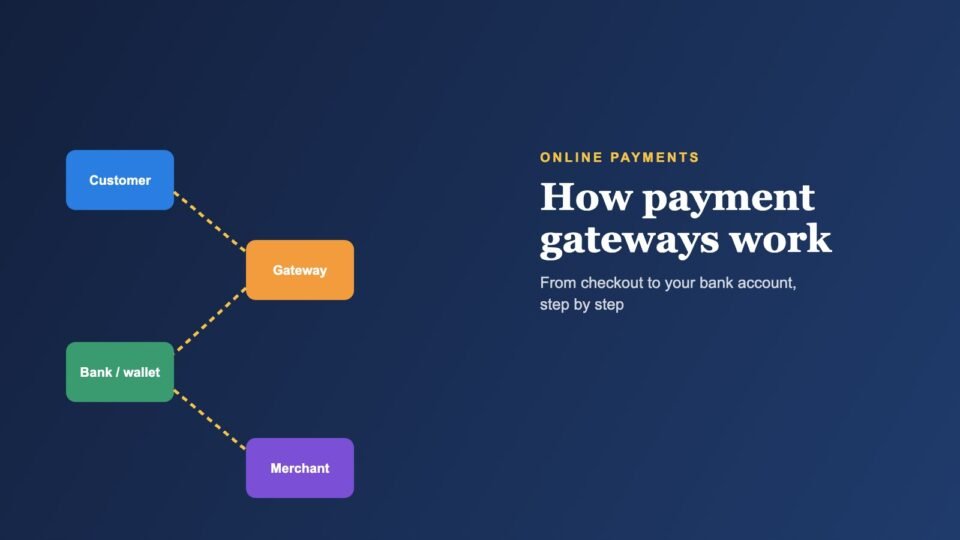
Disclosure: the Payoneer and nsave links above are referral links. If you sign up through them, Dhaka Debates may receive a reward at no extra cost to you. It does not affect how we report. We compared more options in our guide to Wise alternatives in Bangladesh, and explained how online card payments flow in how payment gateways work in Bangladesh.
Beyond freelancers, there is a bigger cross-border question. Sri Lanka and Nepal have linked their QR systems. India has linked UPI with several countries. Bangladesh has not yet connected Bangla QR or IIPS to any foreign system. If Bangladesh could link its rails with Gulf countries and Malaysia, where millions of its workers live, remittances could become cheaper and faster, and Bangladeshi fintech firms would have a natural route abroad.
Does the delay in LDC graduation change anything?
On 29 October 2026, the UN General Assembly gave Bangladesh three more years before it graduates from the group of least developed countries (LDCs). The new date is 24 November 2029 instead of 24 November 2026, The Business Standard reported. The UN urged Bangladesh to use the time for reforms and to report its progress every year.
This is mostly a trade story, about keeping duty-free access for exports such as garments. But it matters for fintech too. The extra years give Bangladesh time to fix its banking sector, raise tax revenue and diversify its economy. Digital finance can help with all three: digital payments make tax collection easier, transaction data helps banks lend more safely, and fintech services can support new export sectors such as IT and freelancing. The reform pressure that comes with the extension could, if used well, speed up the very changes a fintech hub needs.
What would it take to become a real fintech hub?
Based on the evidence above and on what has worked in India, Pakistan and other markets, here is our checklist. None of it is new. The challenge is doing it, and doing it consistently.
- Deliver IIPS on time. Every bank, wallet and microfinance institution should be connected by July 2027, as promised, with low or no fees for small transfers.
- Open the approved digital banks. Give the four banks approved in September 2026 and Kori a clear timetable and let them launch, then judge them on results.
- Keep rules stable. Avoid restarting licensing processes or changing capital rules every time leadership changes. Investors value predictability more than generosity.
- Make the sandbox real. Publish clear timelines, accept applications all year and report on which products have graduated to full licences.
- Create licences for non-bank fintech. Allow technology companies to offer payment, savings aggregation or insurance distribution services with capital rules that match their risk, rather than forcing them under a bank.
- Cut the cost of staying digital. Lower cash-out fees over time and keep merchant fees small, so people have a reason to keep money in digital form.
- Fix cross-border payments. Bring PayPal and similar services in, make it easy for startups to receive foreign investment and send profits home, and link Bangla QR and IIPS with the Gulf and Southeast Asia.
- Unlock local capital. Let pension funds, insurers and banks invest a small share in venture funds, and create real exit routes through the stock market.
- Protect users. Invest heavily in cyber security, fraud prevention and a fair, clear data protection regime, and resolve the Nagad situation transparently.
- Publish better data. As The Daily Star’s analyst argued, Bangladesh Bank should publish transaction counts and values together, with clear definitions and a record of revisions, so investors can see real progress.
What could happen by 2030? Three scenarios
No one can predict the future, but it helps to think about the paths Bangladesh could take. These scenarios are our own analysis, based on the trends in this story.
| Scenario | What happens | Result for Bangladesh |
|---|---|---|
| 1. Breakthrough | IIPS goes live on time; digital banks launch in 2027; PayPal and cross-border QR links arrive; rules stay stable; local funds start investing. | Bangladesh becomes South Asia’s leader in mobile-first finance for ordinary people and migrants, second only to India in overall fintech activity. |
| 2. Slow progress | Systems launch but late; one or two digital banks open; funding recovers slowly; cash-out fees stay high. | A big domestic market dominated by bKash and a few large groups, but not a regional hub. Pakistan stays ahead on instant payments and digital banking. |
| 3. Stall | IIPS slips; licences are again reversed; a major fraud or failure hurts trust; foreign investors stay away. | Mobile money remains useful at home, but talent and startups move to Singapore, Dubai or India to grow. |
Right now, Bangladesh looks most likely to be on the second path, with a real chance of moving to the first if the next 18 months go well. The most important dates to watch are the launch of the first digital bank, the full switch-on of IIPS by July 2027, and any firm date for PayPal.
What does this mean for ordinary people?
Whether or not Bangladesh becomes a “hub”, the changes now under way will affect how you manage money:
- Sending money will get easier: with person-to-person Bangla QR and IIPS, you should be able to send money from any bank or wallet to any other, instantly, by scanning a code.
- More choice in banking: digital banks backed by bKash, telecom operators and big groups may offer simpler apps and better rates on savings and small loans.
- Watch the fees: keeping money digital is cheapest. Cashing out of a wallet often costs far more than using a bank. Use QR payments where you can.
- Protect your account: never share your PIN or OTP, be careful with calls claiming to be from your wallet company, and report fraud quickly.
- Think beyond payments: as your digital transaction history grows, it may help you get loans or credit that banks would not give you before. Our guides on buy now, pay later and choosing your first bank account can help you use these tools wisely.
Frequently asked questions
Is Bangladesh already a fintech hub?
Not yet. It is one of South Asia’s biggest mobile money markets, but it lacks the capital, stable rules and cross-border links that define a hub. India is far ahead, and Pakistan is ahead on instant payments and digital banks.
How much money moves through mobile wallets in Bangladesh?
An average of Tk 5,883 crore a day in 2025, according to Bangladesh Bank data reported by The Daily Star. In April 2026, monthly MFS transactions reached Tk 2,01,337 crore. These totals include cash-in and cash-out, not only purchases.
When will digital banks open in Bangladesh?
No date has been announced. In September 2026, Bangladesh Bank approved bKash Digital Bank, Nova Digital Bank, Boost Digital Bank and Digital Banking of Bhutan, and decided to issue a letter of intent to Kori Digital Bank. They can launch once they complete the remaining formalities.
What is IIPS?
The Interoperable Instant Payment System is Bangladesh Bank’s new platform for instant transfers between any bank, mobile wallet or financial institution. It was introduced in November 2025, and full operation is targeted for July 2027.
Why did startup funding in Bangladesh fall so sharply?
LightCastle Partners points to a shortage of local growth capital and the absence of local institutional investors. Political change, policy reversals, high returns on safe investments and difficulty moving money in and out of the country also discourage investors.
Is PayPal available in Bangladesh?
Not for normal receiving and sending. The prime minister told Parliament in April 2026 that the government had taken steps and formed a committee to bring PayPal in, but no launch date has been given.
Which country is Bangladesh’s closest fintech rival?
Pakistan. Both have large young populations and strong mobile money histories. Pakistan launched Raast instant payments in 2021 and licensed its first digital bank, Easypaisa, in January 2025, putting it a few years ahead on those fronts.
Key words explained
| Term | What it means |
|---|---|
| Fintech | Short for financial technology: companies and tools that use software to offer payments, loans, savings, insurance or investing. |
| MFS | Mobile financial services, such as bKash, Nagad and Rocket, which let you send, receive and store money on your phone. |
| Interoperability | The ability to send money between different banks and wallets as easily as within one. |
| IIPS | Interoperable Instant Payment System, Bangladesh Bank’s new instant transfer platform. |
| NPSB | National Payment Switch Bangladesh, which links banks for cards, ATMs and transfers. |
| Bangla QR | The national QR code standard that lets one code work with any bank or wallet. |
| Digital bank | A licensed bank with no branches that serves customers only through apps and websites. |
| Regulatory sandbox | A controlled testing space where startups can try new financial products with real customers under supervision. |
| UPI and Raast | India’s and Pakistan’s national instant payment systems. |
| Unicorn | A private startup valued at $1 billion or more. |
| LDC graduation | Leaving the UN’s list of least developed countries, which ends some trade benefits. |
| Cash-out fee | The charge for turning money in a mobile wallet into cash at an agent. |
How we reported this
This story draws on Bangladesh Bank data as reported by The Daily Star, The Financial Express, The Business Standard, Prothom Alo, Bonik Barta and The Daily Ittefaq, and on startup investment reports by LightCastle Partners. For the regional comparison we used reports from Dawn (Pakistan), YourStory and IANS (India) and the Daily FT (Sri Lanka), plus The Fintech Times, a UK-based industry publication, and Xinhua for telecom data. Where sources gave different figures for the same thing, such as deal counts, we say so. Figures marked “our calculation” are our own arithmetic based on those sources. The three scenarios and the checklist are Dhaka Debates’ analysis and opinion, not forecasts by any official body. Some figures, such as MFS account numbers and the share of unbanked adults, are estimates or registrations rather than counts of individual people, and we have flagged that where it matters. The full list of sources is in the sources box below.
Editor’s note: Rupa Akter is an illustrative character created for this story. Her experience is based on common problems that freelancers in Bangladesh describe, but she is not a real person.
Sources
- The Daily Star: Why is bKash dominating Bangladesh? · thedailystar.net
- The Daily Star: What Bangladesh’s payment surge does and does not tell us · thedailystar.net
- The Daily Star: One QR, every wallet · thedailystar.net
- Bonik Barta: How bKash became a BDT 160 billion enterprise · en.bonikbarta.com
- Bonik Barta: BB governor says interoperable transaction to go live by July 2027 · en.bonikbarta.com
- The Financial Express: BB set to introduce person-to-person transfers through Bangla QR · thefinancialexpress.com.bd
- The Financial Express: Startups fetch $124m in 2025 · thefinancialexpress.com.bd
- The Financial Express: Start-up funding plunges 95pc in Jan-June 2026 · thefinancialexpress.com.bd
- The Financial Express: Upstart digital banks face rocky rollout · thefinancialexpress.com.bd
- The Financial Express: Regulation and the fintech Catch-22 · today.thefinancialexpress.com.bd
- Prothom Alo: bKash, Robi among four entities receive initial approval for digital banks · en.prothomalo.com
- Prothom Alo: Bangladesh receives record $35.56b in remittances in FY2025-26 · en.prothomalo.com
- The Business Standard: Know the 12 entities that have applied for digital bank licences · tbsnews.net
- The Business Standard: Bangladesh gets 3 more years before LDC graduation · tbsnews.net
- Jagonews24: PM sparks hope over PayPal as freelancers tally the cost · jagonews24.com
- The Daily Ittefaq: Bangladesh eyes PayPal rollout · en.ittefaq.com.bd
- The Peninsula (Xinhua): Bangladesh adds over 6 mln internet users in H1 · thepeninsulaqatar.com
- The Fintech Times: Bangladesh’s fintech ecosystem in 2026 · thefintechtimes.com
- LightCastle Partners: Bangladesh startup investments 2026 · lightcastlepartners.com
- YourStory: UPI completes 10 years · yourstory.com
- IANS: India’s fintech sector raises $2.4 billion in 2025 · ianslive.in
- Dawn: Digital channels account for 92pc of retail payments · dawn.com
- Dawn: Easypaisa Bank gets digital bank licence · dawn.com
- Daily FT: Sri Lanka and Nepal launch cross-border digital payment connectivity · ft.lk