Can Bangladesh Become a Cashless Economy?
Mobile wallets move thousands of crores a day and Bangla QR is now mandatory in every shop. Yet cash outside banks hit a record Tk 3.8 lakh crore and still makes up most of the value of transactions. We look at why, and what a realistic path to less cash looks like.

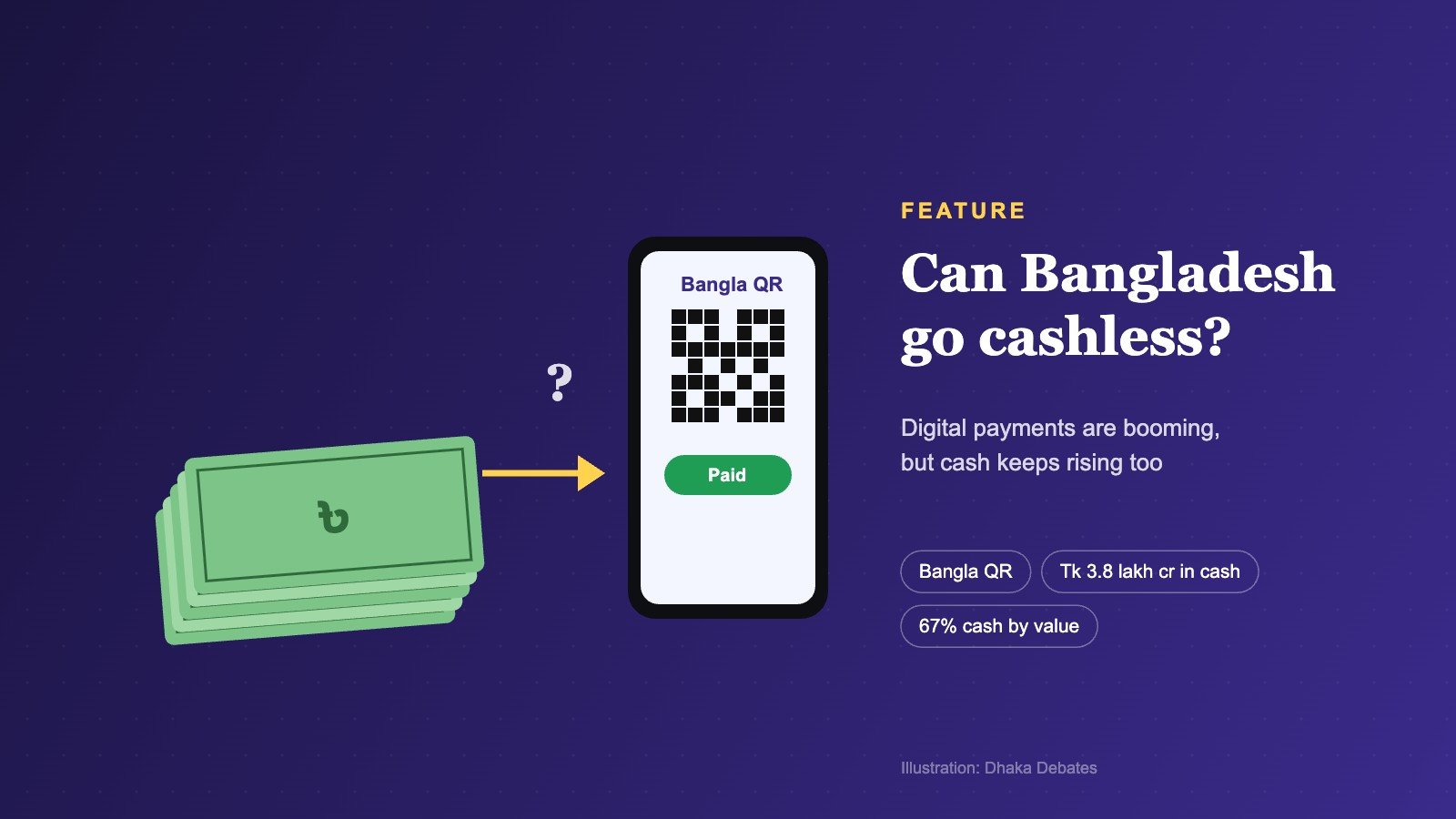
Abdul Malek has sold vegetables at Karwan Bazar for 22 years. Since July, a laminated Bangla QR code has hung from a nail above his tomatoes. The central bank says every shop must have one. Abdul says about one customer in ten uses it, mostly young office workers buying a few hundred taka of vegetables on their way home.
Everyone else pays in notes. So does Abdul. He pays the wholesaler in cash at four in the morning, pays his helper in cash, pays the man who brings the vegetables from Jashore in cash, and keeps the day’s takings in a cloth bag tied to his waist. “If the wholesaler took QR, I would use it more,” he says. “But he wants cash, so I need cash.”
Abdul’s day captures Bangladesh’s cashless question perfectly. The digital pipes are being laid fast: mobile wallets, instant transfers, a national QR code. But most money still moves the old way, from hand to hand. So can Bangladesh really become a cashless economy? And should it?
The short answer: Not fully, and not soon, but it can become far less cash-dependent. Bangladesh has built strong digital rails: mobile wallets move thousands of crores of taka a day, Bangla QR became mandatory at every merchant point in July 2026, and an instant payment system linking all banks and wallets is due by July 2027. Yet cash made up 67.2% of the value of transactions in 2025, according to Bangladesh Bank’s annual report as cited by The Business Standard, and cash held outside banks hit a record of about Tk 3.8 lakh crore in July 2026. The reasons are a huge informal economy, high cash-out and merchant fees, weak trust in banks after recent crises, gaps in digital skills and tax avoidance. A realistic goal is “less cash”, where most everyday and business payments are digital and cash remains a choice, not a necessity.
What does “cashless” actually mean?
No large country is completely cashless. Even Sweden and China, often held up as examples, still print and use cash. When governments talk about a “cashless society”, they usually mean one where:
- most everyday payments, from groceries to rickshaw fares, can be made digitally and usually are
- wages, government payments and business-to-business payments move digitally
- people keep their money in accounts rather than at home
- cash is still available for those who need or prefer it
By that measure, Bangladesh is still near the beginning, even though its mobile money use is among the highest in the developing world.
How much do Bangladeshis still use cash?
A lot. Here are the key numbers:
| Measure | Figure | Source |
|---|---|---|
| Cash share of total transaction value, 2025 | 67.2% (digital 32.8%) | Bangladesh Bank annual report, via The Business Standard |
| Cash share of formal retail transactions, FY25 | 35% | The Daily Star |
| Cash outside banks, July 2026 | About Tk 3.8 lakh crore (a record) | Bangladesh Bank officials, via Bonik Barta |
| Cash outside banks, June 2021 | Tk 2.09 lakh crore | Bonik Barta |
| Banknote printing cost, FY2025-26 | Tk 458.9 crore, up 95% in a year | Bangladesh Bank, via The Daily Ittefaq |
The most striking figure is cash held outside banks, sometimes called “mattress money”. It rose from Tk 2.09 lakh crore in June 2021 to about Tk 3.8 lakh crore in July 2026, according to figures reported by Bonik Barta. That is an increase of more than 80% in five years (our calculation), during the same period that digital payments boomed.
How fast is digital payment growing?
Very fast. Bangladesh’s digital payments story is one of the biggest in the developing world:
- Mobile wallets: MFS transactions averaged Tk 5,883 crore a day in 2025, The Daily Star reported. In April 2026, they reached Tk 2,01,337 crore in a single month.
- Internet banking: monthly value rose 244% between July 2023 and April 2026, a Daily Star analysis of central bank data found.
- Bangla QR: 9.63 lakh merchants were onboarded by the end of 2025, and a single QR code became mandatory at all merchant points on 1 July 2026. Person-to-person QR payments were planned from 1 November 2026.
- Instant payments: the Interoperable Instant Payment System (IIPS), launched in November 2025, aims to connect every bank, wallet and financial institution by July 2027.
We covered these systems in detail in our story on whether Bangladesh can become South Asia’s next fintech hub and in our guide to Bangla QR payments.
If digital payments are booming, why is cash also rising?
This is the central puzzle. Both digital payments and cash in circulation are rising at the same time. There are several explanations.
Much “digital” money ends up as cash
A large share of mobile wallet activity is cash going in and cash coming out. A garment worker’s family receives money by bKash, then withdraws it at an agent. Both steps count as MFS transactions, but the money ends up as cash. “A payment recorded by a digital system is not necessarily a purchase made without cash,” SM Mohidul Islam, a data science researcher, wrote in The Daily Star in October 2026. Big digital totals do not prove that shopping has moved away from cash.
Inflation
When prices rise, people need more notes to buy the same things. Inflation was 8.34% in September 2026, according to official figures reported by bdnews24.com. “The main reason cash in circulation has risen so much is inflation,” City Bank’s chief executive Mashrur Arefin told Bonik Barta.
Falling trust in banks
The banking sector’s troubles have pushed some depositors to keep cash at home. Bonik Barta reported that a governance crisis at Islami Bank triggered panic withdrawals of nearly Tk 25,000 crore, and that the panic spread to other lenders. When people fear for their deposits, they hold cash. “The central question is whether the public is retreating from commercial banks,” a central bank spokesperson told the paper.
The informal and shadow economy
Nearly 85% of employed people work in the informal sector, The Daily Star has reported. Much of that work is paid in cash. And some cash is held deliberately to avoid scrutiny. “Modernising the payment system should have contracted the informal economy,” CPD’s executive director Fahmida Khatun told Bonik Barta, linking high cash holdings to bribery, corruption and undeclared income.
Zahid Hussain, former lead economist at the World Bank’s Dhaka office, made a similar point to The Business Standard: “Large businesses in transport, agriculture and wholesale-retail trade continue to operate outside banking channels.” Abdul’s wholesaler is one small example.
What stops ordinary people from going cashless?
Fees
Cash has no transaction fee. Digital money often does. Taking money out of a mobile wallet costs between Tk 12.99 and Tk 18.50 per Tk 1,000, The Daily Star reported, so cashing out Tk 10,000 can cost nearly Tk 200. Merchants pay at least 1% on Bangla QR payments, including VAT. For a vegetable seller working on thin margins, giving up 1% of sales is a real cost.
The chain problem
Digital payments only work well when everyone in the chain uses them. If Abdul’s customers pay him by QR but his wholesaler and helper want cash, he must withdraw the money, paying a fee, or keep two systems. Until suppliers, wholesalers, transport operators and landlords also accept digital money, small sellers will keep needing cash.
Skills, phones and networks
Bangladesh had 135.94 million internet subscriptions in June 2026, according to the telecom regulator, but subscriptions are not the same as people, and many users rely on basic phones or patchy networks. Older people, rural women and people with limited reading skills often find apps confusing. “Digital payment systems must become easier, more accessible and more convenient,” Mutual Trust Bank’s chief executive Syed Mahbubur Rahman told The Business Standard.
Fear of fraud and failed payments
Many people have heard stories of PINs being stolen by fake calls, or of money “stuck” in a failed transfer. NRBC Bank’s chief executive Md Touhidul Alam Khan warned in The Business Standard that fraud, failed transactions and complicated interfaces could erode trust and push users back to cash. One bad experience can send someone back to notes for years.
Privacy and control
Cash is private. Some people worry that digital records could be used to track their spending or by tax authorities. Others remember that in February 2026, before the national election, Bangladesh Bank temporarily limited mobile wallet transfers and suspended some internet banking transfers to prevent vote buying, The Daily Star reported. The measure had a clear purpose, but it reminded people that digital money can be restricted in ways cash cannot.
What would less cash mean for Bangladesh?
The benefits are real:
- More tax revenue: digital transactions leave a record, making it harder to hide income. Bangladesh has one of the lowest tax-to-GDP ratios in the region.
- Less corruption: government payments sent directly to accounts reduce the chance of money being skimmed by middlemen.
- Lower costs: printing, transporting, guarding and counting cash is expensive. Bangladesh Bank spent Tk 458.9 crore on printing banknotes alone in 2025-26, up 95% in a year, The Daily Ittefaq reported, mainly because of higher paper and ink prices. Banks and businesses spend much more on handling cash.
- Safety: shopkeepers and workers carrying less cash are less at risk of theft and robbery.
- Access to credit: digital sales records help small businesses prove their income and get loans. We explained why this matters in our feature on why small businesses struggle to access finance.
- Growth: a 2022 study for the Better Than Cash Alliance estimated that digitising payments could add 1.7% to Bangladesh’s GDP, about $6.2 billion a year, largely by digitising micro-merchant payments and agricultural credit.
What are the risks of going cashless too fast?
A rush to remove cash could hurt the people least able to cope:
- Exclusion: older, poorer and rural people without smartphones or digital skills could be shut out of everyday life.
- System failures: network outages, power cuts or cyber attacks can stop all payments at once. Cash keeps working when the network does not.
- Fees falling on the poor: if digital payments come with charges and cash disappears, those charges become unavoidable.
- Privacy and control: a fully digital system gives governments and companies far more data about people’s lives.
NRBC Bank’s Touhidul Alam Khan called for an inclusive transition that expands consumer choice rather than eliminating cash. That is a sensible principle.
What have other countries done?
Bangladesh’s neighbours offer useful lessons:
| Country | What they did | Result |
|---|---|---|
| India | Built UPI, a free, instant payment system open to every bank and app, and made it easy to pay by scanning a QR code | 2,366 crore UPI transactions in July 2026 alone (YourStory) |
| Pakistan | Launched the Raast instant payment system in 2021 and pushed banks and wallets onto it | 92% of 3.4 billion retail payments were digital in October to December 2025 (Dawn) |
| Bangladesh | Mobile money first, then Bangla QR (mandatory from July 2026) and IIPS (due by July 2027) | Huge wallet use, but cash still 67.2% of transaction value in 2025 |
The common lesson from India and Pakistan is that a free or nearly free national instant payment system, open to every bank and app, does more to shift people away from cash than any rule forcing shops to accept digital payments. People switch when digital is cheaper and easier than cash, not because they are told to.
Has Bangladesh met its own targets?
Not yet. In April 2023, Bangladesh Bank set a goal for at least 75% of retail transactions to be settled digitally by 2027, The Daily Star reported. More recently, the central bank has spoken of reaching 80% digital transactions within a decade. With cash still at 35% of formal retail transactions in FY25 and much higher in informal trade, the 2027 goal looks out of reach. But the direction is right, and the tools now being built, especially IIPS and person-to-person QR, could speed things up.
What would a realistic path look like?
Based on the evidence and the experience of other countries, these are the steps that would make the biggest difference. This is our analysis.
- Make small digital payments free. Person-to-person and small merchant payments should cost nothing for users, as with UPI. Fees can apply to large business payments.
- Cut the cost of staying digital. Lower cash-out fees over time and keep merchant fees for small shops close to zero.
- Digitise the whole chain. Target wholesalers, transport operators and suppliers, not just the final shop, so traders like Abdul can pay their suppliers digitally.
- Pay everything public digitally. All salaries, pensions, allowances, subsidies and tax payments should move through accounts.
- Rebuild trust in banks. Resolve weak banks quickly and protect depositors, so people stop holding cash out of fear.
- Fight fraud visibly. Fast complaint handling, quick refunds for failed transactions and public campaigns against scams.
- Keep cash available. Make clear that cash will remain legal and accepted, so the shift is a choice, not a threat.
- Measure honestly. Publish data that separates real digital purchases from cash moving in and out of wallets, as researchers have urged.
What can you do?
You do not need to wait for the system to change. Paying by QR, card or wallet where you can, asking shops and service providers whether they accept digital payment, and keeping savings in a bank rather than at home all help, both you and the wider economy. If you are just starting with digital banking, our guides on choosing your first bank account and BEFTN vs NPSB transfers are good places to begin.
Frequently asked questions
Is Bangladesh becoming cashless?
Digital payments are growing fast, but cash still accounted for 67.2% of transaction value in 2025, and cash held outside banks reached a record of about Tk 3.8 lakh crore in July 2026.
Is Bangla QR mandatory?
Yes. A single Bangla QR code became mandatory at all merchant points on 1 July 2026.
Why is cash in circulation rising?
Bankers and economists point to inflation, falling trust in some banks, the large informal economy and money held to avoid taxes or scrutiny.
Will cash be abolished in Bangladesh?
There is no plan to abolish cash. The aim is to make digital payments the normal choice while keeping cash available.
Key words explained
| Term | What it means |
|---|---|
| Cashless economy | An economy where most payments are made digitally, though cash may still exist. |
| Cash outside banks | Banknotes and coins held by people and businesses rather than deposited in banks. |
| Bangla QR | The national QR code standard that works with any bank or wallet. |
| IIPS | Interoperable Instant Payment System: Bangladesh Bank’s platform for instant transfers between any bank or wallet. |
| Merchant discount rate | The fee a shop pays on each digital payment it receives. |
| Informal economy | Work and business outside official registration, tax and regulation. |
| UPI and Raast | India’s and Pakistan’s national instant payment systems. |
How we reported this
We drew on Bangladesh Bank data and statements reported by The Business Standard, Bonik Barta, The Daily Star, The Daily Ittefaq and bdnews24.com, regional figures from YourStory and Dawn, and a Better Than Cash Alliance study. Different measures of cash use cover different things, such as total transaction value versus formal retail payments, and we say which is which. Figures marked “our calculation” are our own arithmetic. The path forward is Dhaka Debates’ analysis.
Editor’s note: Abdul Malek is an illustrative character created for this story. His experience reflects what small traders commonly describe, but he is not a real person.
Sources
- The Business Standard: What is holding Bangladesh back from becoming a cashless society? · tbsnews.net
- Bonik Barta: Cash outside Bangladesh’s banks hits record despite digital payments · en.bonikbarta.com
- The Daily Ittefaq: Banknote printing costs nearly double · en.ittefaq.com.bd
- The Daily Star: BB sets goal for 75% retail transactions digitally by 2027 · thedailystar.net
- The Daily Star: What Bangladesh’s payment surge does and does not tell us · thedailystar.net
- The Daily Star: Why is bKash dominating Bangladesh? · thedailystar.net
- The Daily Star: One QR, every wallet · thedailystar.net
- The Daily Star: NPSB transfers to remain suspended for 96 hours · thedailystar.net
- bdnews24.com: Inflation in September · bdnews24.com
- Better Than Cash Alliance: Digitizing payments can add US$6.2 billion to Bangladesh’s annual GDP · betterthancash.org
- YourStory: UPI completes 10 years · yourstory.com
- Dawn: Digital channels account for 92pc of retail payments · dawn.com
Keep reading
Why India Is Leading the Digital Payments Revolution
How Blockchain Could Change Financial Services
What Is Banking as a Service?