What Is Embedded Finance? Explained With Real Examples
Embedded finance puts loans, payments, savings and insurance inside apps that are not banks, like a loan button in bKash or credit inside a shopkeeper's ordering app. Here is how it works, with real examples from Bangladesh and abroad, and what to watch out for.

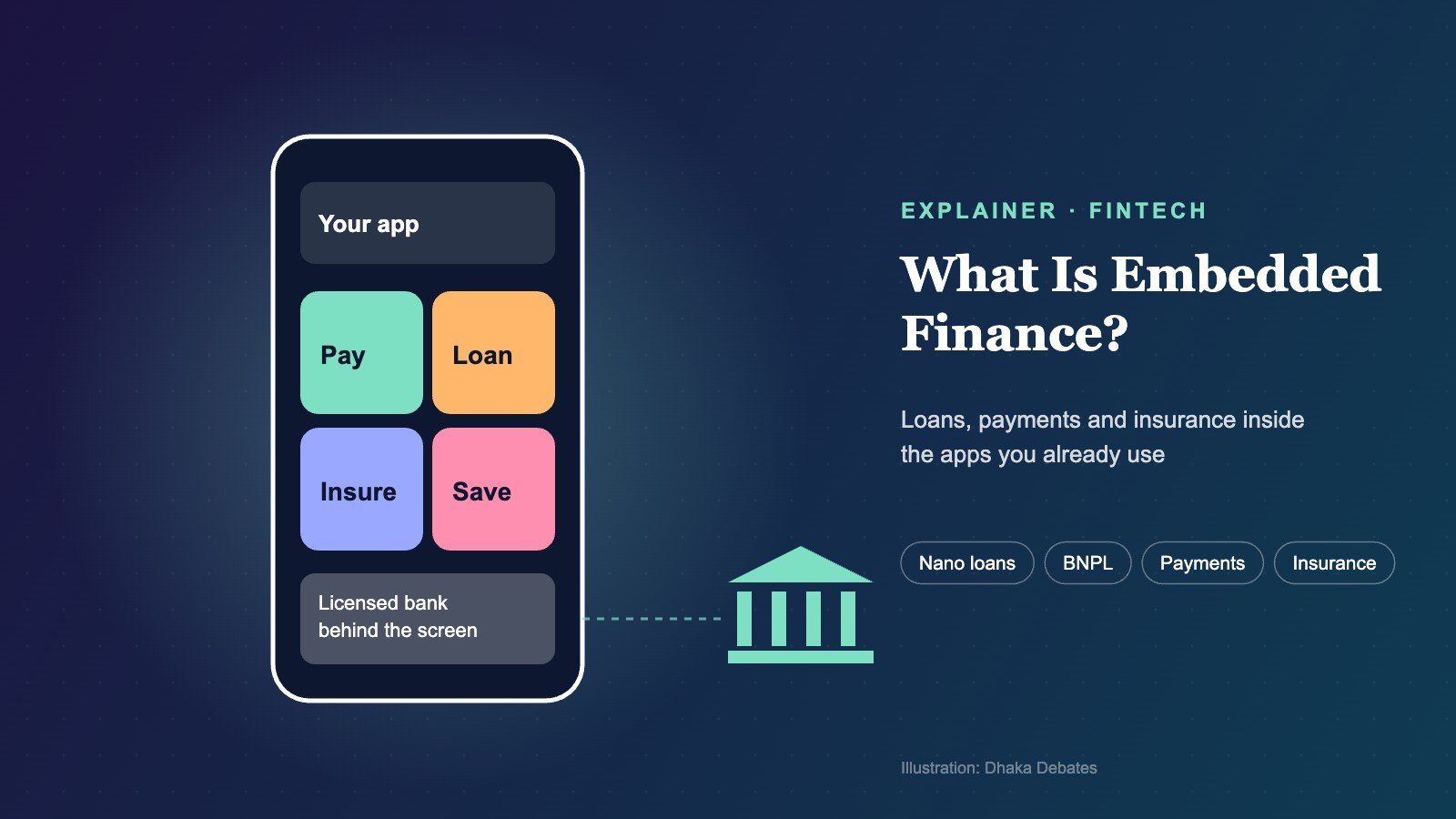
Think about the last time you bought travel insurance. Did you go to an insurance office? Probably not. More likely a box popped up while you were booking a bus or flight ticket: “Add trip protection for Tk 50?” You ticked it and moved on. That small box is embedded finance. A company that sells tickets sold you insurance, and an insurer you may never have heard of stood behind it.
The same idea now runs through ride-hailing apps, online shops, wholesale ordering apps for small shopkeepers and, most of all in Bangladesh, mobile wallets. This explainer covers what embedded finance is, how it works behind the screen, the main types, real examples, who earns money from it, and the risks you should know about.
The short answer: Embedded finance means financial services, such as payments, loans, savings or insurance, offered inside an app or website whose main business is not finance. You do not go to a bank. The bank comes to the app you already use. The clearest Bangladeshi example is the Digital Nano Loan inside the bKash app: the loan is made by City Bank, but you apply, receive and repay it inside bKash. By July 2026 that partnership had lent Tk 10,000 crore through 3.19 crore loans to 35 lakh people. Abroad, Shopify lends to online sellers and takes repayment from their daily sales. Embedded finance can make credit and insurance far easier to reach. It can also make borrowing too easy, so read the terms.
What does embedded finance mean in simple words?
“Embedded” means built in. Embedded finance is finance built into something else. A shop, an app or a software platform adds a financial product to the service it already offers, at the exact moment the customer needs it.
Three things usually mark it out:
- The customer stays in one place. You never leave the app to fill in a bank form.
- It appears at the moment of need. A loan offer appears when you are short of money, an instalment option appears at checkout, insurance appears when you buy a ticket.
- A licensed partner does the regulated part. In most countries only banks, finance companies or insurers can lend money or sell insurance. The app provides the customer and the screen; the licensed partner provides the money and carries the legal responsibility.
How is embedded finance different from Banking as a Service?
The two terms are close cousins and are often used together. A simple way to separate them is to ask whose side you are looking from.
- Banking as a Service (BaaS) is the bank’s side. A licensed bank opens up its systems and licence so other companies can build on them.
- Embedded finance is the customer’s side. It is what you see: a loan, payment or insurance option sitting inside a non-financial app.
Put simply, BaaS is the kitchen and embedded finance is the meal served in someone else’s restaurant. We explained the kitchen side in detail in our explainer What Is Banking as a Service?
| Term | What it describes | Example |
|---|---|---|
| Embedded finance | A financial product offered inside a non-financial app or website | A loan button inside the bKash app |
| Banking as a Service | A bank renting out its licence and systems to other companies | City Bank funding and booking the loans that bKash users take |
| Open banking | Rules that let you share your bank data with other apps through standard connections | Not yet in place in Bangladesh |
| Fintech | Any company using technology to deliver financial services | bKash, Nagad, Pathao Pay, ShopUp |
How does embedded finance work behind the screen?
Let us follow a single Digital Nano Loan inside bKash, since millions of Bangladeshis have used one.
- The app knows you. bKash has years of data on how you send, receive and spend money: how regularly money comes in, whether you pay bills on time, how much you keep in your wallet.
- A credit score is built from that data. City Bank, the lender, uses this transaction history, with your consent, to decide whether to offer you a loan and how much. The Business Standard reported that City Bank runs an AI-powered scoring engine on bKash transaction data.
- An offer appears in the app. Eligible users see a loan option. More than 1.2 crore bKash customers were eligible by July 2026, according to Prothom Alo.
- The money moves. If you accept, City Bank sends the money to your bKash wallet in seconds. No branch visit, no paper, no guarantor.
- Repayment happens in the app. You repay through bKash in instalments. The bank books the loan; bKash handles the customer experience.
The connection between the two companies runs through APIs (application programming interfaces), secure software links that let bKash’s system ask City Bank’s system to approve a loan or send money. That technical link is what makes the whole experience feel like one app.
What are the main types of embedded finance?
Research firms usually group embedded finance into four types. Allied Market Research, for example, uses these four categories in its 2026 market report.
1. Embedded payments
The most common type. You pay inside the app without being sent to a separate bank page: a ride fare charged automatically, a food order paid with a saved wallet, a QR payment inside a shopping app. Most people do not even notice it as “finance” any more. Our guide on how payment gateways work in Bangladesh explains the plumbing.
2. Embedded lending
Loans offered inside a non-bank app. This includes small personal loans in wallets, working capital loans for sellers on e-commerce platforms, stock-on-credit for shopkeepers, and buy now, pay later (BNPL) at checkout. It is the fastest-growing and most debated type, because it combines easy access with real debt. Our guide to buy now, pay later in Bangladesh covers the checkout version.
3. Embedded insurance
Insurance sold at the point of purchase: travel cover with a ticket, device protection with a phone, accident cover for ride-hailing drivers, health cover inside an app. Premiums are usually small, and the policy is designed for a single situation.
4. Embedded savings and investment
Savings schemes, deposits or investment products offered inside non-bank apps. In Bangladesh, wallet users can open small savings schemes with partner banks and financial institutions directly from their MFS app. Abroad, some shopping and payment apps let users put spare change into investment funds.
| Type | What you see | Who usually stands behind it |
|---|---|---|
| Payments | “Pay” button inside an app | Banks, card networks, payment gateways, MFS providers |
| Lending | “Get a loan” or “Pay in instalments” | Banks or finance companies |
| Insurance | “Add protection for Tk X” | Licensed insurance companies |
| Savings and investment | “Start saving” or “Invest” | Banks, finance companies, fund managers |
What are real examples of embedded finance in Bangladesh?
bKash and City Bank: Digital Nano Loan
This is Bangladesh’s biggest and best-documented embedded lending product. City Bank and bKash launched it commercially in December 2021. By July 2026, Prothom Alo reported, cumulative lending had crossed Tk 10,000 crore across 3.19 crore loans to 35 lakh customers, and around Tk 900 crore was being lent every month. The average loan was about Tk 3,000, and the average borrower had taken more than nine loans. Only about 0.5% of the money lent, around Tk 53 crore, had gone bad or been written off.
Our calculation: Tk 10,000 crore divided by 3.19 crore loans gives an average of a little over Tk 3,100 per loan, which matches the reported figure. These are tiny, short loans, the kind a rickshaw puller or small trader might need to cover a gap until the next payment comes in. Before this product, such people had almost no choice except relatives, informal moneylenders or a microfinance group.
One detail matters for borrowers: The Business Standard reported in 2025 that City Bank had first used a Bangladesh Bank refinancing scheme that capped the interest rate at 9%, but later moved to funding the loans from its own money, which gives it more freedom on pricing. Always check the full cost of a loan in the app before you accept.
ShopUp: credit for neighbourhood shops
ShopUp runs Mokam, a wholesale ordering app for small neighbourhood shops. In April 2020 it launched Baki (the Bangla word shopkeepers use for goods taken on credit), which lets shop owners buy stock on credit directly inside the ordering app, according to a history of the company published by Future Startup. The shopkeeper does not apply to a bank. The credit appears where they already order their rice, oil and soap.
In 2025 ShopUp merged with Sary, a Saudi business-to-business platform, to form SILQ Group, with US$110 million in new funding. The combined group says it has disbursed more than US$750 million in embedded financing across its markets. This is a good example of embedded finance for businesses, not just consumers: the app that supplies the goods also finances them.
Pathao Pay Card
Pathao, best known for ride-hailing and food delivery, offers a prepaid Mastercard linked to its Pathao Pay wallet. The card is issued with Mutual Trust Bank. Pathao owns the customer and the app; the bank issues the card. We cover the details in our Pathao Pay review.
EMI at online checkout
When an online shop or electronics retailer offers “0% EMI for 6 months” on a bank’s credit card at checkout, that is a simple form of embedded lending. The shop does not lend; the card-issuing bank turns your purchase into instalments, often with the shop paying part of the cost to attract you.
Savings inside wallets
MFS apps in Bangladesh, including bKash, let users open small monthly savings schemes with partner banks and finance companies from inside the app. The wallet collects the deposit each month; the partner institution holds the savings and pays the return. For more on comparing savings options, see our guide to FDR, DPS, Sanchayapatra and gold.
What are real examples from other countries?
Shopify Capital: loans repaid from daily sales
Shopify, the Canadian company whose software runs millions of online shops, lends money to the merchants that use it. Because Shopify already sees each shop’s sales, it can decide how much to offer without a long application. Merchants repay through a cut of their daily sales, so they pay more on good days and less on slow ones. In March 2026, The Logic reported that Shopify Capital had about US$1.78 billion outstanding, up from just over US$9 million in its first full quarter in 2016, and that it earned US$258 million in lending interest and fees in its last financial year. It also wrote off US$103 million in loans and US$28 million in merchant cash advances that year, a reminder that even data-rich lenders take losses.
Buy now, pay later at checkout
Companies such as Klarna and Afterpay sit inside the checkout pages of online shops in Europe, the United States and Australia, splitting a purchase into a few payments. The shop pays the BNPL company a fee because customers who can pay in instalments tend to buy more. Not every attempt works: Apple launched its own Apple Pay Later in the United States in 2023 and shut it down in 2024, choosing instead to offer instalment loans from outside lenders inside Apple Pay.
Super apps in Southeast Asia
In Indonesia, Malaysia and Singapore, ride-hailing and delivery “super apps” such as Grab and Gojek grew from transport into wallets, then into loans for drivers and small merchants, insurance and investment. Their logic is the same as bKash’s: they see how much a driver earns every day, so they can lend against that income.
UPI credit in India
In India, credit lines from banks can now be linked to the UPI payment network, so a shopper can pay a small shop’s QR code using a pre-approved loan. We covered this in our feature on why India is leading the digital payments revolution.
| Example | Country | Type | Main business of the app | Licensed partner |
|---|---|---|---|---|
| Digital Nano Loan | Bangladesh | Lending | Mobile wallet (bKash) | City Bank |
| Baki on Mokam | Bangladesh | Business lending | Wholesale ordering (ShopUp) | Financial partners of ShopUp |
| Pathao Pay Card | Bangladesh | Payments | Ride-hailing and delivery (Pathao) | Mutual Trust Bank |
| Shopify Capital | Global | Business lending | E-commerce software | Shopify and partner lenders |
| Klarna, Afterpay | Europe, US, Australia | BNPL | Checkout tools for shops | The BNPL firms’ own licences |
| Grab, Gojek | Southeast Asia | Payments, lending, insurance | Ride-hailing and delivery | Own licences and partner banks |
How big is embedded finance?
Estimates vary a lot, because researchers define the market differently. Allied Market Research, in a report released in April 2026, valued the global embedded finance market at US$82.7 billion in 2023 and projected it to reach US$570.9 billion by 2033, growing about 21% a year. That figure measures the revenue earned from embedded financial products, not the total money flowing through them, which is far larger. Treat such forecasts as a sign of direction rather than exact predictions.
In Bangladesh, no official figure exists for embedded finance as a whole. The bKash–City Bank numbers are the best single indicator, and they show rapid growth: The Daily Star reported Tk 700 crore disbursed in early 2024, The Business Standard reported Tk 2,300 crore by April 2025, and Prothom Alo reported Tk 10,000 crore by July 2026.
Why do companies want to offer financial services?
- Extra income. A share of interest, fees or insurance premiums. Shopify’s lending income is a good example.
- More sales. Instalments and credit help customers buy more, or buy now instead of later.
- Loyalty. A shopkeeper who gets stock on credit through an ordering app is less likely to switch to a rival app.
- Data advantage. The platform already sees sales or transactions, so it can judge risk better than a bank meeting the customer for the first time.
Banks and insurers gain too. They reach customers they could never serve profitably through branches, and the platform does the marketing. This is especially important in Bangladesh, where many small businesses cannot borrow because banks cannot see their income, as we described in our feature on why small businesses struggle to access finance.
What are the benefits for ordinary people?
- Access. People with no bank relationship, no collateral and no salary slip can get small loans based on their wallet history.
- Speed. Money arrives in seconds, which matters in an emergency.
- Convenience. No branch visits, forms or queues.
- Building a record. Repaying small loans on time can open the door to larger ones later.
- Right-sized products. Insurance for a single trip or a small savings scheme can fit a tight budget better than a traditional policy or account.
What are the risks?
Borrowing becomes too easy
When a loan is one tap away, it is easy to take one you do not really need, or to roll from one loan to the next. The average bKash nano loan borrower has taken more than nine loans. For many that is healthy, regular use. For some it may be a cycle of debt. Treat an in-app loan exactly as seriously as a bank loan.
The real cost is hidden
Fees, service charges and late penalties can make a small, short loan expensive when you work out the yearly rate. “0% EMI” offers sometimes carry processing fees. Always look at the total amount you will repay, not just the instalment.
Who is responsible?
When something goes wrong, customers may not know whether to complain to the app, the bank or the insurer. A claim may be rejected by an insurer the customer never chose knowingly. Good providers name the licensed partner clearly; check for it.
Your data
Embedded finance runs on data about your spending and income. That data is shared between companies. You should know what you are agreeing to share and with whom.
Rules have not caught up
Bangladesh does not yet have a dedicated framework for fintech lending or open banking. The Business Standard noted that bKash initially rolled out nano loans on a small scale because the rules were unclear, and that the World Bank has recommended a framework allowing MFS providers to lend directly. Until clearer rules arrive, every product must fit existing banking, MFS and insurance regulations, which slows innovation and leaves some consumer protection questions open.
How should you use an embedded finance product safely?
- Find the licensed partner. Check which bank, finance company or insurer stands behind the product.
- Read the total cost. Note the amount you will repay in total and the late fee.
- Borrow for a reason. Use small loans to cover a real gap or earn money, not for impulse buying.
- Repay on time. Late payment can block future credit and may be reported to credit records.
- Keep screenshots. Save the offer, the terms and your repayment receipts.
- Know where to complain. Start with the app’s support, then the licensed partner. Bangladesh Bank also runs a customer complaint hotline for banking issues.
What could come next in Bangladesh?
Three changes could make embedded finance much bigger here. First, open banking rules and standard APIs would let apps connect to many banks instead of building one partnership at a time. Second, the new digital banks approved in 2026 could act as partner banks for fintechs. Third, clear rules for digital lending would give both companies and borrowers more certainty. Watch for embedded insurance for delivery riders and ride-hailing drivers, more credit inside wholesale and e-commerce apps, and salary advances offered through payroll software. We look at the wider picture in our feature on the future of digital banking in Bangladesh.
Frequently asked questions
Is embedded finance the same as fintech?
No. Fintech is any company using technology for financial services. Embedded finance is a specific model where non-financial companies offer financial products inside their own apps, usually with a licensed partner.
Who lends the money in a bKash nano loan?
City Bank. bKash provides the app, customer data and repayment channel.
Is buy now, pay later a type of embedded finance?
Yes. BNPL offered at an online checkout is one of the best-known forms of embedded lending.
Is embedded finance safe?
The products are usually provided by regulated banks, finance companies or insurers. The main risks are over-borrowing, unclear costs and data sharing, so read the terms and check the licensed partner.
Can a small business in Bangladesh benefit?
Yes. Shopkeepers already get stock on credit through wholesale apps, and sellers with steady digital sales are more likely to qualify for data-based loans in future.
Key words explained
| Term | What it means |
|---|---|
| Embedded finance | Financial services built into a non-financial app or website |
| Embedded lending | Loans offered inside such an app, including BNPL |
| BaaS | Banking as a Service: a bank letting others build products on its licence and systems |
| API | A secure software link that lets two companies’ systems work together |
| Nano loan | A very small, short-term digital loan, often a few thousand taka |
| BNPL | Buy now, pay later: splitting a purchase into instalments at checkout |
| EMI | Equated monthly instalment: fixed monthly payments on a purchase or loan |
| Credit scoring | Using data to estimate how likely a borrower is to repay |
| Licensed partner | The bank, finance company or insurer that legally provides the product |
How we reported this
We used reporting from Prothom Alo, The Business Standard and The Daily Star on the City Bank–bKash Digital Nano Loan, Future Startup’s history of ShopUp and the SILQ merger, The Logic’s March 2026 reporting on Shopify Capital, and Allied Market Research’s April 2026 embedded finance market release. Descriptions of how embedded finance works are our explanation of standard industry practice. The average loan calculation is our own, marked “our calculation.” We did not receive payment from any company named here.
Sources
- City Bank–bKash Digital Nano Loan disbursement surpasses Tk 100 billion (Prothom Alo) · en.prothomalo.com
- How mobile wallets are driving the rise of digital nano loans (The Business Standard) · tbsnews.net
- City Bank disburses Tk 700 crore in digital loans thru bKash (The Daily Star) · d11.thedailystar.net
- A brief history of ShopUp (Future Startup) · futurestartup.com
- Shopify Capital merchant loans (The Logic) · thelogic.co
- Embedded Finance Market to Reach $570.9 billion by 2033 (Allied Market Research via PR Newswire) · tools.prnewswire.com
Keep reading
What Is Bangla QR? Who Owns It, How Does It Work, and Who Runs the System?
How Artificial Intelligence Is Changing Banking
What Bangladesh Can Learn From Singapore’s Banking System