How to Invest in Mutual Funds in Bangladesh
A plain-English guide to mutual funds in Bangladesh: open-end vs closed-end funds, how to buy, minimums, SIPs, fees, tax, risks, and the new BSEC rules on discounted funds.

Short answer: To invest in a mutual fund in Bangladesh, open a BO (beneficiary owner) account with a broker, choose a licensed asset management company (AMC) and an open-end fund that fits your goal, fill in its purchase form with your NID, nominee details and bank information, and pay by cheque or bank transfer. Units are bought at the fund’s net asset value (NAV) and credited to your BO account. Many funds let you start from about Tk 5,000, or with a monthly plan (SIP) from a few thousand taka. You can also buy closed-end funds on the Dhaka or Chittagong stock exchange through your broker, but many have traded far below their asset value.
Tk 3,000 a month, and a lot of questions
Mitu, 28, works as a merchandiser in a buying house in Uttara. She saves about Tk 3,000 a month in a DPS. A colleague tells her she should try a mutual fund instead. “I don’t know how to pick shares, and I don’t have time to watch the market,” she says. “Is a mutual fund safe? Where do I even buy one?”
What is a mutual fund?
A mutual fund pools money from many investors and puts it into shares, bonds, treasury securities or bank deposits. A licensed asset manager makes the investment decisions, a trustee watches over the manager on behalf of investors, and a custodian holds the assets. You own units of the fund, and the value of each unit, the NAV, rises or falls with the fund’s investments.
In Bangladesh, mutual funds are regulated by the Bangladesh Securities and Exchange Commission (BSEC) under the Mutual Fund Rules, 2025. Of 140 BSEC-approved mutual funds, 104 are open-end funds, The Business Standard reported in May 2026. You can check whether an asset manager is licensed on BSEC’s website, sec.gov.bd.
Open-end or closed-end: which should you choose?
| Open-end fund | Closed-end fund | |
|---|---|---|
| Where you buy | Directly from the asset manager or its selling agents | On DSE or CSE, through your broker |
| Price | At NAV (plus or minus small loads) | Market price, often far below NAV |
| Selling | Surrender units to the asset manager | Sell to another investor on the exchange |
| Fund size | Grows and shrinks with investors | Fixed number of units |
| Monthly plan (SIP) | Usually available | Not available |
| Best for | Most new investors | Experienced investors who understand discounts |
The problem with closed-end funds
Many closed-end funds have traded for years at deep discounts to their NAV, so investors could not get the true value of their units. BSEC’s new rules now require any closed-end fund trading more than 24% below its NAV, on a six-month rolling average, to either convert into an open-end fund or be wound up. Conversion needs the approval of three-fourths of units at a special meeting, and trading is suspended from the record date. In June 2026, BSEC told trustees to comply immediately, The Financial Express reported. If you hold a closed-end fund, watch for notices about record dates and meetings.
How to invest in an open-end mutual fund, step by step
- Open a BO account with a brokerage house, if you don’t have one. Units are credited to this account. IDLC Securities, for example, charges Tk 450 to open and Tk 450 a year.
- Pick an asset manager and a fund. Decide what you want: growth (mostly shares), income (mostly bonds and deposits), balanced, or Shariah-based.
- Read the prospectus and fact sheet: what the fund invests in, its fees, its exit load and its past returns.
- Fill in the purchase form, online or at the asset manager’s office or selling agent.
- Pay by cheque, pay order or bank transfer (BEFTN) to the fund’s account. Do not pay cash to any individual.
- Get confirmation that units have been credited to your BO account, and keep it.
Buying and selling open-end funds is still largely manual. You apply to the asset manager and transfer the money, and units are credited to your BO account. The Chittagong Stock Exchange built an online platform, but as of February 2026 trading had not started, The Financial Express reported, and the Dhaka Stock Exchange has been building its own system for orders through brokers’ apps.
Documents you usually need
- Your NID or passport copy, and your nominee’s
- Passport-size photos of you and your nominee
- BO account details
- A bank statement or a cheque leaf, for redemption payments
- Your e-TIN certificate, if you have one (it lowers the tax deducted on dividends)
How much do you need to start?
It varies by fund. As one example, IDLC Asset Management sets a minimum of 500 units for individuals, about Tk 5,000 at a unit price near Tk 10, and a minimum monthly SIP of Tk 3,000. Units surrendered within 90 days of purchase from its balanced, growth and Shariah funds carry a 3% exit load, and redemption money is paid within two working days, according to IDLC’s FAQ. Check each fund’s own terms.
What returns have funds made?
Returns differ widely, and past returns do not guarantee future ones. As examples, these funds showed the following three-year annualised returns on a one-time investment, as of 29 October 2026, according to the fund tracker ReturnKoto:
| Fund | Type | 3-year return (per year) |
|---|---|---|
| Ekush Stable Return Fund | Income | 13.74% |
| UCB Income Plus Fund | Income | 13.60% |
| Ekush Growth Fund | Growth | 12.77% |
| EDGE Bangladesh Mutual Fund | Growth | 11.79% |
These are examples only, not recommendations. Many other funds made less, and some lost money.
What a monthly plan could grow to
By our calculation, Tk 3,000 a month for 10 years adds up to Tk 3.6 lakh in deposits. It would grow to about:
| Average yearly return | Value after 10 years |
|---|---|
| 6% | About Tk 4.94 lakh |
| 8% | About Tk 5.52 lakh |
| 10% | About Tk 6.20 lakh |
Before tax and fees, assuming monthly compounding. Real returns go up and down from year to year.
What does it cost?
- Management fees are taken from the fund every year. ReturnKoto lists fees of about 2.5% for many growth and balanced funds.
- Buy and sell prices may differ slightly from the NAV.
- Exit loads apply if you sell soon after buying.
- BO account fees are charged by your broker.
How are mutual funds taxed?
- Dividends: tax is deducted at source. IDLC’s FAQ says the rate is 10% with an e-TIN and 15% without. The June 2026 budget also set a flat, final 15% tax on dividends for individual investors in shares, The Business Standard reported. Ask your fund or tax adviser how this applies to fund dividends.
- Tax rebate: investment in mutual funds can count towards your investment tax rebate, and the same budget removed a Tk 5 lakh ceiling on mutual fund investment that qualified for it.
Mutual fund, FD or savings certificate?
| Option | Return | Risk | Access to money |
|---|---|---|---|
| Bank fixed deposit | Fixed; private banks’ highest 6-month FD rates averaged about 8.5% (BRAC Bank base rate data) | Low; insured up to Tk 2 lakh per bank | Penalty if broken early |
| Savings certificate | Fixed, set by the government | Very low | Lower profit if cashed early; purchase limits |
| Income mutual fund | Varies | Low to moderate | Surrender any time; exit load early on |
| Growth mutual fund | Varies widely | Higher; can lose money | Surrender any time; exit load early on |
Risks to understand before you invest
- No guarantee: mutual funds are not bank deposits and are not covered by deposit insurance.
- Market risk: a growth fund can fall sharply when the stock market falls.
- Manager risk: results depend on the asset manager’s skill and honesty. Check its track record and regulatory news.
- Closed-end discount risk: the market price can stay well below NAV for years.
- Short-term selling costs: exit loads reduce returns if you need the money within months.
Tips for first-time investors
- Keep an emergency fund in the bank first, and clear expensive debts. See our guide on whether early loan repayment is worth it.
- Start with an income or balanced fund if you are nervous about losses.
- Invest monthly through a SIP, so you buy at different prices over time.
- Think in years, not months. Growth funds need at least three to five years.
- Compare funds on returns after fees, over several years, not just last year.
- Never hand cash to an agent who promises fixed or guaranteed returns.
Back to Mitu
Mitu kept her DPS running for emergencies and opened a BO account. She now puts Tk 3,000 a month into an income fund through a SIP. “I check it once every few months,” she says. “If it does well, I may move part of it into a growth fund later.”
This article is general information, not investment advice, and does not recommend any fund. Mutual fund investments carry market risk. Read the prospectus and consult a licensed adviser before investing.
Frequently asked questions
Do I need a BO account to buy a mutual fund?
Yes, in most cases. Units of both open-end and closed-end funds are held in your BO account.
What is the minimum investment?
It depends on the fund. Many open-end funds start at around Tk 5,000, and monthly SIPs from a few thousand taka.
Are mutual funds safe in Bangladesh?
They are regulated by BSEC, with trustees and custodians protecting assets, but returns are not guaranteed and you can lose money. Income funds are usually less risky than growth funds.
How do I sell my mutual fund units?
For open-end funds, submit a surrender form to the asset manager and a transfer form through your broker. For closed-end funds, sell on the stock exchange through your broker.
Are there Shariah-based mutual funds?
Yes. Several asset managers run Shariah funds that invest only in approved companies and instruments.
Key words explained
| Term | What it means |
|---|---|
| NAV | Net asset value: the value of a fund’s assets per unit. |
| Open-end fund | A fund that issues and buys back units directly, at NAV. |
| Closed-end fund | A fund with a fixed number of units, traded on the stock exchange. |
| AMC | Asset management company: the licensed firm that manages a fund. |
| BO account | Beneficiary owner account, where your shares and fund units are held. |
| SIP | Systematic investment plan: investing a fixed amount every month. |
| Exit load | A charge for selling units soon after buying them. |
| Discount to NAV | When a closed-end fund’s market price is below its asset value. |
How we reported this
We used The Business Standard’s reports on open-end fund numbers and the June 2026 budget, The Financial Express’s reports on BSEC’s closed-end fund rules and the trading platform, IDLC Asset Management’s published FAQ, return data from the ReturnKoto fund tracker as of 29 October 2026, and BRAC Bank’s base rate data. The SIP projections are our own calculations. Fund examples are for illustration only.
Editor’s note: Mitu is illustrative, created to show how a first-time investor might approach mutual funds. She is not a real person. The rules and figures come from the published sources listed with this article and our own calculations.
Sources
- The Business Standard: First-ever separate platform for buying, selling open-end mutual funds on the cards · tbsnews.net
- The Financial Express: BSEC orders conversion or liquidation of closed-end funds · today.thefinancialexpress.com.bd
- The Financial Express: CSE platform ready, yet open-ended fund trading remains offline · today.thefinancialexpress.com.bd
- The Business Standard: Dividend tax slashed, listing threshold axed · tbsnews.net
- IDLC Asset Management: Frequently asked questions · idlc.com
- ReturnKoto: Bangladeshi open-end mutual funds, returns and details · returnkoto.com
- BRAC Bank: Base rate for retail loans · bracbank.com
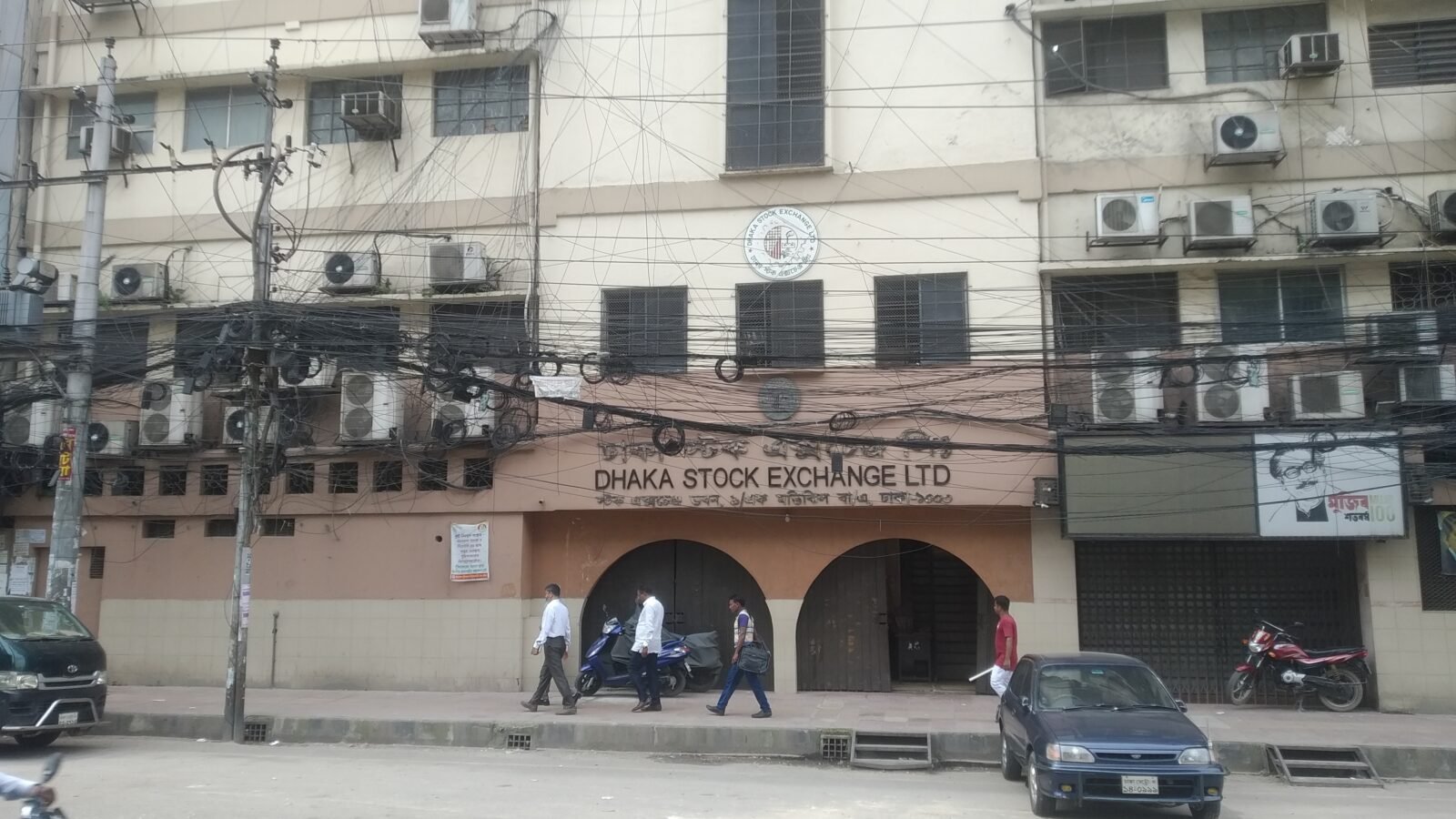
- Wikimedia Commons: Dhaka Stock Exchange (Ifteebd10, CC BY-SA 4.0, featured image) · commons.wikimedia.org