What Is Buy Now, Pay Later and How Does It Work?
Buy now, pay later lets you split a purchase into instalments. How BNPL, card EMI and app-based loans work in Bangladesh, what "0% EMI" really costs, the risks, and how to use it safely.

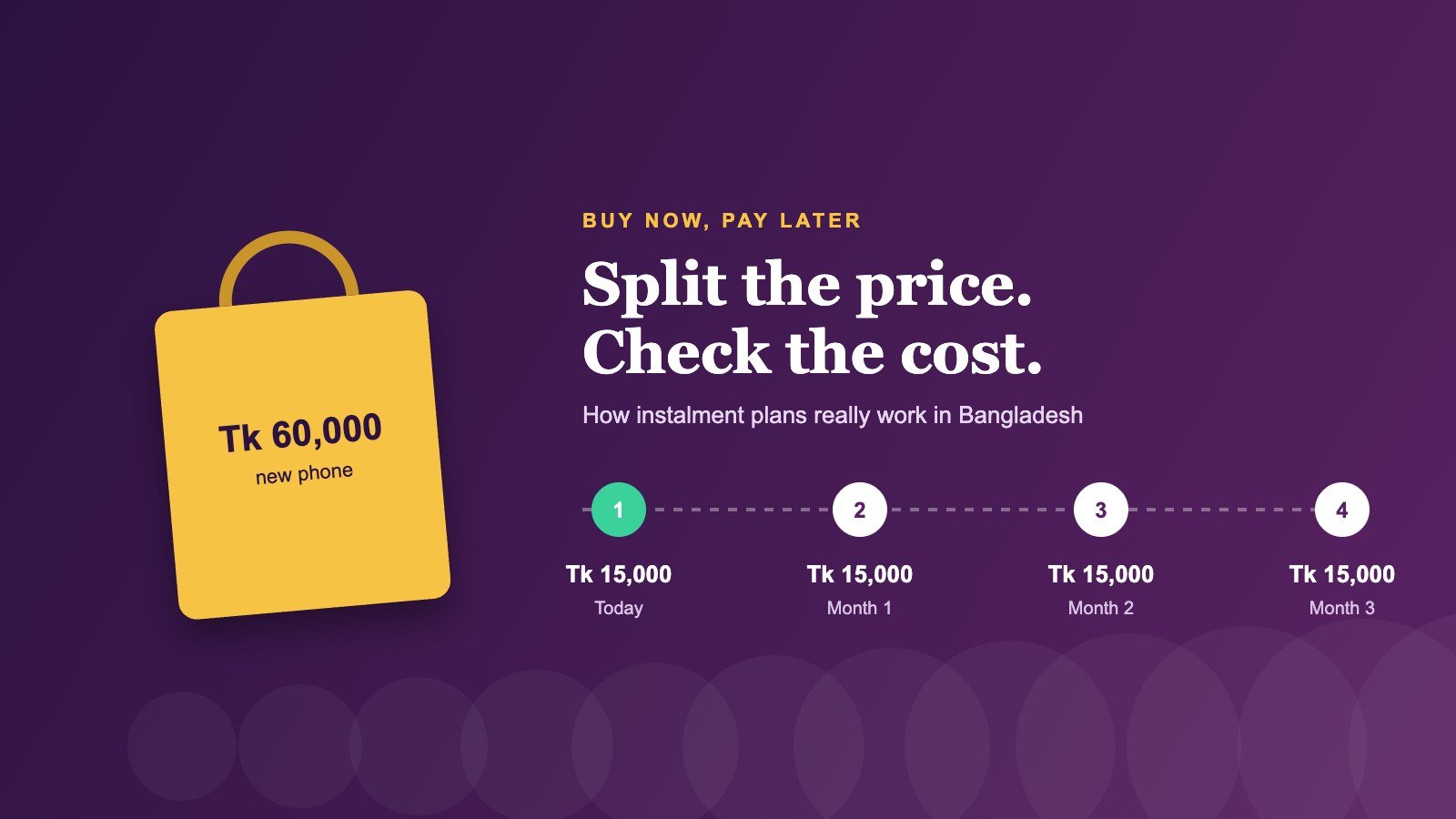
Short answer: Buy now, pay later (BNPL) lets you take a product today and pay for it in instalments, often over a few weeks or months, sometimes with no interest. In Bangladesh, it mostly comes in three forms: credit card EMI plans at shops and online stores, short “pay later” credit inside apps such as Pathao, and small digital loans through mobile wallets such as bKash, funded by banks. There is no BNPL-specific law, so the cost depends on each provider. “0% EMI” often still carries a bank processing fee and a card charge, which can make the true cost about 19% to 23% a year by our calculation. Use BNPL only for planned purchases you could afford anyway, and never miss a payment.
A new phone, in four parts
Arif, 26, a junior software tester in Dhaka, wanted a Tk 60,000 phone. The shop offered “0% EMI for 6 months” on his credit card: just Tk 10,000 a month. It sounded free. Then the bill showed a processing fee of several thousand taka on the first statement. “Zero percent, but not zero cost,” he says. “Nobody explained that at the counter.”
What is buy now, pay later?
Buy now, pay later is short-term credit at the point of sale. Instead of paying the full price, you pay in parts, either in fixed monthly instalments or in one lump sum after a set period. A bank, finance company or fintech pays the seller, and you repay the lender. Globally, apps such as Klarna and Afterpay made the idea popular. In Bangladesh, the market was estimated at about US$1.17 billion in 2025 by the research firm Research and Markets, which named Pathao and bKash among the players (GlobeNewswire). That is a commercial estimate, not official data.
How does BNPL work, step by step?
- You choose the instalment or pay-later option at checkout.
- The provider checks whether you qualify, using your card limit, app history or credit data.
- The lender pays the seller in full.
- You repay in instalments, often automatically from your card, wallet or account.
- If you pay late, you face late fees, interest and possibly a damaged credit record.
What types of BNPL are available in Bangladesh?
| Type | How it works | Typical terms |
|---|---|---|
| Credit card EMI | Your card purchase is split into monthly instalments at partner shops | Often 3 to 24 months; “0% interest” but processing fees usually apply |
| App pay-later | Credit inside an app, repaid after a set period | Small limits; e.g., Pathao’s early pay-later started at Tk 2,000, repaid within 30 days |
| Wallet digital loan | A bank lends through a mobile wallet; can be used for purchases | bKash loans from Tk 500 to Tk 50,000, up to 6 months |
| Shop instalment plans | Some retailers sell on instalments, sometimes with finance partners | Varies widely; read the contract |
Credit card EMI
This is the most common form of BNPL in Bangladesh. Electronics shops, online stores and travel sites offer EMI on credit cards from partner banks. Debit and prepaid cards usually do not qualify. ShareTrip’s terms, for example, require a purchase above Tk 10,000, offer plans up to 24 months, and say the customer pays no interest but does pay a bank processing fee of 4% to 6% for six months or 6% to 10% for 12 months, plus a card charge of 1.5% (2.5% for Amex) on the total (ShareTrip). If you don’t have a card yet, see how to get your first credit card.
App pay-later
Pathao tested a “Pay Later” feature on its food app in 2021. Selected users got a Tk 2,000 limit, could pay in parts within a 30-day window, were not charged for using the feature, but faced a late charge of up to Tk 200, The Daily Star reported. Terms change, so check the app’s current conditions.
Wallet digital loans
bKash offers loans from partner banks of Tk 500 to Tk 50,000, with a processing fee of 0.575% including VAT. Interest is set by the lending bank, accrues daily and is shown in the app. Late payments carry a penalty and can lower your future limit, according to bKash’s loan FAQ. City Bank’s loan through bKash runs for up to six months, and early repayment carries no extra charge, UNB reported.
Is “0% EMI” really free?
Often not. The interest rate may be zero, but fees taken at the start mean you effectively borrow less than the price and repay the full price. By our calculation, for a Tk 60,000 purchase:
| Plan | Fees (example) | Extra cost | Approximate yearly cost |
|---|---|---|---|
| 6 months, “0% EMI” | 5% processing + 1.5% card charge | Tk 3,900 | About 23% |
| 12 months, “0% EMI” | 8% processing + 1.5% card charge | Tk 5,700 | About 19% |
Our calculation of the effective annual rate, treating the fees as paid at the start and the price repaid in equal monthly instalments. Fees vary by bank and shop; VAT may apply.
Also watch for a higher “EMI price” than the cash price, and for any cash discount you lose by choosing EMI. Both are hidden costs.
What are the benefits?
- You can buy an essential item, such as a laptop for work, without paying everything at once.
- Fixed instalments make budgeting easier than an open credit card balance.
- Genuine interest-free offers with low fees can cost less than a personal loan.
- Paying on time can help build a credit history.
What are the risks?
- Overspending. Small monthly amounts make expensive items feel cheap.
- Stacking. Several BNPL plans at once can add up to more than you can repay.
- Late fees and interest. Missing a card EMI instalment can trigger card interest and late fees. See what happens if you miss a credit card payment.
- Your credit record. Bank-funded instalments and loans can be reported to Bangladesh Bank’s credit bureau. Late payments can hurt future loan applications; see what CIB is and how it affects your loan.
- Weak protection. There is no BNPL-specific law in Bangladesh; it is covered indirectly by banking, finance company, consumer rights and digital commerce rules (LegalSeba). Read the terms carefully.
BNPL, credit card or personal loan: which is better?
| Option | Best for | Watch out for |
|---|---|---|
| Card EMI / BNPL | One planned purchase from a partner shop | Processing fees, higher EMI prices, missed instalments |
| Credit card (full payment) | Everyday spending you clear every month | High interest if you carry a balance |
| Personal loan | Larger needs over a longer period | Interest, fees and longer commitment |
| Saving first | Anything that is not urgent | Waiting, but no cost at all |
How to use BNPL safely
- Ask for the total cost in taka: price, processing fee, card charge and VAT.
- Compare the EMI price with the cash price and any cash discount.
- Keep your total instalments well within your monthly budget.
- Set reminders or auto-pay, and never miss a due date.
- Avoid using BNPL for food, bills or everyday spending.
- Check whether you can settle early and what it costs; see is early loan repayment worth it.
Back to Arif
Arif still paid off his phone on time. For his next purchase, a laptop, he asked the shop for the cash price, the EMI price and the bank’s fee in writing. “The cash discount was bigger than I expected,” he says. “So I saved for three months and paid in full.”
This article is general information, not financial advice. Terms and fees vary by provider and change often; read the conditions before you agree.
Frequently asked questions
Is buy now, pay later legal in Bangladesh?
Yes. There is no BNPL-specific law, but providers must follow banking, finance company, consumer rights and digital commerce rules.
Is 0% EMI really interest-free?
The interest rate may be zero, but banks often charge a processing fee and shops may add a card charge. Ask for the total cost before you agree.
Can I use EMI with a debit card?
Usually not. Most EMI plans in Bangladesh need a credit card from a partner bank.
Does BNPL affect my credit record?
Bank-funded instalments and loans can be reported to the credit bureau. Paying on time helps; missing payments can hurt your chances of future loans.
What happens if I miss a BNPL payment?
You may pay late fees and interest, lose access to future credit, and in bank-funded plans, damage your credit record.
Key words explained
| Term | What it means |
|---|---|
| BNPL | Buy now, pay later: short-term credit to split a purchase into payments. |
| EMI | Equated monthly instalment: a fixed monthly payment. |
| Processing fee | A one-off charge for setting up an instalment plan or loan. |
| Effective annual rate | The true yearly cost of credit once fees are included. |
| Tenure | The length of the repayment period. |
| CIB | Bangladesh Bank’s Credit Information Bureau, which records borrowers’ repayment history. |
How we reported this
We used ShareTrip’s published EMI terms, bKash’s loan FAQ, UNB’s report on City Bank’s digital loan through bKash, The Daily Star’s report on Pathao’s pay-later launch, LegalSeba’s overview of BNPL law, and a commercial market estimate from Research and Markets. The cost examples are our own calculations. The featured image is an illustration made by Dhaka Debates. We do not recommend any provider.
Editor’s note: Arif is illustrative, created to show how a buyer might experience an EMI plan. He is not a real person. The terms and figures come from the published sources listed with this article and our own calculations.
Sources
- ShareTrip: EMI FAQ and terms · sharetrip.net
- bKash: Loan FAQ · bkash.com
- UNB: Collateral-free digital loan limit through bKash app raised to Tk 50,000 · unb.com.bd
- The Daily Star: Pathao introduces Bangladesh to Pay Later feature · thedailystar.net
- LegalSeba: Buy Now, Pay Later (BNPL) regulations and related laws in Bangladesh · legalseba.com
- GlobeNewswire (Research and Markets): Bangladesh Buy Now Pay Later Business and Investment Report 2026 · globenewswire.com
- The Business Standard: SSLCOMMERZ, CASHe Alliance forge buy-now-pay-later partnership · tbsnews.net