What Is Mushak 6.3? Understanding the VAT Challan
Mushak 6.3 is the VAT tax invoice, or "VAT challan", every VAT-registered business in Bangladesh must issue on each taxable sale. Here is what it must show, who issues it, why buyers need it for input tax credit, and the mistakes that cost money.

If you have ever bought something for your company and the accounts team asked “Did they give you the Mushak?”, this is the document they meant. For many small businesses, Mushak 6.3 is the first VAT form they meet, and mistakes on it can cost both seller and buyer money.
The short answer: Mushak 6.3 is the official VAT tax invoice, commonly called the “VAT challan”, that every VAT-registered business in Bangladesh must issue for each taxable sale of goods or services. It is prescribed under the VAT and Supplementary Duty Rules 2016, made under the VAT and Supplementary Duty Act 2012. It must show the seller’s 13-digit BIN, the buyer’s details (and BIN, if registered), what was sold, the price, the VAT rate and amount, and the total. For the seller, it is proof of a sale and the VAT charged. For a VAT-registered buyer, a valid Mushak 6.3 is what allows them to claim input tax credit. Businesses enlisted for turnover tax do not issue it.
What does “Mushak” mean?
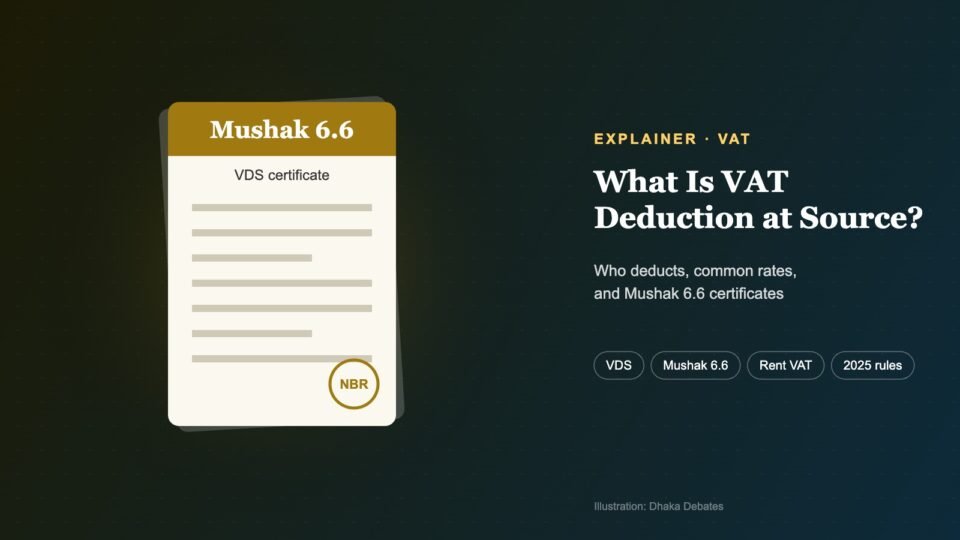
“Mushak” (মূসক) is the Bangla abbreviation for mullya sanjojon kor, value added tax. The VAT system uses numbered Mushak forms for every task: Mushak 2.1 is the registration application, 6.1 the purchase book, 6.2 the sales book, 6.3 the tax invoice, 6.6 the VDS certificate, and 9.1 the VAT return.
| Form | What it is |
|---|---|
| Mushak 6.1 | Purchase book |
| Mushak 6.2 | Sales book |
| Mushak 6.2.1 | Combined purchase-sales book |
| Mushak 6.3 | Tax invoice (VAT challan) for sales |
| Mushak 6.4 | Invoice for contractual manufacturing |
| Mushak 6.5 | Invoice for transferring goods between your own units |
| Mushak 6.6 | VAT deduction at source (VDS) certificate |
| Mushak 6.7 | Credit note |
| Mushak 6.8 | Debit note |
Who must issue a Mushak 6.3?
Every VAT-registered supplier must issue a Mushak 6.3 for every taxable supply, at the time of supply. That includes sales to ordinary consumers who are not VAT-registered; in that case the buyer’s BIN field is simply left blank.
You do not issue a Mushak 6.3 when:
- your business is enlisted for turnover tax rather than VAT-registered,
- the supply is exempt from VAT,
- you move goods between your own units (use Mushak 6.5 instead), or
- the transaction is not a supply at all, such as a security deposit.
Not sure whether you are registered or enlisted? See our guide on how to get a BIN certificate in Bangladesh.
What must a Mushak 6.3 show?
| Field | Notes |
|---|---|
| Seller’s name, address and 13-digit BIN | Must match the registration exactly |
| Buyer’s name and address | Required |
| Buyer’s BIN | If the buyer is VAT-registered; essential for their input tax claim |
| Invoice (challan) number | In an unbroken sequence; never reused |
| Date and time of issue | The date of supply |
| Description of goods or services | With HS code where relevant |
| Unit, quantity and unit price | Price shown before VAT and supplementary duty |
| Supplementary duty rate and amount | If applicable |
| VAT rate and amount | For example 15%, or a reduced rate |
| Total value including all taxes | Often also written in words |
| Name and designation of the person issuing | With signature or system authentication |
Why does the buyer care about Mushak 6.3?
Because of input tax credit. A VAT-registered business can deduct the VAT it paid on purchases from the VAT it collects on its own sales. But it can only do so with a valid Mushak 6.3 from the supplier, showing the buyer’s correct BIN.
Our calculation: a garment accessories maker buys packaging for ৳1,00,000 plus 15% VAT (৳15,000). If the supplier gives a proper Mushak 6.3, the maker can deduct that ৳15,000 from the VAT it owes on its own sales. Without a valid invoice, or with a wrong BIN on it, that ৳15,000 is simply lost.
VAT advisers note that input tax should be claimed within four tax periods of the invoice, and that a wrong or inactive buyer BIN is one of the most common reasons claims are rejected. Large purchases generally need to be paid through a bank, not in cash, for the credit to be allowed. Check the current rules with your adviser.
How should a Mushak 6.3 be issued?
- Through software or an EFD. Many businesses issue Mushak 6.3 from accounting or ERP software. The Finance Act 2026 accepts records kept in ERP and other software as valid documents, PwC notes. Shops and restaurants covered by the NBR’s electronic fiscal device (EFD) programme issue receipts from those machines, which send sales data to the NBR.
- Manually, using the official format, if no software is used. Keep the numbering continuous.
Every Mushak 6.3 must also be recorded in your sales book (Mushak 6.2) and then flow into your VAT return (Mushak 9.1). Keep copies for at least five years. If you need to correct an invoice later, for example after a return or price change, issue a credit note (Mushak 6.7) or debit note (Mushak 6.8) rather than editing or deleting the original.
Accounting software that produces Mushak forms automatically can save a lot of work; we compared options in best accounting software for small businesses in Bangladesh.
What are the most common mistakes?
- Not issuing a Mushak 6.3 at all for cash sales.
- Writing the buyer’s BIN incorrectly or using an old 9- or 11-digit number.
- Gaps or repeats in invoice numbers.
- Showing the VAT-inclusive price as the unit price.
- Deleting or rewriting invoices instead of issuing credit or debit notes.
- Issuing invoices that do not match what is reported in the VAT return.
The consequences can be serious. Failure to issue proper invoices can lead to penalties, the buyer losing input tax credit, and closer scrutiny in an audit. Issuing a false or fake invoice is treated far more severely. VAT advisers cite penalties of up to 100% of the VAT involved for fake invoices, though penalty levels were revised by the Finance Act 2026, so check current amounts.
As a customer, should you ask for a Mushak 6.3?
Yes, especially at restaurants, shops and service providers. Asking for a proper VAT invoice or EFD receipt helps make sure the VAT you pay actually reaches the government, rather than staying with the seller. If you are buying for a VAT-registered business, insist on it, with your company’s BIN.
Frequently asked questions
Is Mushak 6.3 the same as a VAT challan?
Yes. In everyday use, “VAT challan” usually means the Mushak 6.3 tax invoice. Do not confuse it with a treasury challan, which is the receipt for depositing tax with the government.
Do turnover tax businesses issue Mushak 6.3?
No. Only VAT-registered businesses issue it. Enlisted turnover tax businesses cannot charge VAT or give buyers input tax credit.
Can I issue Mushak 6.3 from my own software?
Yes, as long as it contains all the required fields and records are kept properly. Some sectors must use NBR-approved devices or software.
How long must I keep Mushak 6.3 copies?
At least five years, along with your sales book and returns.
Key words explained
| Term | What it means |
|---|---|
| Mushak | Bangla abbreviation for value added tax; also the prefix for VAT forms |
| Tax invoice / VAT challan | The Mushak 6.3 document issued for a taxable sale |
| BIN | 13-digit Business Identification Number |
| Input tax credit | VAT paid on purchases that can be deducted from VAT on sales |
| Output tax | VAT charged on your own sales |
| Credit note / debit note | Documents (Mushak 6.7 and 6.8) used to correct an earlier invoice |
| EFD | Electronic fiscal device that issues receipts and reports sales to NBR |
| Treasury challan | Proof of depositing tax with the government |
Next: learn how sales and purchases come together in the Mushak 9.1 VAT return, and how buyers sometimes deduct VAT before paying you in what is VAT deduction at source (VDS).
How we reported this
We used PwC’s Worldwide Tax Summaries for Bangladesh (reviewed July 2026) and its summary of the Finance Act 2026, together with published guidance from Bangladeshi VAT advisers on the VAT and Supplementary Duty Rules 2016. The input tax example is our own calculation. Rules and penalties change; confirm current requirements on vat.gov.bd or with a VAT adviser. This is general information, not tax advice.
Sources
- PwC Worldwide Tax Summaries: Bangladesh, other taxes · taxsummaries.pwc.com
- PwC: Finance Act 2026 key amendments · pwc.com
- Mushak 6.3: the Bangladesh VAT tax invoice, field by field (BizRP) · bizrp.com