How to File Your Income Tax Return in Bangladesh
There is no 30 November deadline any more: from tax year 2026-27 you can file any time from July to June, with a rebate for filing early and extra tax for filing late. Who must file, what to prepare, how to file, and what happens if you do not.

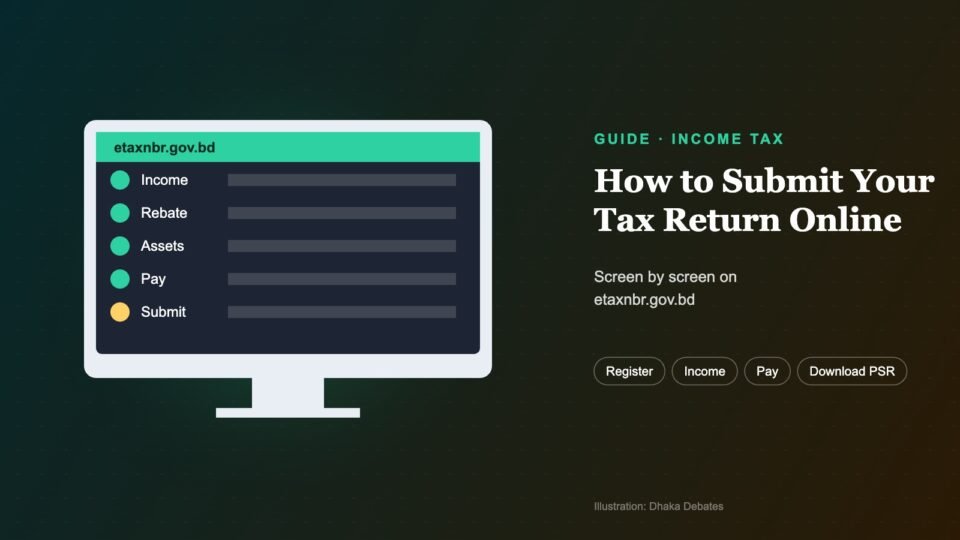
Bangladesh has about 1.12 crore TIN holders, but only around 40 lakh file returns each year, Prothom Alo reported in late 2025. Many people who should file do not, often because they think it is complicated. For most individuals, it is not. This guide explains the rules and process; our companion article, how to submit your income tax return online, walks through the e-Return portal screen by screen.
The short answer: You must file an income tax return in Bangladesh if your income is above the tax-free limit (৳4 lakh for most people in tax year 2026-27), if you were taxed in any of the past three years, if you hold certain roles such as company director or government employee, or if you need proof of return submission (PSR) for services such as a large bank loan or a trade licence. Most individuals must file online through the NBR’s e-Return system at etaxnbr.gov.bd. Under the Finance Act 2026, the old 30 November “Tax Day” deadline has gone: you can file any time from 1 July 2026 to 30 June 2027 for income earned from July 2025 to June 2026. Filing by 30 September earns a rebate of 5% of tax payable, up to ৳25,000; filing from January onwards adds extra tax. You need your TIN, income records, tax already deducted, investment proofs, and a list of your assets and liabilities.
Who must file a return?
According to a guide by BD Advocacy summarising the Income Tax Act 2023 as amended in 2026, you must file if any of these apply:
- Your total income is above the tax-free limit for your category.
- You were assessed for tax, or had taxable income, in any of the three previous years.
- You are a shareholder-director of a company, a company sponsor, a partner in a firm, a government employee, or a salaried employee at managerial or executive level, whatever your income.
- You need proof of submission of return (PSR) for any of the services listed in the law, such as a bank loan above ৳20 lakh, a trade licence in a city corporation or municipality, or registering land or a flat.
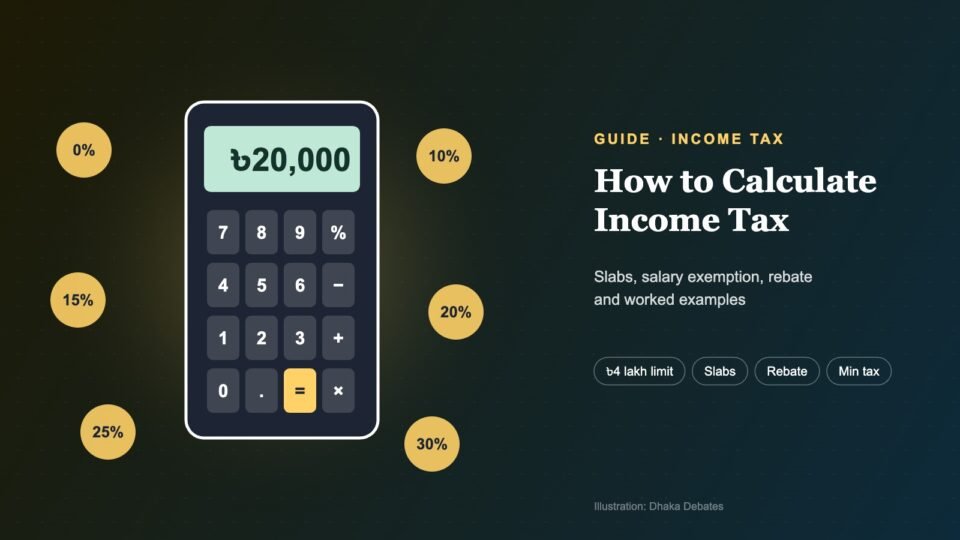
Not sure if your income is above the limit? Work it out with our guide on how to calculate income tax in Bangladesh.
When do you have to file?
This is the biggest change this year. Under the Finance Act 2026, there is no single deadline. You can file any time during the tax year, but the timing affects what you pay, The Daily Star reported:
| Filing period (tax year 2026-27) | What happens |
|---|---|
| 1 July – 30 September 2026 | Rebate of 5% of tax payable, up to ৳25,000 |
| 1 October – 31 December 2026 | No rebate and no extra tax |
| 1 January – 31 March 2027 | Extra tax of 2% of tax payable or ৳3,000, whichever is higher |
| 1 April – 30 June 2027 | Extra tax of 5% of tax payable or ৳5,000, whichever is higher |
| After 30 June 2027 | Higher charges and loss of many exemptions, according to tax advisers |
If you are reading this in November 2026, you are in the no-rebate, no-penalty window until 31 December. Filing before then avoids extra tax.
Online or on paper?
Online filing is compulsory for regular individual taxpayers, The Daily Asian Age reported when the NBR opened the e-Return service for tax year 2026-27 on 22 July 2026. Paper returns are still allowed for:
- senior citizens aged 65 or over,
- persons with disabilities, with certificates,
- Bangladeshis living abroad,
- legal representatives filing for a deceased taxpayer,
- foreign nationals working in Bangladesh, and
- others who cannot register for e-Return due to technical problems, with prior approval from their tax office.
Nearly 47 lakh individuals filed online in tax year 2025-26, a record, the same report said.
What do you need before you start?
| If you are… | Prepare |
|---|---|
| Everyone | TIN; NID; mobile number registered in your own NID; last year’s return and acknowledgement; proof of tax-rebate investments; list of assets and liabilities as of 30 June 2026 |
| Salaried | Salary certificate showing tax deducted; bank statement for the year; provident fund statement |
| Landlord | Rent agreements; rent received (through bank); municipal tax and repair costs; home loan interest certificate |
| Business owner or professional | Profit and loss account; trade licence; bank statements; TDS certificates from customers |
| Investor | FDR, savings certificate and DPS statements with tax deducted; dividend statements; BO account statement |
If you do not yet have a TIN, start with how to get an e-TIN certificate.
What goes into the return?
- Personal details and TIN.
- Income by source: salary, rent, business or profession, capital gains, financial assets (interest, dividends), and other income.
- Tax calculation: tax on income, investment rebate, minimum tax check.
- Tax already paid: TDS and advance tax.
- Assets and liabilities: property, cash, bank balances, investments, vehicles, jewellery, and loans.
- Living expenses: a summary of family spending.
- Declaration and payment of any balance.
The assets, liabilities and expenses sections matter. The NBR uses them to check that your wealth growth matches your declared income. A big jump in assets without matching income invites questions.
How do you file, in brief?
- Register on etaxnbr.gov.bd with your TIN and NID-registered mobile number.
- Enter your income, investments, tax paid, assets and liabilities.
- Check the calculated tax.
- Pay any balance online by bank, card or mobile wallet.
- Submit and download the acknowledgement (your PSR) and income tax certificate.
Detailed screen-by-screen steps are in how to submit your income tax return online.
What is a PSR and why does it matter?
PSR stands for proof of submission of return. It is the acknowledgement you get after filing. The Income Tax Act 2023 lists many services that require a PSR, including some bank loans, trade licences in cities, land and flat registration, and others. Without a current PSR, you may be refused these services. Keep a copy of every year’s acknowledgement.
Note one easing in 2026: when it passed the Finance Bill, parliament scrapped the requirement to show a TIN certificate to open most bank accounts and for some property mutations, The Daily Star reported.
What happens if you do not file?
- Extra tax for late filing, as shown in the table above.
- Penalty for non-filing: BD Advocacy describes a penalty under the Act of 10% of the tax on your last assessed income (minimum ৳1,000), plus ৳50 per day of default.
- Interest on unpaid tax.
- Loss of exemptions and reduced rates for late filers.
- No PSR, which can block loans, licences and property deals.
Can you correct a return after filing?
Yes. A return can generally be revised before it is assessed, according to tax guides. If you discover a mistake, such as missed income or a wrong figure, file a revised return as soon as possible and pay any extra tax.
Tips for a smooth filing
- File between July and September to get the rebate, if you owe tax.
- Ask your employer for your salary certificate early.
- Make rebate investments before 30 June, the end of the income year.
- Receive rent and large payments through the bank, so records match.
- Keep copies of everything for at least five years.
- Use the NBR call centre on 09643717171 if stuck.
Salaried readers may also want our earlier guide, tax return basics for salaried people. Business owners registering for VAT should see how to get a BIN certificate, which is a separate system.
Frequently asked questions
Is 30 November still the deadline?
No. From tax year 2026-27 you can file until 30 June 2027, but filing after 31 December 2026 adds extra tax, and filing by 30 September earns a rebate.
Do I have to file if I have a TIN but low income?
You must file if any of the conditions above apply, such as having been taxed in the past three years or needing a PSR. Many TIN holders choose to file every year to keep their records clean.
Can I file on paper?
Only if you are in an exempt group, such as aged 65 or over, a person with a disability, living abroad, or with permission from your tax office.
What is the income year for this return?
1 July 2025 to 30 June 2026.
Key words explained
| Term | What it means |
|---|---|
| Income tax return | Your annual statement of income, tax and wealth to the NBR |
| e-Return | The NBR’s online filing system at etaxnbr.gov.bd |
| TIN / e-TIN | Your 12-digit taxpayer identification number |
| PSR | Proof of submission of return, needed for many services |
| Income year | July–June year in which income is earned |
| Tax year | The following year, when the return is filed |
| TDS | Tax deducted at source |
| Revised return | A corrected return filed after the original |
How we reported this
We used The Daily Star’s reports on the Finance Bill 2026 and the early-filing rebate, The Daily Asian Age’s report on the e-Return launch for tax year 2026-27, Prothom Alo’s November 2025 report on filing numbers, and BD Advocacy’s guide to the Income Tax Act 2023 as amended in 2026. Penalty details come from secondary guides and should be confirmed with the NBR. This is general information, not tax advice.
Sources
- Early tax filers to get up to Tk 25,000 rebate (The Daily Star) · thedailystar.net
- Finance Bill passed: tax-free income threshold set at Tk 4 lakh (The Daily Star) · thedailystar.net
- NBR launches e-Return service for tax year 2026-2027 (The Daily Asian Age) · dailyasianage.com
- NBR urges taxpayers to submit e-returns (Prothom Alo) · en.prothomalo.com
- Income tax return filing 2026-27 (BD Advocacy) · bdadvocacy.com
- Income tax 2026-27: what changed for individual taxpayers (RebateBhai) · rebatebhai.com