How to Calculate Income Tax in Bangladesh
The tax-free limit is now ৳4 lakh and the 5% slab is gone. A plain, step-by-step guide to working out your income tax for tax year 2026-27, with the salary exemption, investment rebate, minimum tax, early-filing rebate and three worked examples.

Income tax looks complicated, but for most salaried people and small business owners the calculation fits on one page. This guide walks through it with the latest rules from the Finance Act 2026 and three worked examples. It is general information, not tax advice; confirm details with the National Board of Revenue (NBR) or a tax adviser if your situation is complex.
The short answer: For tax year 2026-27, which covers income earned from 1 July 2025 to 30 June 2026, you work out income tax in six steps: (1) add up your income from all sources; (2) subtract exempt amounts, such as one-third of salary income up to ৳5 lakh; (3) apply the slab rates to your taxable income, with the first ৳4 lakh tax-free for most people (৳4.5 lakh for women and those aged 65 or over); (4) subtract the investment rebate, generally 15% of eligible investment within limits; (5) check the minimum tax of ৳5,000 (৳1,000 for a new taxpayer); and (6) subtract tax already deducted at source. Above the tax-free limit the rates are 10%, 15%, 20%, 25% and 30%. The old 5% slab has been removed. File between July and September and you get a further rebate of 5% of the tax payable, up to ৳25,000.
Which year are we talking about?
Bangladesh uses two linked years:
- Income year: the year you earn the income, 1 July to 30 June. For the returns being filed now, that is 1 July 2025 to 30 June 2026.
- Tax year (assessment year): the following year, in which you file and pay. Here, tax year 2026-27, from 1 July 2026 to 30 June 2027.
What is the tax-free income limit?
| Taxpayer | Tax-free limit, tax year 2026-27 | Previous year |
|---|---|---|
| General | ৳4,00,000 | ৳3,50,000 |
| Women and taxpayers aged 65 or over | ৳4,50,000 | ৳4,00,000 |
| Persons with disabilities and third-gender taxpayers | ৳5,25,000 | ৳4,75,000 |
| Gazetted war-wounded freedom fighters | ৳5,50,000 | ৳5,00,000 |
| Gazetted July fighters | ৳5,50,000 | No separate limit |
Parliament raised the general limit to ৳4 lakh when it passed the Finance Bill 2026, up from the ৳3.75 lakh first proposed, and set it to rise to ৳4.5 lakh and later ৳5 lakh in future years, The Daily Star reported.
What are the tax slabs?
| Taxable income (general taxpayer) | Rate | Maximum tax in this band |
|---|---|---|
| First ৳4,00,000 | 0% | ৳0 |
| Next ৳3,00,000 (৳4–7 lakh) | 10% | ৳30,000 |
| Next ৳4,00,000 (৳7–11 lakh) | 15% | ৳60,000 |
| Next ৳5,00,000 (৳11–16 lakh) | 20% | ৳1,00,000 |
| Next ৳20,00,000 (৳16–36 lakh) | 25% | ৳5,00,000 |
| Above ৳36,00,000 | 30% | — |
These are marginal rates: each rate applies only to the part of your income inside that band. Earning one taka more never makes your total tax jump on all your income.
How do you calculate it, step by step?
Step 1: Add up your total income
Include every source for the income year: salary (basic pay, allowances, bonuses, benefits), business or professional profit, rent from property, interest on savings and FDRs, dividends, capital gains, and other income such as freelancing or agriculture.
Step 2: Subtract exemptions
The most important one for employees: one-third of salary income or ৳5 lakh, whichever is lower, is exempt, as reported in coverage of the 2025-26 budget. For rental income, allowable deductions such as repairs and municipal tax can be taken off. Some incomes, such as certain IT-enabled service exports, may be exempt under specific rules.
Step 3: Apply the slabs
Apply the rates above to your taxable income, starting after your tax-free limit.
Step 4: Subtract the investment rebate
If you invested or saved in eligible ways during the income year, you get a rebate (a direct reduction in tax). Under the rules described by tax guides, the rebate is the lowest of:
- 15% of your eligible investment,
- 3% of your taxable income, or
- ৳10 lakh.
Eligible investments typically include life insurance premiums, contributions to a recognised provident fund, DPS deposits within limits, government savings certificates (Sanchayapatra), treasury bonds, listed shares and mutual funds. Keep proof of each. Our guides on mutual funds and government bonds explain some of these options.
Step 5: Check the minimum tax
If your income is above the tax-free limit, you must pay at least the minimum tax: ৳5,000 everywhere in the country, or ৳1,000 for a new taxpayer, under the current rules. Previously the minimum varied by area.
Step 6: Subtract tax already paid
Deduct tax deducted at source (TDS) by your employer, bank or others, and any advance tax paid, for example with vehicle registration. What is left is the tax payable with your return.
Step 7: Adjust for when you file
| When you file (tax year 2026-27) | Effect |
|---|---|
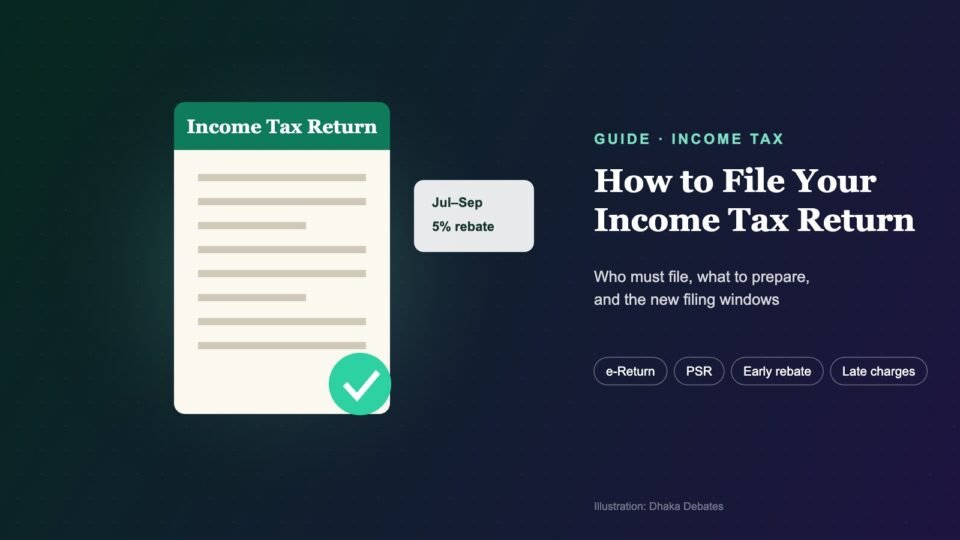
| 1 July – 30 September 2026 | Rebate of 5% of tax payable, up to ৳25,000 |
| 1 October – 31 December 2026 | No rebate, no extra tax |
| 1 January – 31 March 2027 | Extra tax of 2% of tax payable or ৳3,000, whichever is higher |
| 1 April – 30 June 2027 | Extra tax of 5% of tax payable or ৳5,000, whichever is higher |
Note that the early-filing rebate is based on tax still payable after TDS, so employees whose employers deducted the full tax may get little or nothing from it.
Worked example 1: a salaried employee
Our calculation. Karim (illustrative) earns a gross salary of ৳9,00,000 for the year. He invested ৳60,000 in a DPS and Sanchayapatra, and his employer deducted ৳9,000 tax at source.
| Step | Amount |
|---|---|
| Gross salary | ৳9,00,000 |
| Less exemption: lower of one-third (৳3,00,000) or ৳5 lakh | − ৳3,00,000 |
| Taxable income | ৳6,00,000 |
| Tax: first ৳4,00,000 at 0% | ৳0 |
| Next ৳2,00,000 at 10% | ৳20,000 |
| Less rebate: lowest of 15% × ৳60,000 (৳9,000), 3% × ৳6,00,000 (৳18,000), ৳10 lakh | − ৳9,000 |
| Tax after rebate (above ৳5,000 minimum) | ৳11,000 |
| Less TDS by employer | − ৳9,000 |
| Tax payable with return | ৳2,000 |
| If filed by 30 September: 5% rebate (৳100) | ৳1,900 |
Worked example 2: a small business owner
Our calculation. Rina (illustrative) runs a shop with a net profit of ৳15,00,000. As a woman, her tax-free limit is ৳4,50,000. She invested ৳2,00,000 in eligible savings and paid no tax in advance.
| Step | Amount |
|---|---|
| Taxable business income | ৳15,00,000 |
| First ৳4,50,000 at 0% | ৳0 |
| Next ৳3,00,000 at 10% | ৳30,000 |
| Next ৳4,00,000 at 15% | ৳60,000 |
| Remaining ৳3,50,000 at 20% | ৳70,000 |
| Tax before rebate | ৳1,60,000 |
| Less rebate: lowest of 15% × ৳2,00,000 (৳30,000), 3% × ৳15,00,000 (৳45,000), ৳10 lakh | − ৳30,000 |
| Tax payable | ৳1,30,000 |
| If filed by 30 September: 5% rebate (৳6,500) | ৳1,23,500 |
Worked example 3: just above the limit
Our calculation. A woman earning a salary of ৳7,20,000 has an exemption of ৳2,40,000 (one-third), leaving taxable income of ৳4,80,000. With a ৳4,50,000 limit, slab tax is 10% of ৳30,000, or ৳3,000. But because her income is above the limit, the minimum tax of ৳5,000 applies (৳1,000 if she is a new taxpayer). Investment rebate cannot take tax below the minimum.
What other taxes or rules might apply?
- Final settlement incomes: some income, such as certain interest or savings certificate profit, may be subject to tax deducted at source that counts as final, so it is not taxed again at slab rates. Ask an adviser how your income is treated.
- Net wealth surcharge: taxpayers with very high net wealth pay a surcharge on top of income tax.
- Company income: companies are taxed at corporate rates, not these slabs.
What should you do next?
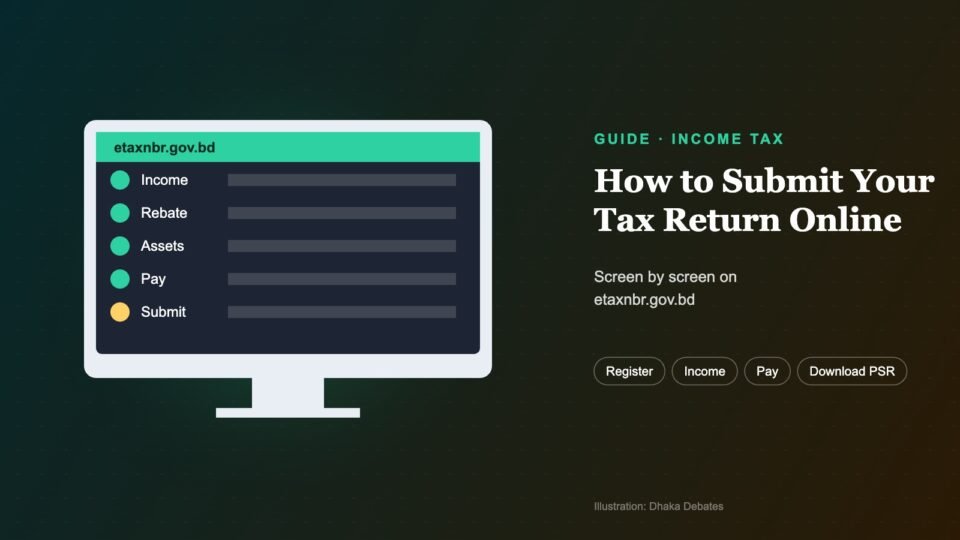
Once you know your tax, file your return. Read how to file your income tax return for the rules and how to submit your return online for the step-by-step portal guide. You will need a TIN; see how to get an e-TIN certificate. Salaried readers may also find our tax return basics for salaried people useful.
Frequently asked questions
What is the tax-free income limit this year?
৳4 lakh for most people for tax year 2026-27, ৳4.5 lakh for women and those aged 65 or over, and higher for persons with disabilities and gazetted freedom fighters and July fighters.
Is there still a 5% tax slab?
No. Income above the tax-free limit now starts at 10%.
Do I pay tax if my income is below the limit?
No income tax, but you may still need to file a return if you meet other conditions, such as having a TIN and needing proof of return submission for certain services.
How much is the minimum tax?
৳5,000 nationwide, or ৳1,000 for a new taxpayer, if your income is above the tax-free limit.
Key words explained
| Term | What it means |
|---|---|
| Income year | The July–June year in which income is earned |
| Tax year | The following year, in which the return is filed |
| Tax-free limit | Income on which no tax is charged |
| Slab | A band of income taxed at one rate |
| Taxable income | Income after exemptions |
| Investment rebate | A reduction in tax for eligible savings and investments |
| Minimum tax | The least tax payable once income exceeds the limit |
| TDS | Tax deducted at source by employers, banks and others |
| Advance tax | Tax paid before filing, for example with vehicle registration |
How we reported this
We used The Daily Star’s reports on the Finance Bill 2026 (June 2026) and on the early-filing rebate (August 2026), summaries of the Finance Act 2026 by Tuhin and Partners and RebateBhai, budget 2025-26 coverage of the salary exemption, and published tax guides on the investment rebate formula. Some secondary sources still show older figures; we used those consistent with the Finance Act 2026. All examples are our own calculations. Confirm your own position with the NBR or a tax adviser. This is general information, not tax advice.
Editor’s note: Karim and Rina are illustrative taxpayers created to explain the calculation. They are not real people.
Sources
- Finance Bill passed: tax-free income threshold set at Tk 4 lakh (The Daily Star) · thedailystar.net
- Income tax 2026-27: what changed for individual taxpayers (RebateBhai) · rebatebhai.com
- Individual income tax slabs AY 2026-27 (Tuhin and Partners) · tnp.legal
- Early tax filers to get up to Tk 25,000 rebate (The Daily Star) · thedailystar.net
- Salaried taxpayers can claim Tk 5 lakh exemption (Daily Sun) · daily-sun.com
- How to calculate income tax in Bangladesh (BD Tax Guide) · bdtaxguide.com