What Are Government Bonds and How Can You Invest?
Treasury bills and bonds let ordinary Bangladeshis lend to the government at around 10% to 11% a year, with no purchase ceiling and only 5% tax at source. Here is how they work, how they differ from Sanchayapatra, and step-by-step how to buy them through a bank or a BO account.

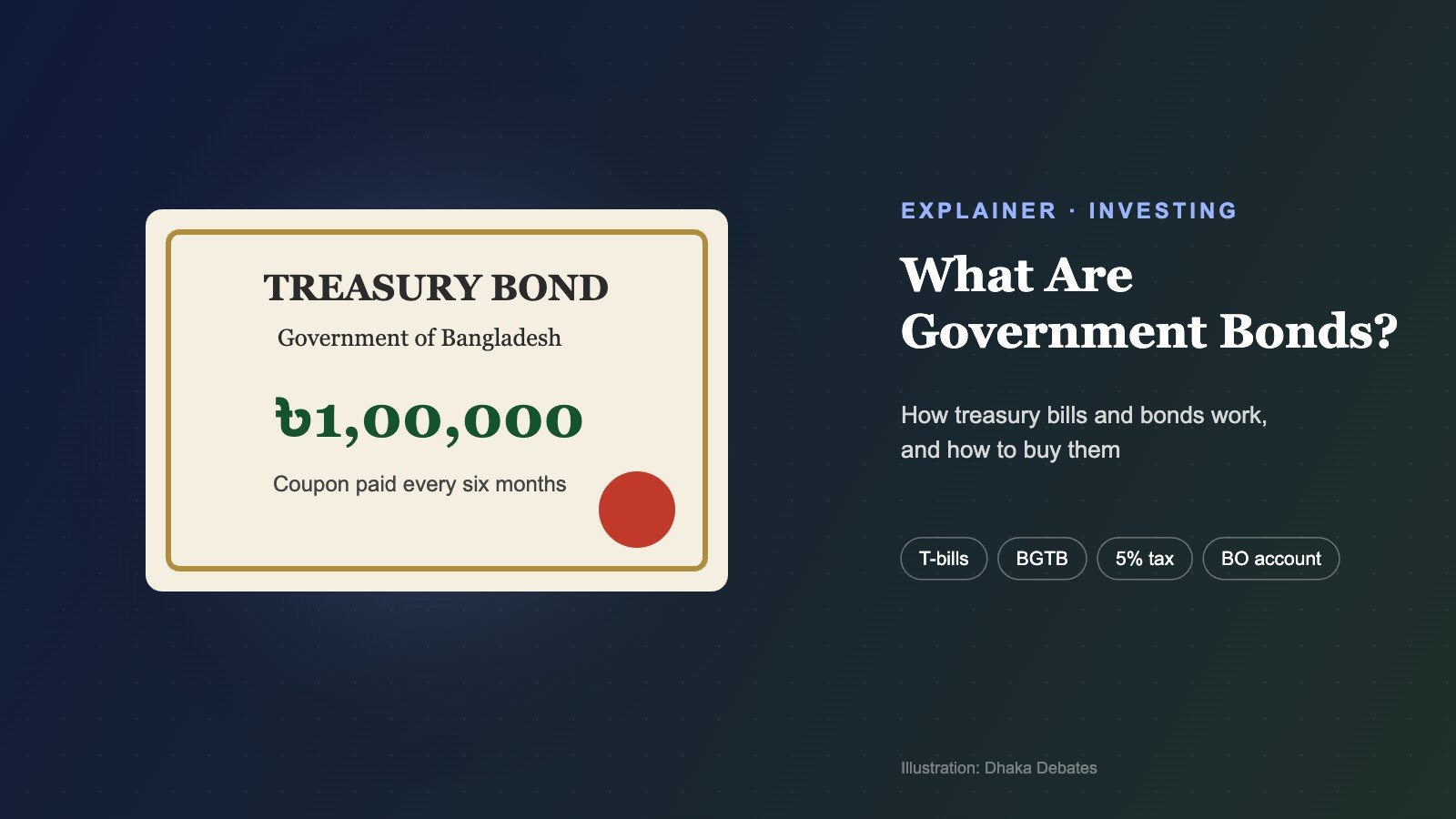
When most Bangladeshi families think of safe, government-backed savings, they think of Sanchayapatra. Fewer know that the government also borrows from the public through treasury bonds, which offer similar safety, comparable returns and some real advantages. Banks and insurance companies own most of these bonds today, but since 2023 individual investors have had easier routes to buy them. This explainer covers what they are, how they work and how to invest step by step.
The short answer: A government bond is a loan you make to the government. In return, the government pays you interest at a fixed rate, usually every six months, and gives your money back on a set date. In Bangladesh, ordinary people can buy treasury bills (91 to 364 days) and treasury bonds (2 to 20 years) with as little as ৳1 lakh, through a bank or a stockbroker using a BO account. In 2026, yields have been around 10% to 11%: the five-year bond’s cut-off yield was 10.75% and the ten-year’s 10.98% in April, The Financial Express reported. Tax at source on the interest is 5%, lower than on most savings options, and unlike Sanchayapatra there is no purchase ceiling. The trade-off: the process is less familiar, and if you sell before maturity the price can be higher or lower than you paid.
What is a government bond in simple words?
Governments spend more than they collect in taxes, so they borrow to cover the gap. One way is to sell bonds. When you buy a bond, you are lending money to the government. The bond is a promise that says:
- how much you lent (the face value),
- what interest rate you will receive (the coupon),
- how often interest is paid (in Bangladesh, every six months for treasury bonds), and
- when you get your money back (the maturity date).
Because the government can raise taxes or print money to repay its taka debts, bonds in the country’s own currency are considered the lowest-risk investment available locally.
What types of government securities exist in Bangladesh?
| Type | Term | How you earn | Who it suits |
|---|---|---|---|
| Treasury bills (T-bills) | 91, 182 or 364 days | Bought below face value; you receive the full face value at maturity | Short-term parking of money |
| Treasury bonds (BGTB) | 2, 5, 10, 15 or 20 years | Fixed interest every six months; face value returned at maturity | Medium to long-term savers, retirees wanting income |
| Government Investment Sukuk | Usually 5 years | Shariah-compliant rental income from government projects | Investors seeking Islamic options |
| Sanchayapatra (savings certificates) | 3 or 5 years | Profit monthly, quarterly or at maturity | Small and middle-income savers |
| Expatriate bonds (e.g. Wage Earner Development Bond) | Varies | Profit for Bangladeshis working abroad | Non-resident Bangladeshis |
This article focuses on treasury bills and bonds, sometimes called BGTB (Bangladesh Government Treasury Bonds). They are issued through auctions run by Bangladesh Bank on behalf of the government.
How much do government bonds pay right now?
Yields move with interest rates in the economy. They rose sharply in 2023 and 2024 as Bangladesh Bank raised its policy rate to fight inflation, and have eased somewhat since. Recent auction results reported by The Financial Express:
| Security | Cut-off yield | Auction reported |
|---|---|---|
| 91-day T-bill | 10.17% | May 2026 |
| 182-day T-bill | 10.47% | May 2026 |
| 364-day T-bill | 10.65% | May 2026 |
| 5-year treasury bond | 10.75% | April 2026 |
| 10-year treasury bond | 10.98% | April 2026 |
One thing to watch: on 2 August 2026, Bangladesh Bank cut its policy rate from 10% to 9.5%, its first cut in about six years, The Daily Star reported. When policy rates fall, bond yields at later auctions often fall too. That means bonds bought today at higher yields lock in those rates for their full term, while new bonds may pay less. Check the latest auction results before you invest.
How are treasury bonds different from Sanchayapatra?
Both are backed by the government, but they work differently.
| Feature | Treasury bonds | Sanchayapatra |
|---|---|---|
| Return in 2026 | About 10.5–11% (set at auction) | 11.77–11.98% (set by government) |
| Tax at source on interest | 5% | Higher; depends on amount invested |
| Purchase limit | No upper limit | Ceilings per person and per scheme |
| Minimum | ৳1 lakh | Lower minimums available |
| Interest paid | Every six months | Monthly, quarterly or at maturity, by scheme |
| Selling early | Sell in the market at the going price | Encash early at a lower profit rate |
| Terms available | 2 to 20 years (bills from 91 days) | 3 or 5 years |
| Where to buy | Banks, or brokers through a BO account | Post offices, banks, National Savings offices, online |
In plain terms: for smaller amounts within the limits, Sanchayapatra usually pays a little more. Once you reach the Sanchayapatra ceiling, or if you want a longer term, regular six-monthly income or lower tax at source, treasury bonds become very attractive.
Our calculation: ৳10 lakh in a five-year bond at a 10.75% coupon pays ৳1,07,500 a year, in two instalments of ৳53,750. After 5% tax at source, you receive about ৳51,063 every six months, or ৳1,02,125 a year. That is a net yield of about 10.2%.
How does a bond auction work?
Bangladesh Bank publishes an auction calendar in advance. On auction day, primary dealer banks and other eligible bidders submit bids saying how much they want and at what yield. The central bank accepts bids from the lowest yield upwards until it has raised the amount it needs. The highest accepted yield becomes the “cut-off yield,” and the bond’s coupon is set at that rate.
As an individual, you do not bid yourself. You instruct your bank or broker, who bids on your behalf. Primary auction purchases are made at face value.
How can you buy government bonds, step by step?
Route 1: Through a bank
Many large banks, especially primary dealer banks, offer treasury bonds to individual customers. Taking BRAC Bank’s published guide as an example:
- Open an account with the bank if you do not have one.
- Open a securities custody account (called a BP ID) with the bank. You will need an application form, NID or passport, photographs, your e-TIN certificate and nominee details.
- Choose a bond and amount. The minimum is ৳1 lakh. Tell the bank which tenor you want.
- Give a signed instruction at least one day before the auction, and make sure the money is in your account before the bank’s cut-off time on auction day.
- Receive the bond in your custody account if the bid succeeds. Interest arrives in your bank account every six months, minus 5% tax.
Banks can also sell you existing bonds from the secondary market at a quoted price, which lets you invest without waiting for an auction.
Route 2: Through a stockbroker using a BO account
Under a 2023 directive from the Bangladesh Securities and Exchange Commission, stock market investors can bid for primary treasury bonds through their brokers, The Business Standard reported:
- Have a BO (beneficiary owner) account with a broker that offers treasury bond bidding.
- Check the auction schedule, which the stock exchanges publish.
- Instruct your broker to bid, in multiples of ৳1 lakh, and provide the money.
- Receive the bonds in your BO account if the bid succeeds.
Treasury bonds also trade on the Dhaka and Chittagong stock exchanges’ debt boards, where you can buy or sell existing bonds. Trading has been thin, so you may not always find a buyer or seller quickly at a good price.
What are the risks?
- Interest rate risk: if rates rise after you buy, your bond’s market price falls. This only matters if you sell before maturity. Hold to maturity and you receive the full face value.
- Inflation risk: a fixed rate can lose real value if inflation rises. With inflation at 8.34% in September 2026, a 10.75% bond still earned a positive real return.
- Liquidity risk: selling early can take time because few individuals trade bonds.
- Reinvestment risk: when a bond matures, rates may be lower and you may not be able to reinvest at the same yield.
- Default risk: very low for taka bonds issued by the government.
Who should consider government bonds?
- Retirees who want safe, regular six-monthly income.
- Savers who have reached Sanchayapatra limits and want more government-backed options.
- People worried about bank safety, given that about a third of bank loans were in default in mid-2026.
- Long-term planners who want to lock in today’s rates for 10 to 20 years.
They are less suited to money you might need suddenly, or to people who want to start with a few thousand taka. For those, a DPS, Sanchayapatra or a mutual fund SIP may be easier. Compare options in our guides on FDR, DPS, Sanchayapatra and gold and how to start investing with small money.
Frequently asked questions
What is the minimum amount to buy a treasury bond?
৳1 lakh, and bids are made in multiples of ৳1 lakh.
How much tax is deducted from treasury bond interest?
5% at source, according to BRAC Bank’s published guide. The income must still be shown in your tax return.
Can I sell a treasury bond before maturity?
Yes, through your bank or on the stock exchange’s debt board. The price depends on current market rates and may be above or below what you paid.
Can Bangladeshis abroad buy treasury bonds?
Non-resident individuals with a Non-Resident Foreign Currency Account can invest, according to BRAC Bank’s guide. Special expatriate bonds are also available.
Are government bonds safer than a bank FDR?
Generally yes. Taka bonds are a direct obligation of the government, while an FDR depends on your bank’s health, with deposit insurance covering only up to ৳2 lakh.
Key words explained
| Term | What it means |
|---|---|
| Bond | A loan certificate that pays interest and returns your money at maturity |
| Treasury bill | A short-term government security of up to one year |
| BGTB | Bangladesh Government Treasury Bond, with terms of 2 to 20 years |
| Face value | The amount returned to you at maturity |
| Coupon | The fixed interest rate a bond pays |
| Yield | The return you earn, based on price and interest |
| Cut-off yield | The highest yield accepted at an auction, which sets the coupon |
| Maturity | The date the bond ends and your money is repaid |
| BO account | Beneficiary owner account used to hold shares and bonds |
| Secondary market | Where existing bonds are bought and sold after the auction |
| Policy rate | Bangladesh Bank’s key interest rate, which influences other rates |
How we reported this
We used auction results reported by The Financial Express (April and May 2026), The Daily Star’s July 2026 report on the policy rate cut, The Business Standard’s guide to buying bonds through BO accounts, BRAC Bank’s published treasury bond manual, and Prothom Alo’s July 2026 report on Sanchayapatra rates. The after-tax income example is our own calculation. This is general information, not personal financial advice.
Sources
- Yield on 5-year T-bonds rises (The Financial Express) · today.thefinancialexpress.com.bd
- 10-year bond yields jump on weak demand (The Financial Express) · thefinancialexpress.com.bd
- Yields on T-bills dip (The Financial Express) · today.thefinancialexpress.com.bd
- BB cuts policy rate to 9.5% (The Daily Star) · thedailystar.net
- How to bid for primary treasury bonds from BO accounts (The Business Standard) · tbsnews.net
- BGTB manual (BRAC Bank) · bracbank.com
- Profit rates on savings certificates will not be reduced (Prothom Alo) · en.prothomalo.com