Why Most People Struggle to Save Money
Saving is hard not because people are careless but because of rising prices, family duties, social pressure, easy credit and the way our brains favour today over tomorrow. Here is what gets in the way for Bangladeshi households, and simple habits that actually work.

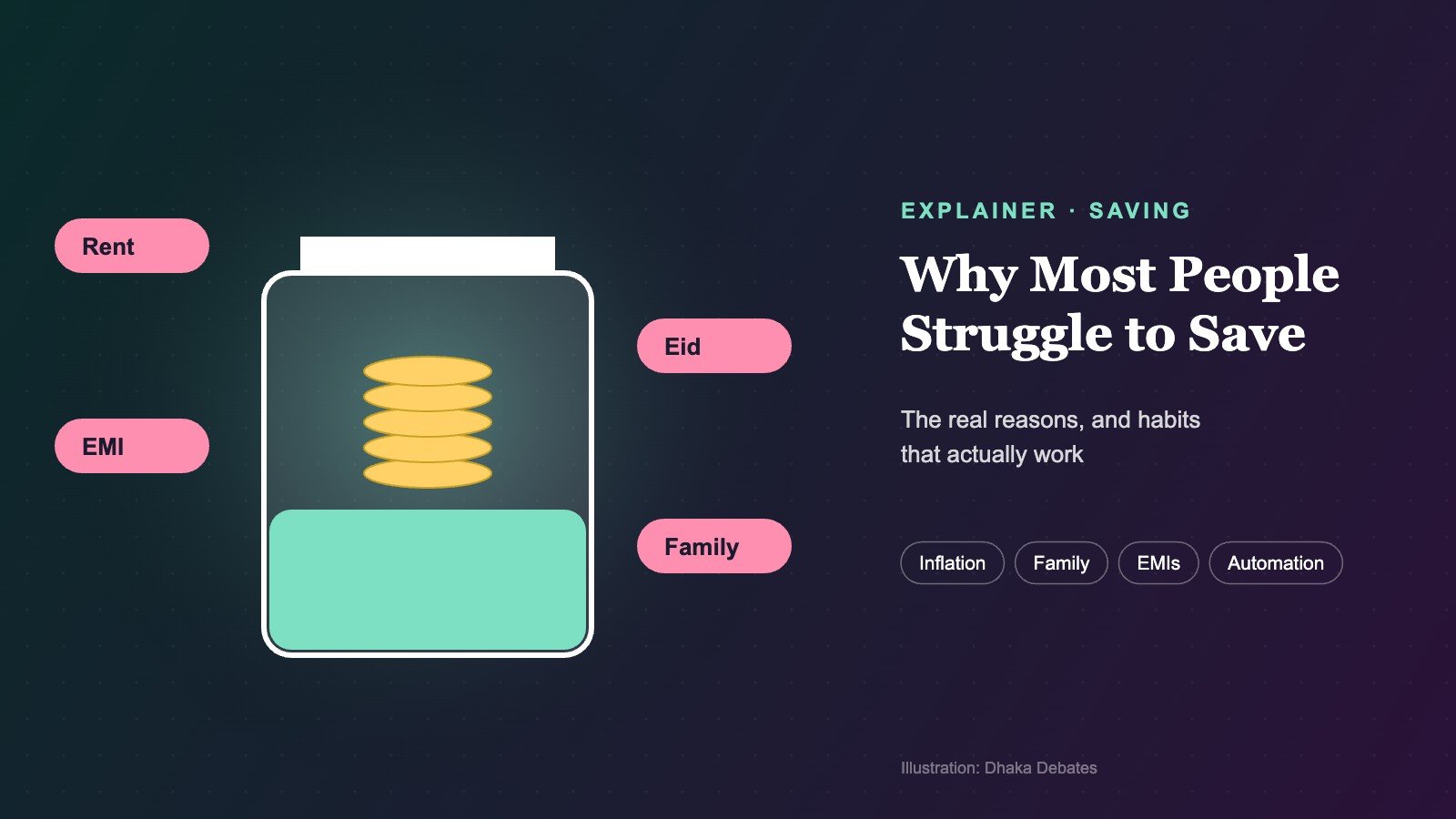
Rafi and Nusrat (not their real names; see the note at the end) both work in Dhaka. Together they earn ৳95,000 a month, more than most families in the country. Every January they promise themselves they will save ৳20,000 a month. By March, the promise has quietly disappeared. There is always something: a cousin’s wedding, a broken fridge, Rafi’s mother’s medicine, school admission for their daughter, Eid shopping, a phone on easy instalments. At the end of the year, their savings account looks almost exactly as it did at the start.
If this sounds familiar, you are not alone. Understanding why saving is so hard is the first step to doing it.
The short answer: Most people struggle to save not because they are lazy or careless, but because the odds are stacked against them. In Bangladesh, prices have risen faster than wages every month since February 2022. The average household spent nearly everything it earned even before that: ৳31,500 of a ৳32,422 monthly income in the government’s 2022 household survey. On top of that, family support, weddings and festivals, easy instalment credit and our natural habit of choosing today’s comfort over tomorrow’s security all work against saving. The fix is less about willpower and more about systems: save automatically on payday, keep savings out of easy reach, give each saving a clear goal, plan for big social costs in advance, and start small enough that you actually keep going.
Reason 1: Prices are rising faster than income
This is the simplest and most important reason. In August 2026, wages grew 8.05% while inflation was 8.26%, and wage growth has lagged inflation every month for more than four and a half years, according to Bangladesh Bureau of Statistics (BBS) data reported by bdnews24.com. Inflation was 8.34% in September 2026, after peaking at 11.66% in July 2024.
When the cost of the same lifestyle rises faster than your pay, the gap is filled first from whatever you used to save. Many families have not “stopped saving”; their savings have been eaten by the cost of living. We explain this in detail in how inflation is changing the value of your money.
Reason 2: There was little margin to begin with
The BBS Household Income and Expenditure Survey 2022 found average household income of ৳32,422 a month and spending of ৳31,500. Our calculation: that leaves under ৳1,000 a month, about 3% of income, before any emergency. For many low-income families, there is nothing left at all, and saving is simply not possible without cutting essentials.
This matters because much saving advice assumes people have spare money. For millions of Bangladeshis, the first goal is not “investing” but building a small cushion so that one illness does not mean borrowing at high interest.
Reason 3: Our brains prefer today
Behavioural economists call it “present bias”: we value something now much more than the same thing later. A new phone this month feels real; a comfortable retirement thirty years away feels abstract. This is not a character flaw; it is how almost everyone is wired. It explains why people sincerely plan to save and then do not.
The good news is that research on saving behaviour around the world shows that the way choices are set up matters more than willpower. When saving happens automatically, people save far more than when they must decide each month.
Reason 4: Lifestyle creep
When income rises, spending often rises with it, sometimes faster. A promotion brings a bigger flat, a better school, more eating out, a car loan. Each step feels reasonable, but together they absorb every raise. Many high earners in Dhaka have little saved for exactly this reason.
Reason 5: Family responsibilities
In Bangladesh, earning family members often support parents, siblings and relatives. Sending money home, paying a younger brother’s tuition or a parent’s medical bills are acts of love and duty, and they are rarely planned for. Because these costs come without warning, they hit whatever savings exist.
The solution is not to stop supporting family. It is to treat family support as a planned budget line, so it does not come out of savings by surprise.
Reason 6: Social and festival spending
Weddings, gifts, Eid shopping, Qurbani, Puja, birthdays and dawats are expected, and they are expensive. Social pressure to match what others spend, now amplified by social media, can push families to spend beyond their means or borrow. Because these events come every year, they are predictable, yet few families save for them in advance.
Reason 7: Easy credit and instalments
Credit card EMIs, “0% instalment” offers, buy now, pay later and small app loans make it easy to spend money you have not yet earned. Each instalment looks small, but several together can commit a large share of next year’s income. Fees and interest make some of these far more expensive than they appear. Our guides on buy now, pay later and embedded finance explain how these offers work.
Reason 8: Irregular income
Freelancers, small business owners, farmers and day labourers often earn unevenly. In good months it feels unnecessary to save; in bad months it is impossible. Without a system to smooth income, savings never build.
Reason 9: Savings are too easy to reach
Money in the same bKash wallet or bank account you spend from does not feel like savings. It feels like available money, and it gets spent. Physical cash at home is even easier to dip into.
Reason 10: No clear goal
“I should save more” is a weak motivator. “I need ৳1.5 lakh for my daughter’s admission next January” is a strong one. People save far more consistently when each taka has a purpose and a deadline.
| What gets in the way | What helps |
|---|---|
| Prices rising faster than wages | Track spending; cut lowest-value costs; grow income |
| Present bias | Automate saving on payday |
| Lifestyle creep | Save at least half of every raise |
| Family support surprises | Make family support a fixed budget line |
| Festivals and weddings | A separate monthly “events fund” |
| Easy instalments | Limit total instalments to a set share of income |
| Irregular income | Save a percentage of every payment received |
| Savings too easy to reach | Separate account, DPS or certificates |
| No clear goal | Name each saving pot with an amount and date |
What actually works?
Pay yourself first
Move a fixed amount into savings on the day your salary arrives, before you spend anything. A monthly DPS, a standing instruction to a separate account or a systematic investment plan in a mutual fund does this for you. Once it is automatic, you no longer need willpower each month.
Start small, then raise it
If 20% feels impossible, start with 5%. Saving ৳2,000 a month steadily beats planning ৳10,000 and giving up in March. Increase the amount every time your income rises.
Use separate pots
Keep different savings in different places: an emergency fund in a bank you do not use for spending, an events fund for Eid and weddings, and long-term savings in Sanchayapatra, bonds or funds that are harder to withdraw on impulse.
Plan for the predictable
Add up last year’s festival, wedding and gift spending and divide by twelve. Save that every month. When Eid comes, the money is ready and your other savings stay untouched.
Set a limit on instalments
Decide a maximum share of income, for example 10%, that can go to all instalments and loans combined. Say no to new offers once you reach it.
Talk about money at home
Couples and families who agree goals together save more. A short monthly conversation about income, spending and plans prevents surprises and arguments.
What could Rafi and Nusrat do differently?
| Monthly step | Amount | Where |
|---|---|---|
| Emergency fund (until ৳3 lakh is reached) | ৳8,000 | DPS at a strong bank |
| Events fund (Eid, weddings, gifts) | ৳5,000 | Separate savings account |
| Family support (planned) | ৳8,000 | Fixed transfer on payday |
| Long-term savings | ৳4,000 | Mutual fund SIP; Sanchayapatra once balance builds |
| Total set aside on payday | ৳25,000 |
The difference from their old approach is not the amount; it is that the money moves automatically on payday, each pot has a job, and family and festival costs no longer raid the savings. They can live freely on the remaining ৳70,000 without guilt.
For next steps, read how to save your first ৳1 lakh, where to keep it and how to build long-term wealth.
Frequently asked questions
How much of my income should I save?
A common target is 10% to 20% of take-home pay. If that is not possible, start with any fixed amount and increase it with each raise.
Should I save or pay off debt first?
Build a small emergency cushion first, then focus on clearing expensive debt such as credit cards, while keeping a modest saving habit going.
How do I save on an irregular income?
Save a fixed percentage of every payment you receive, and use good months to build a larger buffer for slow ones.
Is it worth saving small amounts?
Yes. Small regular amounts build the habit, and the habit matters more than the size of the first deposit.
Key words explained
| Term | What it means |
|---|---|
| Present bias | The tendency to value today’s rewards more than future ones |
| Lifestyle creep | Spending rising whenever income rises |
| Pay yourself first | Saving before spending, as soon as income arrives |
| Emergency fund | Savings set aside for unexpected costs |
| DPS | Deposit pension scheme: a monthly savings scheme at a bank |
| SIP | Systematic investment plan: a fixed monthly investment in a fund |
| EMI | Equated monthly instalment on a purchase or loan |
| HIES | BBS Household Income and Expenditure Survey |
How we reported this
We used BBS inflation and wage data reported by bdnews24.com (September 2026) and The Daily Star (July 2024), and the BBS Household Income and Expenditure Survey 2022 for household income and spending. Ideas on present bias and automatic saving draw on widely published behavioural economics research. The household plan and margin figures are our own calculations and examples.
Editor’s note: Rafi and Nusrat are an illustrative couple based on the common experience of working families in Dhaka. They are not real people, and their income and plan are examples only.
Sources
- Inflation and wage growth, August 2026 (bdnews24.com) · bdnews24.com
- September 2026 inflation (bdnews24.com) · bdnews24.com
- July inflation hits 11.66%, highest in 13 years (The Daily Star) · d11.thedailystar.net
- Household Income and Expenditure Survey 2022 (Bangladesh Bureau of Statistics) · bbs.gov.bd