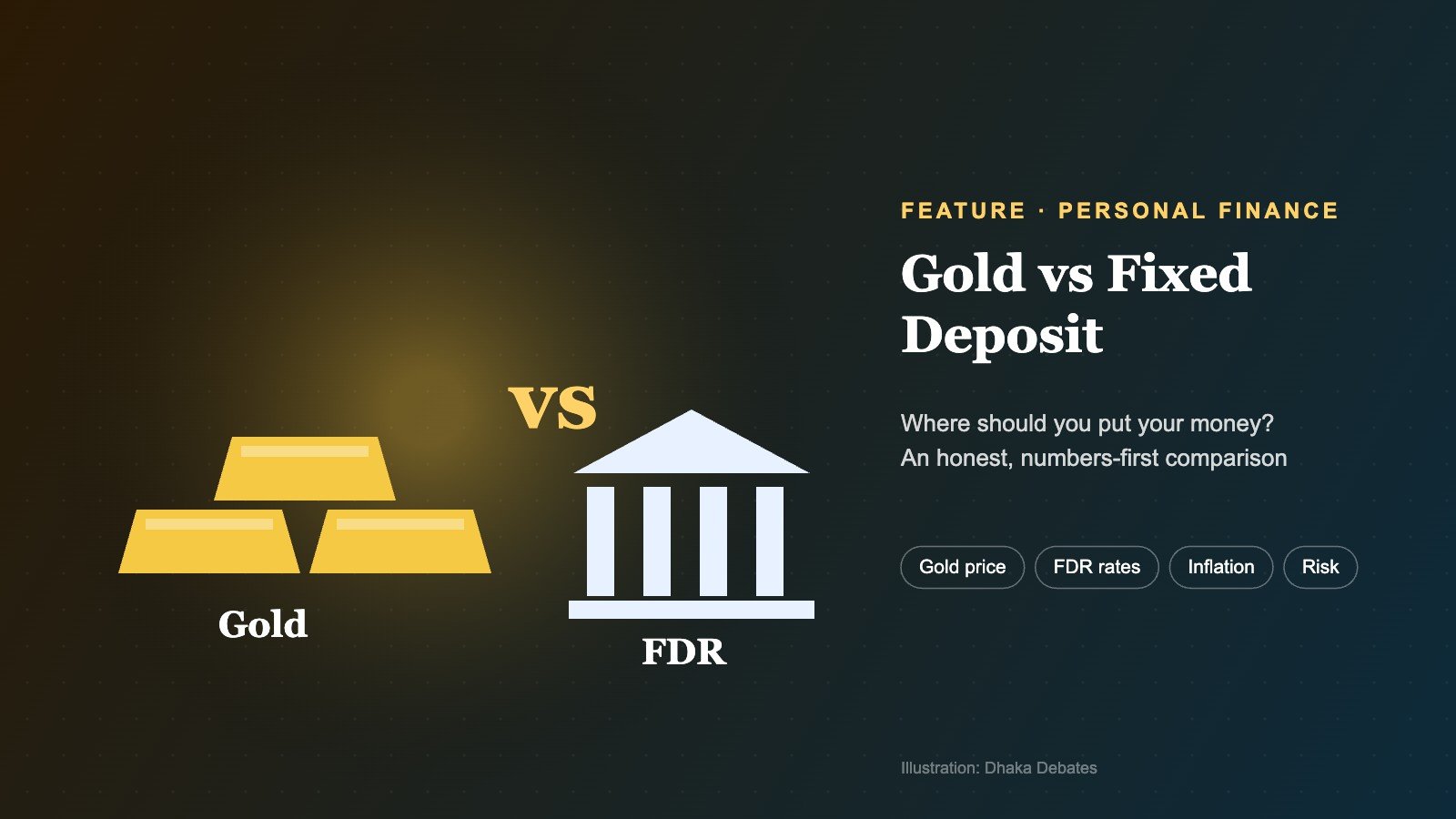
Gold vs Fixed Deposit: Where Should You Put Your Money?
Gold has jumped in price but also fallen about 12% this year; fixed deposits pay around 10% but barely beat inflation after tax. Here is an honest, numbers-first comparison for Bangladeshi savers, with real costs, risks and a simple way to decide.

Rokeya teaches mathematics at a girls’ school in Rajshahi. This year she received ৳5 lakh from her provident fund, and everyone in her family has an opinion about what to do with it. Her mother says gold: “Gold never loses value.” Her brother, who works at a bank, says a fixed deposit: “Guaranteed return, no headache.” Her neighbour says gold has already gone too high. Rokeya, being a maths teacher, wants to see the numbers.
This is one of the most common money questions in Bangladeshi households. Gold carries generations of trust. Fixed deposits (FDRs) are the default choice of careful savers. Both have had a remarkable few years, for very different reasons. Let us do what Rokeya wants: put them side by side, honestly, with real prices, costs and risks.
The short answer: Neither is always better. A fixed deposit gives a known return, around 10% a year at many banks, but after tax and inflation (8.34% in September 2026) the real gain is close to zero, and your money is only as safe as your bank. Gold has risen far faster over the long run, from about ৳1.38 lakh per bhori (22 carat) in December 2024 to about ৳2.27 lakh in November 2026, but it is volatile: it has fallen nearly 12% since January 2026, and buying and selling jewellery costs you a lot. For most families, the sensible answer is both: an FDR in a sound bank for money you need within a few years, and a smaller share in gold, ideally bars or coins rather than jewellery, as long-term protection against a falling taka.
What are gold and fixed deposits, really?
They are very different kinds of things, which is why comparing them is tricky.
- A fixed deposit is a loan you make to a bank. You hand over money for a fixed period, say one year, and the bank promises to return it with interest at an agreed rate. Your return is known in advance. Your risk is that the bank cannot pay you back, and that inflation eats the value of what you get.
- Gold is a physical asset. It pays no interest. You make money only if you sell it later for more than you paid. Its taka price depends on two things: the world price of gold in US dollars, and the taka’s exchange rate. When the taka weakens against the dollar, gold in taka usually rises.
In simple terms, an FDR is a bet on your bank and on interest rates staying ahead of prices. Gold is a bet on world gold prices and on the taka’s weakness.
How much has gold actually returned in Bangladesh?
The long-term record is impressive. Using prices set by the Bangladesh Jewellers Association (BAJUS) and compiled by Dhaka Tribune, here is how 22-carat gold per bhori (11.664 grams) has moved:
| Date | 22-carat gold price per bhori |
|---|---|
| 2000 | ৳6,900 |
| 2010 | ৳42,165 |
| 2020 | about ৳70,000 |
| 2023 | over ৳1,00,000 |
| December 2024 | ৳1,38,288 |
| January 2026 | ৳2,57,191 |
| 6 November 2026 | ৳2,26,923 |
Our calculations from these figures:
- From 2010 to November 2026, gold rose about 5.4 times, an average of roughly 11% a year.
- From 2020 to November 2026, it rose about 3.2 times, roughly 22% a year, boosted by a sharp fall in the taka and a global gold rally.
- From December 2024 to November 2026, it rose about 64%. In 2025 alone, the price rose by about ৳1.19 lakh per bhori, the largest one-year jump on record, Dhaka Tribune reported.
- But from January 2026 to November 2026, it fell about 12%. Someone who bought at the January peak is still sitting on a loss.
That last point matters. Gold’s long-run average hides big swings. It can stay flat or fall for years at a time. Globally, gold prices went mostly sideways from about 2012 to 2019. Bangladeshi buyers were partly protected in that period only because the taka slowly weakened.
How much does a fixed deposit really earn?
FDR rates have been unusually high since 2024, when Bangladesh Bank raised its policy rate to fight inflation and freed lending and deposit rates from earlier caps. In February 2026, The Financial Express quoted Mutual Trust Bank’s chief executive as saying FDR rates “remain at 10 per cent or above in the market,” while the average deposit rate across banks was around 9%. Rates differ by bank, amount and term, and weaker banks often offer more to attract deposits.
But the headline rate is not what you keep. Two things reduce it:
- Tax. Banks deduct tax at source on FDR interest, commonly 10% if you have a Taxpayer Identification Number (TIN) and a higher rate if you do not. Check your bank for the current rate. An annual excise duty also applies to account balances above a threshold; the 2026-27 budget proposed raising the exempt limit from ৳3 lakh to ৳4 lakh, The Daily Star reported.
- Inflation. Prices rose 8.34% in the year to September 2026, according to the Bangladesh Bureau of Statistics as reported by bdnews24.com. Bangladesh Bank’s own review found that real returns on new deposits had fallen to near zero by March 2026, The Financial Express reported in July.
Our calculation: ৳5 lakh in a one-year FDR at 10% earns ৳50,000 in interest. After 10% tax at source (৳5,000), Rokeya keeps ৳45,000, a 9% return. With inflation at about 8.3%, her money’s real buying power grows by well under 1%. She is protecting her savings, not growing them much.
What does it really cost to buy and sell gold?
This is where many families lose money without realising it. The BAJUS price is only the starting point.
- VAT: from July 2026, gold carries a flat VAT of ৳2,500 per bhori, replacing the earlier 5% VAT, under the revised Finance Bill reported by The Daily Star.
- Making charges (“majuri”): jewellery carries a making charge on top of the gold price. It varies by design and shop, and is often several percent of the gold value or more for intricate pieces.
- Deductions when you sell: when you sell or exchange old jewellery, shops deduct a portion of the value for wear, impurities and their margin. You do not get back the making charge or VAT.
- Purity risk: if the jewellery is not genuinely 22 carat, you lose even more when you sell. Always buy hallmarked gold with a proper receipt.
- Storage and safety: keeping gold at home carries theft risk; a bank locker costs a yearly fee.
Our calculation, using an example: say buying a jewellery piece costs you 10% above the pure gold value (making charge plus VAT), and selling it later loses another 8% to deductions. Gold would have to rise by roughly 20% just for you to break even. That is why jewellery is a poor investment, even when gold prices rise. Plain gold bars or coins, bought from reputable sellers with documentation, carry much lower making charges and are easier to sell near the market price.
How do the two compare side by side?
| Question | Fixed deposit | Gold |
|---|---|---|
| Return known in advance? | Yes | No |
| Typical recent return | About 9–11% a year before tax | Long-run 11%+ a year since 2010, but −12% so far in 2026 |
| Beats inflation? | Only barely, after tax | Usually over many years; not every year |
| Protects against a falling taka? | No | Yes, largely |
| Main risk | Weak bank; inflation | Price swings; theft; purity; costs |
| Costs | Tax on interest; excise duty on large balances | VAT, making charges, resale deductions, storage |
| Easy to get money back? | Yes, but early withdrawal cuts interest | Yes, but selling jewellery loses value |
| Regular income? | Yes, monthly or at maturity | No |
| Protection if things go wrong | Deposit insurance up to ৳2 lakh per bank | None |
| Best for | Money needed within 1–3 years; emergency reserves | Long-term store of value; part of a mix |
How safe is a fixed deposit in Bangladesh today?
This question used to be almost unthinkable. It is not any more. At the end of June 2026, defaulted loans made up 32.78% of all bank lending, according to Bangladesh Bank data reported by Ittefaq. Several banks have struggled to return depositors’ money on time. In 2025 five troubled Shariah-based banks were merged into Sammilito Islami Bank, and depositors faced withdrawal limits while the government stepped in.
Deposit insurance covers individual deposits of up to ৳2 lakh per depositor per bank, and in 2026 the Deposit Insurance Fund was used to repay merged-bank depositors. But amounts above that are at risk if a bank fails. The lesson is not to avoid FDRs. It is to choose banks carefully:
- Be wary of banks offering rates well above the market. A high rate often signals that a bank is desperate for cash.
- Check a bank’s default loan ratio and capital in its annual report or in reliable news.
- Spread large savings across two or three sound banks.
We compared Bangladesh’s banking system with one of the safest in the world in our analysis of what Bangladesh can learn from Singapore. For choosing a bank, see our guide on how to choose a bank.
Why do Bangladeshis trust gold so much?
Gold is more than an investment here. It is part of weddings, gifts and family security. For many women, jewellery has been the one asset that is clearly their own. In hard times, families pawn or sell it. And history has rewarded that trust: each time the taka has weakened sharply, gold in taka terms has risen.
That protection against a falling taka is gold’s real strength. Between 2022 and 2025 the taka lost a large share of its value against the US dollar. Taka deposits could not protect savers from that, but gold did. If you worry about the taka’s long-term value, a share of your savings in gold makes sense.
When does a fixed deposit make more sense?
- You will need the money within one to three years: a child’s admission fee, a wedding, a down payment.
- You want regular income, such as monthly interest for a retired parent.
- You are building an emergency fund and cannot afford a price drop.
- You cannot sleep if your savings fall 10% in a few months.
When does gold make more sense?
- You are saving for the long term, five years or more, and can wait out price falls.
- You want protection against the taka losing value.
- You already have an emergency fund and safe savings in place.
- You can buy plain bars or coins, or jewellery you will genuinely wear and keep, rather than pieces you plan to resell.
Are there other options to consider?
Yes. Gold and FDRs are not the only choices. Government savings certificates (Sanchayapatra) usually pay more than FDRs and are backed by the government, though there are purchase limits and rules. Treasury bonds offer government-backed returns too. Monthly deposit schemes (DPS) suit people who save a small amount each month. Mutual funds and shares offer higher long-term potential with higher risk. Our guide on FDR, DPS, Sanchayapatra and gold compares these options, and how to save your first ৳1 lakh covers the first steps.
So what should Rokeya do?
Here is one sensible way to split her ৳5 lakh, based on a common approach used by financial planners. It is an illustration, not personal advice.
| Purpose | Where | Amount |
|---|---|---|
| Emergency fund (about 6 months’ expenses) | Short FDR or savings account in a strong bank | ৳1,50,000 |
| Planned expense in 2 years | Two-year FDR in a different sound bank | ৳1,50,000 |
| Long-term savings, government-backed | Sanchayapatra or treasury bond | ৳1,25,000 |
| Long-term protection against a weaker taka | Gold bar or coin (about a third of a bhori) | ৳75,000 |
| Total | ৳5,00,000 |
In this example, about 15% sits in gold, enough to soften the blow if the taka weakens again, but not so much that a 12% fall in gold prices would hurt her plans. Each FDR stays within the ৳2 lakh deposit insurance limit at its bank. And the money she might need soon is not exposed to gold’s swings.
What mistakes should you avoid?
- Buying gold after a big jump because everyone is talking about it. Those who bought at the January 2026 peak are down about 12%.
- Treating jewellery as an investment. Making charges and resale deductions eat much of the gain.
- Chasing the highest FDR rate. A bank offering far more than others may be in trouble.
- Putting everything in one place. Whether one bank or one asset, concentration increases risk.
- Ignoring tax. Get a TIN to avoid paying a higher tax rate on interest.
- Breaking FDRs early. Early withdrawal usually cuts the interest you receive.
Frequently asked questions
What is today’s gold price in Bangladesh?
From 6 November 2026, BAJUS set 22-carat gold at ৳2,26,923 per bhori, 21-carat at ৳2,16,712 and 18-carat at ৳1,86,099, bdnews24.com reported. Prices change often; check the latest BAJUS announcement before buying.
What FDR rate can I get?
Many banks have offered around 10% or more for term deposits in 2026, with an industry average deposit rate around 9%. Compare current rates at several sound banks.
Is gold safer than a bank deposit?
They carry different risks. Gold cannot go bankrupt, but its price can fall sharply and it can be stolen. A deposit in a strong bank has a fixed return and insurance up to ৳2 lakh, but loses value to inflation.
Is jewellery a good investment?
Usually not, because making charges, VAT and resale deductions are high. Gold bars or coins are better if your goal is investment.
How much of my savings should be in gold?
There is no fixed rule. Many planners suggest keeping gold to a modest share, often 5% to 15%, after you have an emergency fund. Choose based on your goals and how much price movement you can tolerate.
Key words explained
| Term | What it means |
|---|---|
| FDR | Fixed deposit receipt: money deposited with a bank for a fixed period at a fixed interest rate |
| Bhori | A traditional unit for gold, equal to 11.664 grams |
| 22 carat | Gold that is about 91.6% pure, common for jewellery |
| BAJUS | Bangladesh Jewellers Association, which sets reference gold prices |
| Making charge (majuri) | The fee a jeweller charges for crafting a piece |
| Real return | Your return after subtracting inflation |
| Tax at source | Tax the bank deducts from your interest before paying you |
| Excise duty | A yearly government charge on bank balances above a threshold |
| Deposit insurance | Protection that repays depositors up to a limit if a bank fails |
How we reported this
Gold prices come from BAJUS announcements as reported by bdnews24.com (November 2026) and Dhaka Tribune’s January 2026 analysis of historical prices. Deposit rates come from The Financial Express (February and July 2026), inflation from Bangladesh Bureau of Statistics data reported by bdnews24.com, gold VAT from The Daily Star’s June 2026 report on the Finance Bill, excise duty from The Daily Star’s 2026-27 budget coverage, and banking sector data from Ittefaq. Growth rates, after-tax returns, break-even costs and the example split are our own calculations, marked as such. This article is general information, not personal financial advice.
Editor’s note: Rokeya is an illustrative character based on the common situation of salaried savers in Bangladesh. She is not a real person, and her savings and the example split are for explanation only.
Sources
- Gold price per bhori from 6 November 2026 (bdnews24.com) · bdnews24.com
- What soaring gold prices mean for Bangladesh (Dhaka Tribune) · dhakatribune.com
- Positive real returns draw savings into banks (The Financial Express) · today.thefinancialexpress.com.bd
- Real returns on fresh bank deposits fall to near zero (The Financial Express) · thefinancialexpress.com.bd
- September 2026 inflation (bdnews24.com) · bdnews24.com
- Govt fixes flat VAT on gold, diamonds, silver (The Daily Star) · thedailystar.net
- Excise duty exemption threshold on bank deposits rises to Tk 4 lakh (The Daily Star) · online91.thedailystar.net
- NPLs surpass Tk 6 lakh crore (Ittefaq) · en.ittefaq.com.bd