What Is NPSB? Bangladesh’s Instant Payment Switch Explained
Every time you use another bank's ATM, tap your card at a shop, send money instantly to another bank or move money between bKash and a bank, NPSB is working in the background. Here is how it works, what it costs, the limits, and when to use it.

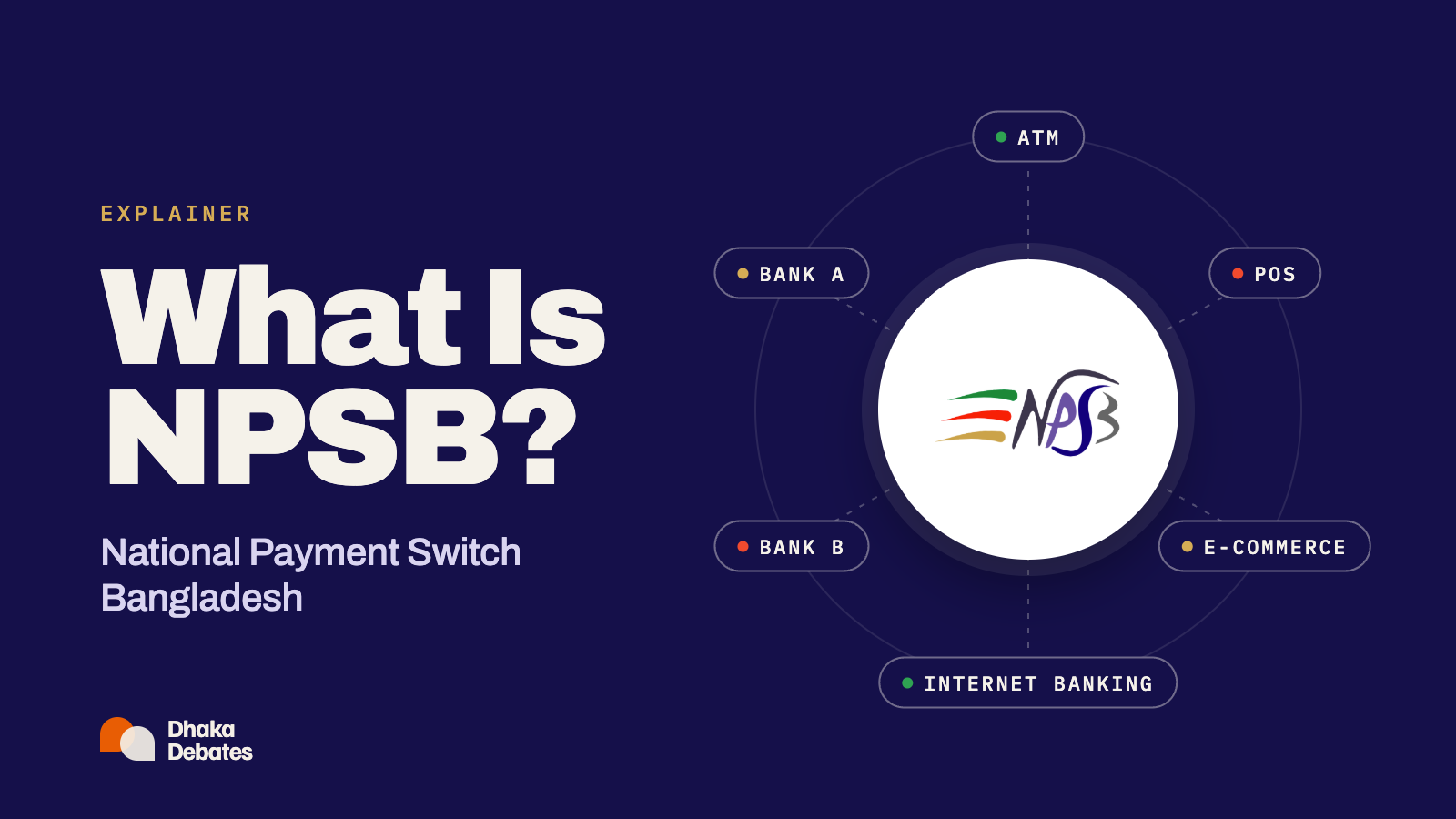
Withdrawing cash from another bank’s ATM, paying by card at a shop, sending money to a friend’s account at a different bank in seconds, scanning a Bangla QR code, moving money from bKash to your bank: all of these run on one system most people have never heard of. It is called NPSB. Here is what it is, how it works, what it costs, and when to use it instead of BEFTN or RTGS.
Editor’s note: Tanvir and his mother are illustrative, created to show how NPSB works in everyday life. They are not real people. The rules, limits and fees come from the published sources linked in this article.
Eleven o’clock on a Friday night
Tanvir, a second-year student in Rajshahi, needed Tk 8,000 for his hostel fee by Saturday morning. It was 11pm on a Friday. His mother, in Khulna, banks with one bank; he banks with another.
A few years ago, that would have meant waiting until Sunday, or asking a cousin to send money by bKash and paying a cash-out fee. This time his mother opened her banking app, chose “instant transfer”, typed in his account number, entered the OTP, and the money was in his account before she had put her phone down. The fee was Tk 10.
“How did it come so fast on a Friday?” Tanvir asked. “Last month my salary from tuition took two days.”
The answer is that his mother’s transfer went through NPSB, while his tuition payment went through BEFTN. They are two very different systems.
What is NPSB?
NPSB stands for National Payment Switch Bangladesh. It is a central payment network owned and run by Bangladesh Bank that connects banks, and now mobile financial services (MFS) and payment service providers (PSPs), so that their customers can pay each other in real time. It has connected banks since 2012.
Think of it as a telephone exchange for money. When your bank needs to reach another bank, it does not need a separate connection with every bank in the country. It connects once to NPSB, and NPSB routes the payment to the right place, instantly.
What runs on NPSB
NPSB started with ATMs and card payments and has grown into the backbone of everyday digital payments:
| Service | What it lets you do |
|---|---|
| Shared ATMs | Withdraw cash or check your balance at another bank’s ATM |
| ATM fund transfer | Send money to another bank’s card or account from an ATM |
| Card payments (POS) | Pay by debit or credit card at shops, using another bank’s machine |
| Internet banking fund transfer (IBFT) | Send money instantly from your banking app to an account at another bank |
| E-commerce | Pay online with a local card |
| Bangla QR | Pay any merchant’s QR code from any participating bank or wallet app |
| Bank, MFS and PSP interoperability | Move money between bank accounts and wallets such as bKash, Nagad and Upay |
The newest piece arrived on 1 November 2025, when Bangladesh Bank made transfers between banks, MFS providers and PSPs interoperable through NPSB, The Daily Star reported. That means a bKash user can now send money directly to a Nagad wallet or a bank account, and the other way round.
How an NPSB transfer works
- You start the payment in your app, at an ATM, at a shop terminal or by scanning a QR code.
- You confirm it, usually with a PIN or a one-time password (OTP). Two-factor authentication is required for internet banking and online payments.
- Your bank or wallet sends the request to NPSB, which routes it to the receiver’s bank, MFS or PSP in real time.
- The receiving institution approves it and credits the account, usually within seconds.
- The banks settle later. The money between institutions is settled through their accounts at Bangladesh Bank. For account transfers this happens quickly; card transactions are typically settled the next working day. You do not see this step.
Because each payment travels on its own, NPSB works around the clock, including Fridays, Saturdays and public holidays, which is why Tanvir’s money arrived at 11pm on a Friday.
What does NPSB cost?
Bangladesh Bank sets the maximum fees for NPSB services. Your bank may charge less, but not more.
| Service | Maximum fee to the customer | Source |
|---|---|---|
| Internet banking transfer to another bank | Tk 10 per transfer, including VAT | Finance minister in parliament, April 2026 |
| Cash from another bank’s ATM | Tk 15 for the first five withdrawals a month; up to Tk 30 after that, or for withdrawals above Tk 20,000 at once | Bangladesh Bank circular, February 2025 |
| Balance inquiry or mini statement at another bank’s ATM | Tk 5 | Bangladesh Bank circular, February 2025 |
| Bank account to wallet or other account | 0.15% (Tk 1.50 per Tk 1,000) | Bangladesh Bank, from November 2025 |
| PSP wallet to bank or MFS | 0.20% (Tk 2 per Tk 1,000) | Bangladesh Bank, from November 2025 |
| MFS wallet (bKash, Nagad etc.) to bank or other MFS | 0.85% (Tk 8.50 per Tk 1,000) | Bangladesh Bank, from November 2025 |
| Card payment at a shop or Bangla QR | No charge to the customer; the merchant pays 1% to 1.15% | Bangladesh Bank, July 2026 |
Sources: The Business Standard (IBFT fee), The Financial Express (ATM fees), The Daily Star (interoperable transfers) and The Business Standard (merchant fee). VAT applies as stated by each source.
Two rules protect you on interoperable transfers: only the sender pays, and the fee must be shown before you confirm. The person receiving the money pays nothing.
The cheapest way to move money matters
The direction you send money in makes a big difference. Sending Tk 5,000 from a bank account to a bKash wallet costs at most Tk 7.50. Sending the same Tk 5,000 from bKash to a bank costs up to Tk 42.50 (our calculation, using the maximum rates). If you have the choice, send from the bank side.
The same goes for ATMs. Using another bank’s ATM five times a month costs about Tk 75 at the maximum rate; the sixth withdrawal can cost Tk 30 on its own (our calculation). Using your own bank’s ATMs where possible, and taking out larger amounts less often, keeps this down.
How much can you send?
Limits come from Bangladesh Bank rules and your own bank’s policy, and the bank’s limit can be lower than the central one. An October 2026 summary of central bank circulars puts the individual internet banking limit at Tk 3 lakh per transfer and Tk 10 lakh a day. Bangladesh Bank removed the cap on the number of daily transfers in 2022.
In practice, many banks set lower limits in their apps, sometimes Tk 50,000 per transfer, especially for new users. Wallet-to-bank and wallet-to-wallet transfers follow the existing limits for each type of account. Check your app’s limits page before you need to send a large amount, because raising a limit can take a branch visit.
NPSB vs BEFTN vs RTGS
| Feature | NPSB | BEFTN | RTGS |
|---|---|---|---|
| Speed | Seconds | Same or next working day | Minutes |
| Hours | 24/7, including holidays | Working days, in sessions | Working days, about 10am to 5pm |
| Typical amount | Small to medium; up to Tk 3 lakh per transfer for individuals | Any amount within bank limits; ideal for bulk | Tk 1 lakh minimum for customer taka transfers |
| Fee (central maximum) | Tk 10 per internet banking transfer | No charge per transfer | Up to Tk 100 |
| Best for | Urgent personal transfers, ATMs, cards, QR, wallet transfers | Salaries, pensions, bills, regular payments | Large, urgent payments |
For a full guide to the batch system, read our explainer on what BEFTN is and how it works.
Which one should you use?
- Need it there now, any day, and the amount is within your limit? NPSB.
- No hurry, or paying many people at once? BEFTN, which is free per transfer.
- Tk 1 lakh or more, urgent, on a working day? RTGS.
What you need to send money by NPSB
- Your bank’s app or internet banking, activated for fund transfers, with a registered mobile number for OTPs
- The receiver’s bank and account number, card number or wallet number, depending on the app
- The receiver’s name, which many apps now show before you confirm. Check it carefully
- For ATM transfers, the receiving bank’s code and the account or card number
Unlike BEFTN, you usually do not need the branch routing number for an instant transfer, which is one reason people find it easier.
When NPSB can let you down
- Money leaves, but does not arrive. Occasionally a transfer fails between banks after your account is debited. Keep the transaction reference and contact your bank; failed transfers are usually reversed after reconciliation, but it can take a few working days.
- Wrong account. Instant also means hard to undo. If you send money to the wrong person, contact your bank immediately. Recovery depends on the other bank and the receiver, and is not guaranteed.
- Temporary suspensions. Bangladesh Bank can pause services. Before the February 2026 national election, it suspended person-to-person internet banking transfers through NPSB for 96 hours to prevent money being used to influence voters, The Daily Star reported. Merchant and bill payments continued.
- App and bank limits. Your app may block a transfer because of a daily limit you did not know about.
Staying safe
- Never share your OTP or PIN, not even with someone claiming to be from your bank or Bangladesh Bank.
- Check the receiver’s name shown in the app before confirming.
- Be suspicious of urgent requests from “relatives” or “officials” asking for an instant transfer. Call the person on a number you already have.
- Turn on transaction alerts so you see every debit straight away.
- Do not accept payment screenshots as proof if you are a seller. Check your own account or merchant app.
Why NPSB matters for businesses
For shops and small businesses, NPSB is the network behind card machines and the national Bangla QR, which became mandatory at merchant points from July 2026. Bangladesh Bank set the merchant fee for these payments at 1% to 1.15%. Our guide to digital payment solutions for Bangladeshi businesses explains how to choose between QR, card machines and online gateways.
Back to Tanvir
Tanvir paid his hostel fee on Saturday morning. Then he changed a few habits. He asked his tuition parent to pay by instant transfer instead of a regular bank transfer, so the money arrived the same day. He stopped using random ATMs late at night after realising his sixth other-bank withdrawal of the month had cost Tk 30. And he started moving money from his bank to bKash, rather than the other way round, after noticing the fee difference.
“It’s the same money,” he told his roommate. “It just depends which road you send it on.”
This article is for general information only. Fees, limits and services change and vary by bank. Check your bank’s current schedule of charges and app limits before making important transfers.
Frequently asked questions
What is the full form of NPSB?
National Payment Switch Bangladesh, a real-time payment network run by Bangladesh Bank.
How long does an NPSB transfer take?
Usually a few seconds, at any time of day, including weekends and holidays.
What is the NPSB transfer fee?
Up to Tk 10 per internet banking transfer, including VAT. Transfers between banks and wallets are charged as a percentage, paid only by the sender.
What is the NPSB limit?
For individuals, up to Tk 3 lakh per internet banking transfer and Tk 10 lakh a day under central bank rules, but your bank may set lower limits in its app.
Can I send money from bKash to a bank account?
Yes. Since November 2025, transfers between MFS wallets, banks and PSPs run through NPSB. Sending from an MFS wallet costs up to 0.85%, paid by the sender.
How much does it cost to use another bank’s ATM?
Up to Tk 15 for each of the first five withdrawals in a month, and up to Tk 30 after that or for withdrawals over Tk 20,000 at once. Balance inquiries cost up to Tk 5.
Is NPSB the same as BEFTN?
No. NPSB is instant and works 24/7. BEFTN processes payments in batches on working days and suits salaries and bulk payments.
Key words explained
| Term | What it means |
|---|---|
| NPSB | National Payment Switch Bangladesh: the real-time network linking banks, wallets and payment providers. |
| IBFT | Internet Banking Fund Transfer: an instant transfer to another bank from your app. |
| POS | Point of sale: the card machine at a shop. |
| Interoperability | Being able to send money between different banks and wallets. |
| MFS | Mobile financial services such as bKash, Nagad and Rocket. |
| PSP | Payment service provider, such as Upay. |
| MDR | Merchant discount rate: the fee a shop pays on card or QR payments. |
| OTP | One-time password used to confirm a transaction. |
How we reported this
We used Bangladesh Bank rules as reported by The Business Standard (April 2026 interbank fees; July 2026 merchant fee), The Financial Express (February 2025 ATM fees) and The Daily Star (November 2025 interoperability and the February 2026 election suspension), plus an October 2026 summary of central bank limits by Elevate Pay and a 2026 NPSB explainer by nsave. Where sources differ, such as on transfer limits, we show the official limit and note that banks often set lower ones. The fee examples are our own calculations. Tanvir and his mother are illustrative, not real people.
Sources
- NPSB in Bangladesh explained · nsave.com
- Cross-platform MFS transfers from November (The Daily Star) · thedailystar.net
- BB re-fixes fees, charges for card transactions (The Financial Express) · thefinancialexpress.com.bd
- No plan to change interbank transaction fees: finance minister (The Business Standard) · tbsnews.net
- BB caps NPSB merchant charge at 1% to boost cashless transactions (The Business Standard) · tbsnews.net
- NPSB transfers remain suspended for 96 hours (The Daily Star) · thedailystar.net
- BEFTN, NPSB and RTGS in Bangladesh (Elevate Pay) · elevatepay.co
Keep reading
What Is RTGS? How Bangladesh Moves Big Money in Minutes
What Is BEFTN? How Bangladesh’s Bank Transfer System Works
How to Become a Kotipoti in Bangladesh: One Family’s Plan, Seven Bank Schemes and the Real Maths