How to Get a BIN Certificate in Bangladesh
Since July 2026 a BIN or VAT enlistment certificate is needed to open a business bank account, renew a trade licence or get an MFS merchant account. Here is who needs one, the turnover thresholds, the documents, and the free online process on vat.gov.bd, step by step.

Sabina (not her real name; see the note at the end) runs a small clothing boutique in Mirpur. When she went to renew her trade licence this year, the city corporation office asked for something she had never needed before: a BIN. Then her bank asked for it to keep her business current account active. Like thousands of small business owners, she had always thought VAT registration was only for big companies. The rules have changed.
The short answer: A BIN (Business Identification Number) is the 13-digit number the National Board of Revenue (NBR) gives a business when it registers for VAT. You apply for free on the NBR’s e-VAT portal, vat.gov.bd, using form Mushak 2.1, and download your certificate (Mushak 2.3) once approved. You will need your trade licence, TIN, NID, bank account details and proof of your business premises, plus company papers if you are a company. Since 1 July 2026, under the Finance Act 2026, a BIN or VAT enlistment certificate is required to open or run a business bank account, take a business loan, renew a trade licence, open an MFS merchant account, get business gas or electricity, and more. So almost every business now needs one, whatever its size.
What is a BIN?
BIN stands for Business Identification Number. It is a 13-digit number issued by the NBR under the Value Added Tax and Supplementary Duty Act 2012. It identifies your business in the VAT system, the same way a TIN identifies you in the income tax system. Older 9-digit and 11-digit numbers are legacy formats; a current BIN has 13 digits.
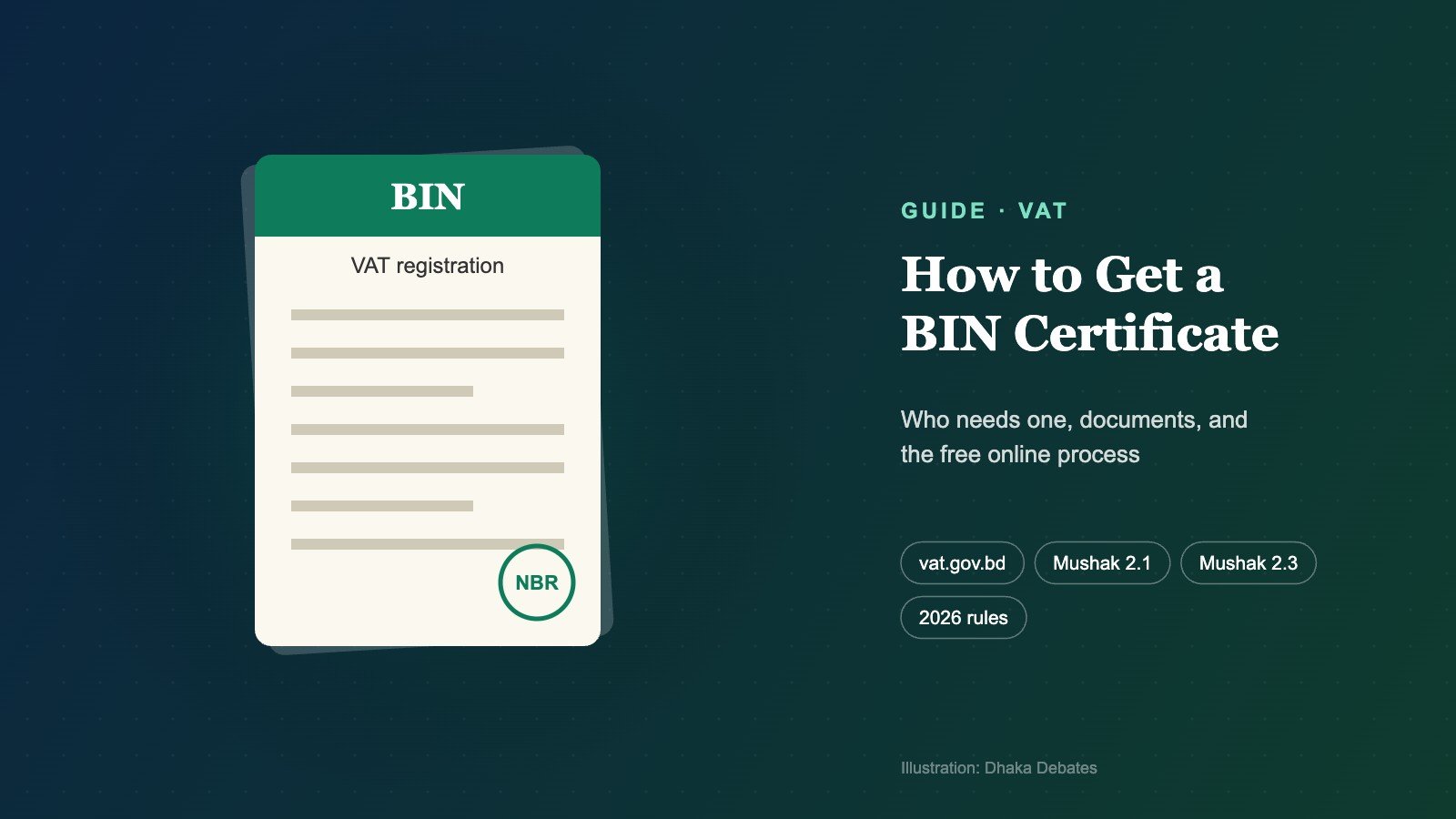
The BIN certificate is the official VAT registration certificate, form Mushak 2.3, which shows your BIN, business name, address and activities. You must display it at your business premises.
BIN, TIN and trade licence: what is the difference?
| Document | Issued by | What it is for |
|---|---|---|
| Trade licence | City corporation, municipality or union parishad | Permission to run a business at a location |
| TIN (e-TIN) | NBR, income tax wing | Income tax identification for a person or company |
| BIN | NBR, VAT wing | VAT registration or enlistment for a business |
Who needs a BIN in 2026?
Two things decide this: your turnover, and the new rules on everyday business services.
Turnover thresholds
| Annual turnover | What applies |
|---|---|
| Up to ৳30 lakh | No VAT or turnover tax payable |
| Above ৳30 lakh up to ৳50 lakh | Turnover tax (enlistment), 4% of turnover |
| Above ৳50 lakh | Full VAT registration; standard rate 15% |
You may find older guides online quoting thresholds of ৳50 lakh and ৳3 crore. Those were earlier rules. Check the date of any guide you rely on.
Businesses that must register regardless of turnover
According to PwC’s summary of Bangladesh’s VAT rules, registration is mandatory, whatever your turnover, for:
- importers and exporters,
- businesses supplying goods or services against a tender,
- suppliers of certain specified goods and services, and
- branches or liaison offices of foreign companies.
The 2026 change: a BIN for everyday business services
The Finance Act 2026 added a new rule to the VAT Act. From 1 July 2026, a BIN or enlistment certificate is a precondition for:
- opening or operating a business current or STD account at a bank or non-bank financial institution,
- taking a loan from a bank or NBFI,
- renewing a trade licence,
- opening an MFS merchant account,
- joining or renewing membership of a trade body,
- getting a business electricity or gas connection, and
- registering a vehicle with BRTA in a business name.
In July 2026, the NBR asked Bangladesh Bank to make banks link all new and existing business current and STD accounts to a BIN, The Business Standard reported. An NBR official expected the rule to bring about 20 lakh new businesses into VAT registration within a year. In practice, this means even a small shop below the turnover threshold will usually need a BIN or enlistment certificate to keep banking normally.
Registration or enlistment: which do you need?
- VAT registration is for businesses above the VAT threshold, or those that must register regardless of turnover. You charge VAT (usually 15%), issue Mushak 6.3 invoices, claim input tax credit, and file Mushak 9.1 returns.
- Enlistment is for turnover tax businesses. You pay a flat percentage of turnover, do not issue Mushak 6.3, cannot claim input tax credit, and file a simpler return.
- Voluntary registration is allowed below the threshold. It can make sense if your customers are businesses that want VAT invoices to claim input tax, or if you plan to bid for tenders.
Both registration and enlistment are applied for through the same online system and form.
What documents do you need?
| Document | Sole proprietor | Partnership | Company |
|---|---|---|---|
| Valid trade licence (name must match) | Yes | Yes | Yes |
| e-TIN certificate | Yes (owner) | Yes (firm) | Yes (company) |
| NID or passport | Owner | All partners | Directors |
| Bank account details in the business name | Yes | Yes | Yes |
| Premises proof (rent agreement or ownership, utility bill) | Yes | Yes | Yes |
| Partnership deed | No | Yes | No |
| Certificate of incorporation, MoA and AoA | No | No | Yes |
| Import or export registration certificate (IRC/ERC) | If trading across borders | If trading across borders | If trading across borders |
| Mobile number and email | Yes | Yes | Yes |
Make sure your business name and address are identical across your trade licence, TIN, bank account and premises documents. Mismatches are one of the most common reasons applications are delayed or rejected. If you have not yet set up your business formally, start with our guide on how to set up a company in Bangladesh.
How do you apply for a BIN online, step by step?
- Go to vat.gov.bd, the NBR’s official e-VAT portal (also called IVAS). Use only the official site; never pay anyone claiming to sell “instant BIN” links.
- Create a user account with your mobile number and email address, and verify both with the one-time codes sent to you.
- Choose registration or enlistment from your dashboard, based on your turnover and business type.
- Fill in form Mushak 2.1. It asks for your business identity, TIN, trade licence number, owners or directors, business and factory addresses, economic activities, expected turnover, bank details, and whether you want one registration for all branches (central registration) or separate unit registrations.
- Upload your documents as clear scans.
- Review and submit. Check every detail; errors in the TIN or address are common reasons for rejection.
- Respond to any queries. The VAT divisional office may ask questions or visit your premises.
- Download your certificate (Mushak 2.3) once approved, print it, and display it at your premises.
How much does it cost and how long does it take?
It is free. There is no government fee for VAT registration or enlistment, according to PwC and the NBR’s own guide. If you hire a consultant, you are paying for their time, not a government charge.
On timing, PwC’s summary of the Finance Act 2026 says registration is now fully automated and a BIN is issued immediately after valid information is submitted, sent to your registered email. In practice, applications that need checking or a premises visit can take a few working days. Missing documents or mismatched details are the usual cause of delay.
What must you do after getting a BIN?
- Display the certificate at your business premises.
- Issue proper invoices. VAT-registered businesses must issue a Mushak 6.3 tax invoice for every taxable sale. See our explainer on what is Mushak 6.3.
- Keep records such as the purchase book (Mushak 6.1) and sales book (Mushak 6.2).
- File returns on time, even when you have no sales. From July 2026 the default is quarterly. See what is Mushak 9.1 and how to submit VAT returns online.
- Update your details on vat.gov.bd if your address, ownership or business activity changes.
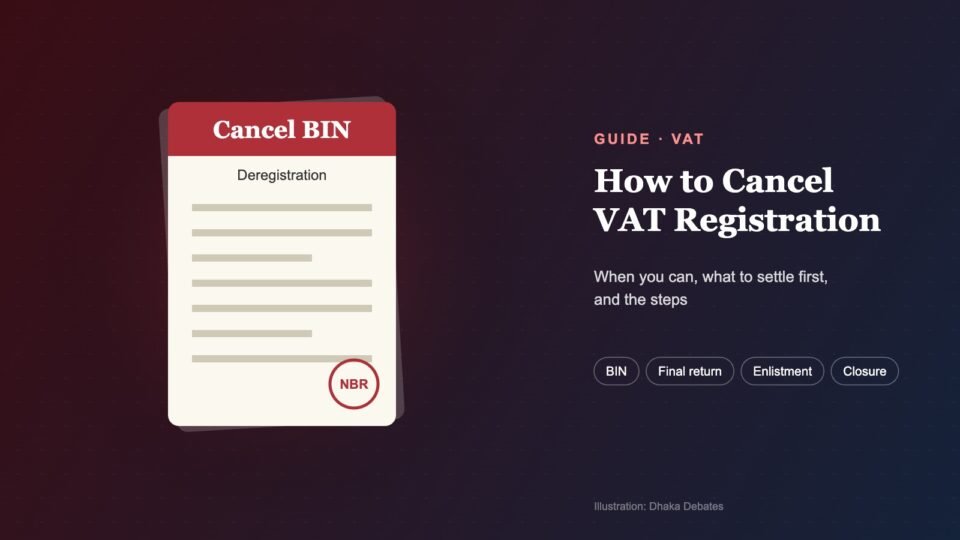
Good accounting software makes VAT records much easier; we compared options in best accounting software for small businesses in Bangladesh. If your business closes, do not simply stop filing; follow our guide on how to cancel VAT registration.
What are common mistakes to avoid?
- Using a trade licence that has expired or shows a different name.
- Entering the wrong TIN or an incomplete address.
- Applying twice and ending up with duplicate registrations.
- Choosing full VAT registration when enlistment fits, or the other way round.
- Getting a BIN and then never filing returns, which leads to notices, interest and fines.
Frequently asked questions
Is a BIN the same as VAT registration?
Yes. The BIN is the number issued when you register (or enlist) under the VAT system. The BIN certificate is the registration certificate, Mushak 2.3.
Is there a fee for a BIN?
No. Registration and enlistment are free on vat.gov.bd.
Do I need a BIN if my turnover is very small?
You may not owe VAT, but since July 2026 a BIN or enlistment certificate is needed for a business bank account, trade licence renewal, an MFS merchant account and other services. Most businesses will therefore need one.
Can a freelancer get a BIN?
A BIN is for a person carrying on a business. Freelancers who operate as a registered business, for example with a trade licence and business account, can apply. Many service exports are zero-rated or exempt, so check with a VAT adviser before registering.
How do I check whether a supplier’s BIN is valid?
Use the BIN verification option on vat.gov.bd and confirm the name and address match the invoice. An invalid supplier BIN can cost you your input tax credit.
Key words explained
| Term | What it means |
|---|---|
| BIN | Business Identification Number, the 13-digit VAT registration number |
| Mushak 2.1 | The application form for VAT registration or enlistment |
| Mushak 2.3 | The VAT registration (BIN) certificate |
| Enlistment | Registration for turnover tax instead of full VAT |
| Turnover tax | A flat tax on the turnover of smaller businesses |
| Input tax credit | VAT paid on purchases that a registered business can deduct from VAT on its sales |
| Central registration | One BIN covering several branches or units |
| e-VAT / IVAS | The NBR’s online VAT system at vat.gov.bd |
How we reported this
We used PwC’s Worldwide Tax Summaries for Bangladesh (reviewed July 2026) and PwC’s summary of the Finance Act 2026, the NBR’s online VAT compliance guide, The Business Standard’s July 2026 report on the NBR’s request to Bangladesh Bank, and published guidance from Bangladeshi law and tax firms on documents and process. Thresholds and rates differ between some sources, which we have noted; confirm the current rules on vat.gov.bd or with a VAT adviser before applying. This article is general information, not legal or tax advice.
Editor’s note: Sabina is an illustrative character based on the common experience of small business owners in Dhaka. She is not a real person.
Sources
- PwC Worldwide Tax Summaries: Bangladesh, other taxes · taxsummaries.pwc.com
- PwC: Finance Act 2026 key amendments · pwc.com
- NBR VAT compliance guide · nbr.gov.bd
- NBR asks BB to require BIN for business bank accounts (The Business Standard) · tbsnews.net
- BIN as a precondition under the Finance Act 2026 (LookUpTax) · lookuptax.com
- BIN registration in Bangladesh: the complete walkthrough (BizRP) · bizrp.com
- VAT/BIN registration guide under Finance Act 2026 (Ismail and Associates) · ismailandassociates.com