How Inflation is Changing the Value of Your Money in Bangladesh
Prices in Bangladesh have risen faster than wages for more than four and a half years. Here is what inflation is, why it has been so high, how it quietly shrinks your salary and savings, and practical steps to protect your money.

Shirin (not her real name; see the note at the end) has managed her family’s kitchen budget in Khulna for twenty years. She keeps a small notebook of prices. In it, she can see how the cost of rice, lentils, oil, eggs and fish has climbed year after year. Her husband’s salary has also gone up, but somehow the money runs out sooner each month. Shirin does not need an economist to tell her what inflation is. But understanding exactly how it works can help her family protect what they have.
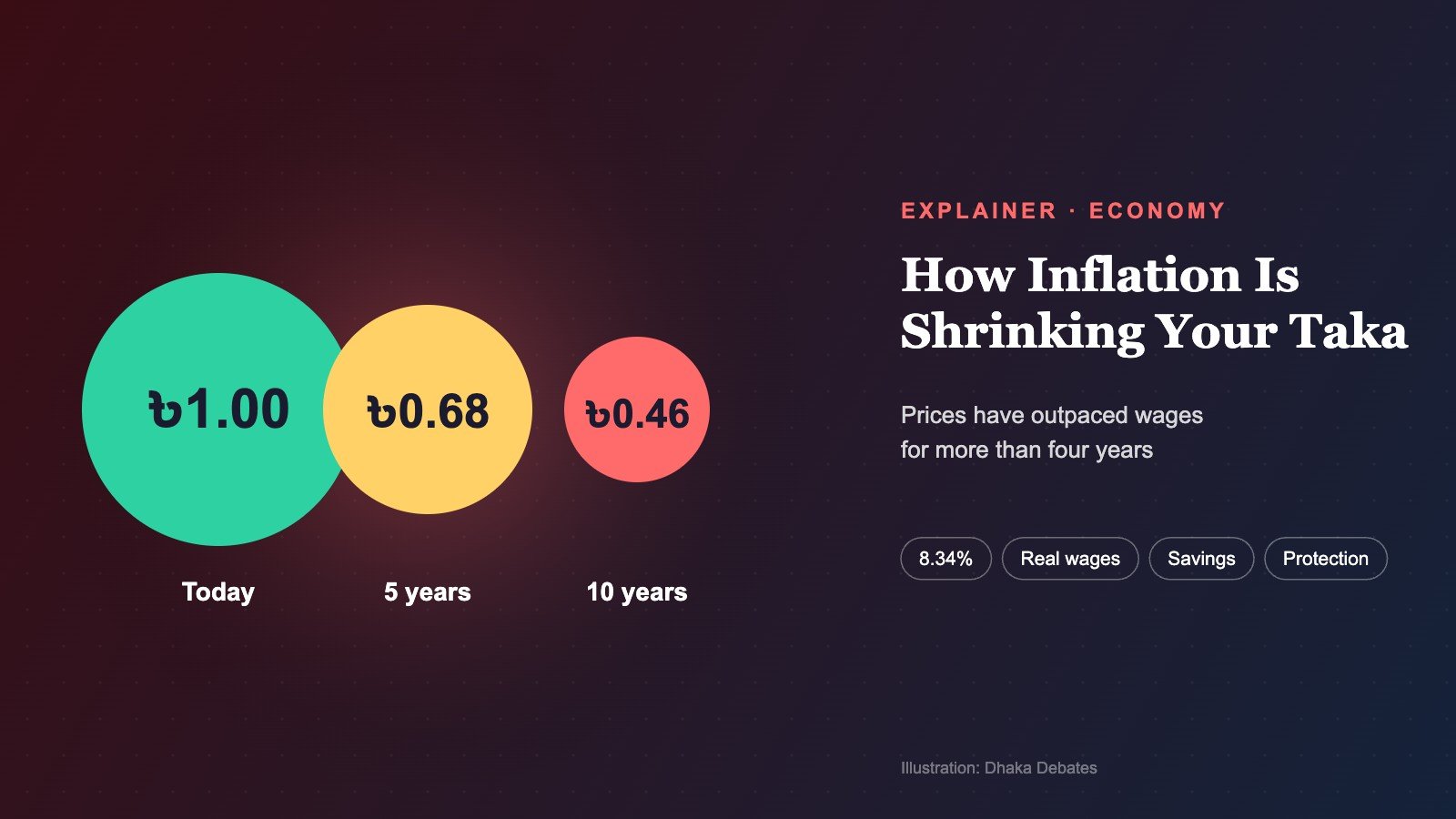
The short answer: Inflation means prices rise over time, so each taka buys less. In Bangladesh, prices rose 8.34% in the year to September 2026, down from a peak of 11.66% in July 2024 but still high. Worse, wages have grown more slowly than prices every month since February 2022, more than four and a half years, according to Bangladesh Bureau of Statistics data reported by bdnews24.com. That means most families have become poorer in real terms even if their salary went up. Our calculation: at 8% inflation, ৳1 lakh kept as cash is worth only about ৳68,000 in today’s money after five years. To protect yourself, keep only what you need in cash, put savings where they earn more than inflation after tax, avoid expensive debt, and plan your budget around rising costs.
What is inflation in simple words?
Inflation is the general rise in prices across the economy. If inflation is 8%, a basket of goods that cost ৳1,000 last year costs about ৳1,080 this year. Your ৳1,000 note has not changed, but it buys less.
In Bangladesh, the Bangladesh Bureau of Statistics (BBS) measures inflation every month by tracking the prices of hundreds of items that households buy, from rice and vegetables to rent, transport, education and medicine. The headline figure you see in the news is usually “point-to-point” inflation: how much prices rose compared with the same month a year earlier.
How high has inflation been in Bangladesh?
For most of the 2010s, inflation in Bangladesh stayed around 5% to 6%. From 2022 it climbed sharply, and it has stayed high since.
| Month | General inflation | Note |
|---|---|---|
| July 2024 | 11.66% | Highest in more than a decade; food inflation 14.1% |
| March 2026 (12-month average) | 8.6% | Bank deposit returns roughly equal to inflation |
| June 2026 (12-month average) | 8.68% | |
| August 2026 | 8.26% | Lowest in 10 months |
| September 2026 | 8.34% | Food 7.22%; non-food 9.30% |
One detail matters for families: in September 2026, non-food inflation (9.30%) was higher than food inflation (7.22%). That means rent, transport, education, healthcare and other services are now rising faster than groceries. Many middle-class households feel this through school fees, house rent and doctors’ bills.
Why has inflation been so high?
- A weaker taka. Since 2022, the taka has lost a large share of its value against the US dollar, moving from around ৳86 to more than ৳120. Bangladesh imports fuel, fertiliser, edible oil, wheat, industrial raw materials and much more, so a weaker taka raises prices across the economy.
- Global shocks. The war in Ukraine in 2022 pushed up world prices for fuel, food and shipping.
- Energy price increases. Government adjustments to fuel, gas and electricity prices raise transport and production costs.
- Market problems. Weak competition, hoarding and supply chain middlemen can push up prices of essentials such as rice, onions and eggs.
- Money supply and government borrowing. Economists have argued that past money printing to finance government spending and support weak banks added to price pressure. Since 2024 Bangladesh Bank has kept interest rates high to bring inflation down, and in August 2026 it made its first policy rate cut in about six years, to 9.5%, The Daily Star reported.
How does inflation affect your salary?
What matters is your “real” income: your salary after adjusting for price rises. BBS tracks a wage index for low-skilled and semi-skilled workers. In August 2026, wages grew 8.05% while inflation was 8.26%, bdnews24.com reported, and wage growth has trailed inflation every month since February 2022.
Our calculation: suppose Shirin’s husband earned ৳40,000 a month two years ago and has had a 7% raise each year, reaching about ৳45,800. If prices rose 9% a year over the same period, his salary would need to be about ৳47,500 just to buy the same things. In real terms, the family is about ৳1,700 a month worse off despite two raises.
This is why so many families feel squeezed even when their income rises. The squeeze is real, and it is worst for people on fixed incomes, such as pensioners, and for low-wage workers whose pay rises slowly.
How does inflation affect your savings?
Savings lose value whenever they earn less than inflation. This “real return” is the number to watch.
| Where your ৳1 lakh sits | Typical return (2026) | Real return at ~8.3% inflation |
|---|---|---|
| Cash at home | 0% | About −8% |
| Ordinary savings account | Low, often a few percent | Negative |
| Bank FDR | About 10% before tax | Close to zero after tax |
| Sanchayapatra | 11.77–11.98% | Positive, roughly 2–3% after tax |
| Treasury bonds | About 10.5–11% | Positive, roughly 1.5–2% after 5% tax |
| Gold | Volatile: strong since 2020, down about 12% in 2026 | Varies widely by year |
Our calculation: at 8% inflation, ৳1 lakh kept as cash is worth about ৳68,000 in today’s money after five years, and about ৳46,000 after ten. Prices roughly double every nine years at that rate. Money that sits idle for a decade loses more than half its buying power.
Bangladesh Bank’s own review found that real returns on new bank deposits had fallen to near zero by March 2026 and turned negative again around June, The Financial Express reported. Savers who keep everything in bank deposits are, at best, standing still.
Does inflation ever help anyone?
Yes: borrowers with fixed-rate loans. If you borrowed ৳10 lakh at a fixed rate, inflation makes each future repayment worth less in real terms. Owners of assets that rise with prices, such as land, property, some businesses and gold, can also keep pace. This is one reason inflation tends to widen the gap between people who own assets and people who live on wages and cash savings.
How can you protect your money from inflation?
1. Keep only working cash
Hold enough cash and wallet balance for daily spending, and keep an emergency fund in a savings account or short FDR at a strong bank. Do not leave large amounts sitting idle at home or in a current account.
2. Put long-term savings where they beat inflation
Government savings certificates and treasury bonds have offered positive real returns in 2026. For money you can leave for many years, a modest share in well-managed mutual funds or shares can grow faster, with more risk. Gold can protect against a falling taka but swings in price. Our guides on government bonds, mutual funds and gold vs fixed deposits explain each option.
3. Pay off expensive debt
Credit card balances and costly personal loans usually charge far more than inflation. Clearing them is a guaranteed saving.
4. Budget for rising prices
- Track your main expenses every month, as Shirin does in her notebook.
- Buy staples in bulk when prices dip, if you have storage and cash.
- Plan for school fees, rent increases and medical costs rising faster than groceries.
- Use government fair-price sales and TCB products where available.
5. Grow your income
When prices rise faster than salaries, the best defence is often a second income stream or new skills that command higher pay. Many Bangladeshis now earn extra through freelancing, tuition or small online businesses.
6. Think in real terms when you plan
When you plan for a child’s education or your retirement, assume costs will rise. Something that costs ৳10 lakh today could cost more than ৳20 lakh in nine years at 8% inflation. Our guide on how to build long-term wealth in Bangladesh explains how to plan with inflation in mind.
What is the government doing about it?
Bangladesh Bank raised its policy rate to 10% during 2024 and kept it there until August 2026 to cool demand and support the taka, before trimming it to 9.5%. Higher rates make borrowing more expensive and saving more attractive, which should slow price rises over time. The government has also adjusted import duties on some essentials and run subsidised sales through the Trading Corporation of Bangladesh (TCB). Inflation has come down from its 2024 peak, but at above 8% it remains well above the 5% to 6% that was normal a decade ago, and well above the levels in neighbouring countries such as India.
Frequently asked questions
What is the current inflation rate in Bangladesh?
8.34% in September 2026, according to BBS data reported by bdnews24.com. Check the latest monthly release for newer figures.
Why do I feel prices are rising faster than the official figure?
The official rate is an average across many items and households. If your spending is weighted towards items rising faster, such as rent, school fees or medicine, your personal inflation may be higher.
Is keeping money in the bank still worth it?
For safety and emergencies, yes. But after tax and inflation, bank deposits have earned close to zero in real terms in 2026, so long-term savings may need to go elsewhere too.
Does a weaker taka cause inflation?
Yes. Bangladesh imports many essential goods and raw materials, so when the taka weakens against the dollar, their prices in taka rise.
Key words explained
| Term | What it means |
|---|---|
| Inflation | The general rise in prices over time |
| Point-to-point inflation | Price rise compared with the same month a year earlier |
| Food / non-food inflation | Price rises for food items, and for everything else such as rent, transport and services |
| Real income | Income after adjusting for price rises |
| Real return | Investment return minus inflation |
| Purchasing power | How much your money can buy |
| Policy rate | Bangladesh Bank’s key interest rate |
| Wage rate index | BBS measure of wage changes for low and semi-skilled workers |
| BBS | Bangladesh Bureau of Statistics, the official statistics agency |
How we reported this
We used BBS inflation and wage data as reported by bdnews24.com (September and October 2026) and The Daily Star (July 2024), Bangladesh Bank’s banking sector review as reported by The Financial Express (July 2026), The Daily Star’s report on the August 2026 policy rate cut, and savings rates from Prothom Alo and The Financial Express. The salary, savings and real return examples are our own calculations. This is general information, not personal financial advice.
Editor’s note: Shirin is an illustrative character based on the common experience of household budget managers in Bangladesh. She is not a real person, and the salary figures are examples only.
Sources
- September 2026 inflation (bdnews24.com) · bdnews24.com
- Inflation and wage growth, August 2026 (bdnews24.com) · bdnews24.com
- July inflation hits 11.66%, highest in 13 years (The Daily Star) · d11.thedailystar.net
- Real returns on fresh bank deposits fall to near zero (The Financial Express) · thefinancialexpress.com.bd
- BB cuts policy rate to 9.5% (The Daily Star) · thedailystar.net
- Profit rates on savings certificates will not be reduced (Prothom Alo) · en.prothomalo.com