How to Claim TDS Credit in Your Income Tax Return
Tax taken from your salary, bank interest and savings certificates counts towards your yearly bill, but only if you claim it. Here is how to claim TDS credit step by step on NBR's e-Return, with a worked example and common mistakes.

Every month, part of your income may already be going to the government before you see it. Your employer takes income tax from your salary. Your bank takes tax from the interest on your savings. The post office or bank takes tax from your savings certificate interest. A client may take tax from your consulting fee.
That money is not lost. It is income tax you have already paid, and it counts towards your yearly bill. But it only counts if you claim it properly in your income tax return. Many taxpayers either forget some of it or enter it wrongly, and end up paying tax twice or getting a return marked incomplete.
The short answer: TDS (tax deducted at source) is income tax that someone else has already deducted from your income and paid to the government for you. In your yearly return, you add up all of it and subtract it from your total tax. On the NBR e-Return system (etaxnbr.gov.bd), you do this in the Tax & Payment section, under Update Tax Payment Status, where each deduction is claimed in the e-Return Ledger. Bank interest and savings certificate TDS can be synced from the income you entered; savings certificates bought from 1 July 2019 can be imported from the National Savings Directorate; government employees’ salary TDS can be pulled from iBAS++; and other salary or deductions are added by hand with the certificate or challan number, date and amount. You do not upload documents, but you must keep the certificates. If your TDS is more than your tax, the difference is a refund.
What counts as TDS on your return?
Any income tax that was deducted or collected from you during the income year (1 July to 30 June) and deposited with the government. Common examples:
| Source of income | Who deducts | Proof you should have |
|---|---|---|
| Salary | Your employer, monthly | Salary certificate or TDS certificate showing tax deducted and challan details |
| Bank savings and fixed deposit interest | Your bank or financial institution | Tax deduction certificate from the bank, or your account statement showing tax deducted |
| Savings certificate (Sanchayapatra) interest | The bank or post office paying the interest | Tax certificate from the issuing office; NSD records for certificates bought from July 2019 |
| Consulting, professional or contract fees | Your client, if it is a specified person | TDS certificate with challan number and date |
| House rent received | Your tenant, if it is a specified person | TDS certificate from the tenant |
| Car ownership (advance income tax) | Collected when you renew your vehicle’s fitness or tax token | Bank deposit transaction number or challan |
| Dividends | The company paying the dividend | Dividend warrant or tax certificate |
Before you start: what to collect
Gather these before you open the e-Return:
- Your TIN and the mobile number registered for e-Return. If you do not have a TIN yet, see how to get an e-TIN certificate.
- Salary certificate from your employer for the full income year.
- Tax deduction certificates or year-end statements from every bank and financial institution where you earned interest.
- Savings certificate details: registration numbers, interest received and tax deducted. For certificates bought before 1 July 2019, you will need paper records.
- TDS certificates from clients or tenants, each showing the challan or certificate number and date.
- Vehicle advance tax receipts, with the bank deposit transaction number.
- Any challans for advance tax you paid yourself.
For each certificate or challan, NBR’s e-Return FAQ says you need the reference, memo or serial number and date for a certificate, or the challan number, date, bank and branch for a challan. Wrong or missing details can make the return invalid or incomplete.
How to claim TDS credit on the e-Return, step by step
The steps below follow NBR’s e-Return FAQ for tax year 2026-27. Menu names may shift slightly as the portal is updated.
- Log in and enter your income first. Log in at etaxnbr.gov.bd and fill in the Income section: salary, interest, rent, business income and so on. This matters because some TDS can only be claimed after the matching income is entered.
- Import savings certificates. In Income from Financial Assets, use Import from NSD for savings certificates bought on or after 1 July 2019. Enter older certificates by hand.
- Go to Tax & Payment. Open Update Tax Payment Status. This opens the e-Return Ledger, where each type of tax already paid is listed.
- Claim source tax. Choose Claim source tax for TDS. For bank interest, profit and savings certificates, use Sync From Income so the TDS matches the income you entered, then save and check the claimed amount.
- Add salary TDS. Government employees choose Salary (iBAS++), click Search, confirm the amount pulled in and save. Everyone else uses Salary (others) and clicks +Add, then enters the employer’s name, the certificate or challan type and number, the date, the certificate amount and the amount you are claiming.
- Add other TDS by hand. For clients, tenants and other deductors, add each certificate the same way. If one certificate or challan covers several people, enter its full amount in the first box and only your share in the claimed amount box.
- Claim advance tax. Choose Claim AIT. For tax on your car, select AIT on Car, enter the bank deposit transaction number, search and save. For advance tax you paid yourself, enter the challan details.
- Check the total. The system adds up all tax already paid and shows any Total Amount Payable. If tax is still due, use Pay Now to pay by e-challan, mobile banking, internet banking or card.
- Go to Return and submit. Click Go to Return, review the full return, submit it and download the acknowledgement.
For the full filing walk-through, see how to submit your income tax return online.
A worked example
Our calculation, for an illustrative salaried taxpayer. Rafiq works for a private company and has a fixed deposit and a savings certificate. Suppose his total tax liability for the year, worked out in the return, is ৳38,000.
| Item | Amount |
|---|---|
| Total income tax for the year (from the return) | ৳38,000 |
| TDS on salary (salary certificate) | − ৳30,000 |
| TDS on fixed deposit interest of ৳40,000 at 10% (bank certificate) | − ৳4,000 |
| TDS on savings certificate interest of ৳30,000 at 10% | − ৳3,000 |
| Advance tax paid on his car | − ৳0 (no car) |
| Balance to pay with the return | ৳1,000 |
If Rafiq forgot to claim the ৳4,000 bank TDS, the system would ask him to pay ৳5,000 instead of ৳1,000. He would have paid the same ৳4,000 twice. If his TDS had added up to more than ৳38,000, the extra would be a refund.
What if more tax was deducted than you owe?
You can get the difference back. PwC notes that individuals whose income is only from employment, financial assets or agriculture get an automated refund within 120 days after filing. Other refund claims go through assessment by the tax office first.
If you have excess tax left over from an earlier year, NBR’s FAQ says it is entered separately under the adjustment option in Tax & Payment, and it takes full effect only after the Deputy Commissioner reviews it.
Is all TDS adjustable?
Not always. Some deductions have been treated as “final tax” in the past, which means they count as your full tax on that income and cannot be refunded. The Finance Act 2026 changed much of this. PwC’s summary says key withholding taxes are no longer treated as final tax. During the budget, Dhaka Tribune reported that tax on savings certificate interest was being changed from a final 5% to an adjustable 10%, which savers below the taxable limit could claim back through a return.
Some exceptions remain. Tax collected on commercial motor vehicles and boats is final, unless regular tax is higher. If you are not sure how a deduction is treated, ask a tax adviser before you file.
Common mistakes
- Claiming TDS without the income. If you claim tax on bank interest but do not show the interest as income, the figures will not match. Use Sync From Income.
- Different numbers in two places. NBR’s FAQ notes that mismatches between the income section and the tax payment section usually come from typing different figures in each place.
- Claiming a joint account’s full TDS. For joint savings certificates or accounts, claim only your share.
- Claiming VDS as TDS. VAT deducted at source belongs in a business’s VAT return, not the income tax return. See TDS vs VDS: what’s the difference?
- No certificate. If an employer or client did not give you a certificate, ask for one in writing, with the challan number and date. Without it you cannot fill in the details properly.
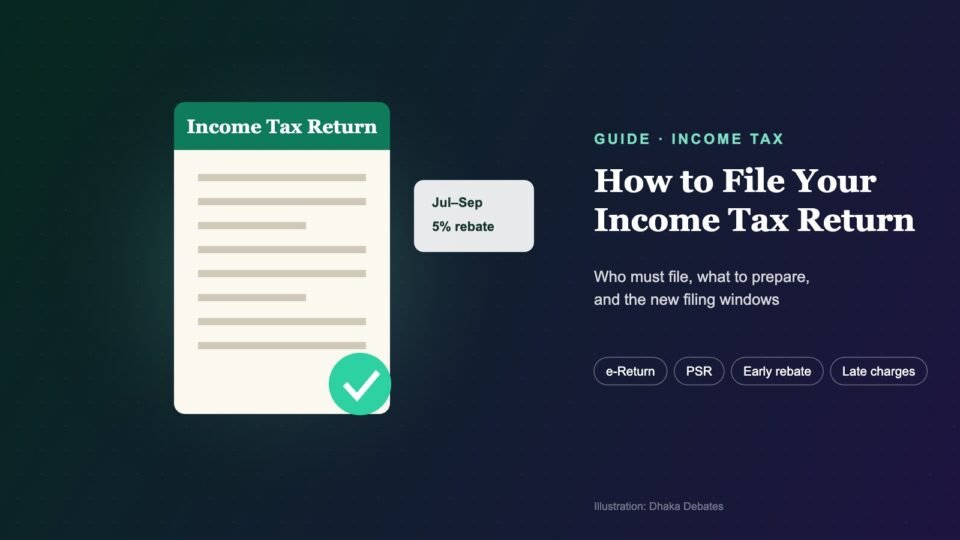
- Ignoring the timing. NBR’s FAQ says returns filed from 1 July to 30 September get a 5% rebate on net tax payable, up to ৳25,000, while later filing can bring extra tax. Claim all your TDS early so your net figure is right.
What about businesses?
Companies and firms claim TDS deducted from their income in the same way, in their own returns. Under the Finance Act 2026, a business that also deducts tax from others must attach the acknowledgement copy of its withholding tax return, or its own income tax return is treated as incomplete, PwC notes. Keeping TDS certificates with your accounts makes this much easier; see how to maintain VAT records for your business for a records routine that covers both taxes.
Frequently asked questions
Do I need to upload TDS certificates?
No. The e-Return does not ask for uploads. You type in the certificate or challan details. Keep the originals in case the tax office asks.
My employer deducted tax but my salary certificate is missing. What can I do?
Ask your employer’s HR or accounts team for a salary certificate showing tax deducted and the challan details. If they refuse or delay, write to them and keep the request.
My bank TDS does not show up. Why?
Bank and savings certificate TDS is linked to the income you entered. Enter the interest income first, then use Sync From Income in the tax payment section.
Can I correct a return if I forgot some TDS?
NBR’s FAQ says corrections to a filed return can be submitted within 180 days of filing.
Is TDS the same as advance income tax (AIT)?
They work the same way in your return: both are tax already paid. TDS is deducted from a payment to you. AIT is tax you pay in advance yourself or that is collected from you, for example on a car.
Key words explained
| Term | What it means |
|---|---|
| TDS | Tax deducted at source: income tax kept back from a payment to you |
| AIT | Advance income tax: tax paid before the return, such as on a car or by your own challan |
| TDS certificate | Proof from the deductor that tax was deducted and deposited |
| Challan | The receipt for tax paid to the government through a bank or online |
| e-Return Ledger | The part of the e-Return where all tax already paid is listed |
| iBAS++ | The government’s financial system, used to pull salary TDS for government employees |
| NSD | National Savings Directorate, which holds savings certificate records |
| Final tax | Tax that settles your liability on that income and cannot be refunded |
| Income year | 1 July to 30 June, the year your income and TDS relate to |
Related guides: how to calculate income tax, how to file an income tax return, and government bonds in Bangladesh.
How we reported this
We followed NBR’s e-Return FAQ for tax year 2026-27 for the menu names and claiming steps, and used PwC’s Worldwide Tax Summaries for Bangladesh (individual tax administration and withholding tax pages, reviewed July 2026) and PwC’s summary of the Finance Act 2026 for refunds, rates and final-tax changes. Dhaka Tribune’s budget coverage informed the savings certificate section. The worked example is our own calculation. This is general information, not tax advice.
Editor’s note: Rafiq is an illustrative example, not a real person.
Sources
- NBR: FAQ on e-Return 2026 · nbr.gov.bd
- PwC Worldwide Tax Summaries: Bangladesh, individual tax administration · taxsummaries.pwc.com
- PwC Worldwide Tax Summaries: Bangladesh, corporate withholding taxes · taxsummaries.pwc.com
- PwC Bangladesh: Finance Act 2026 key amendments · pwc.com
- Dhaka Tribune: Double tax on savings certificates hits middle class, pensioners the hardest · dhakatribune.com