How Artificial Intelligence Is Changing Banking
From Bangla chatbots answering half a bank's calls to AI face checks, fraud alerts and instant loan decisions, artificial intelligence is quietly reshaping Bangladeshi banking. We look at what is already happening, the risks, and how the central bank is responding.

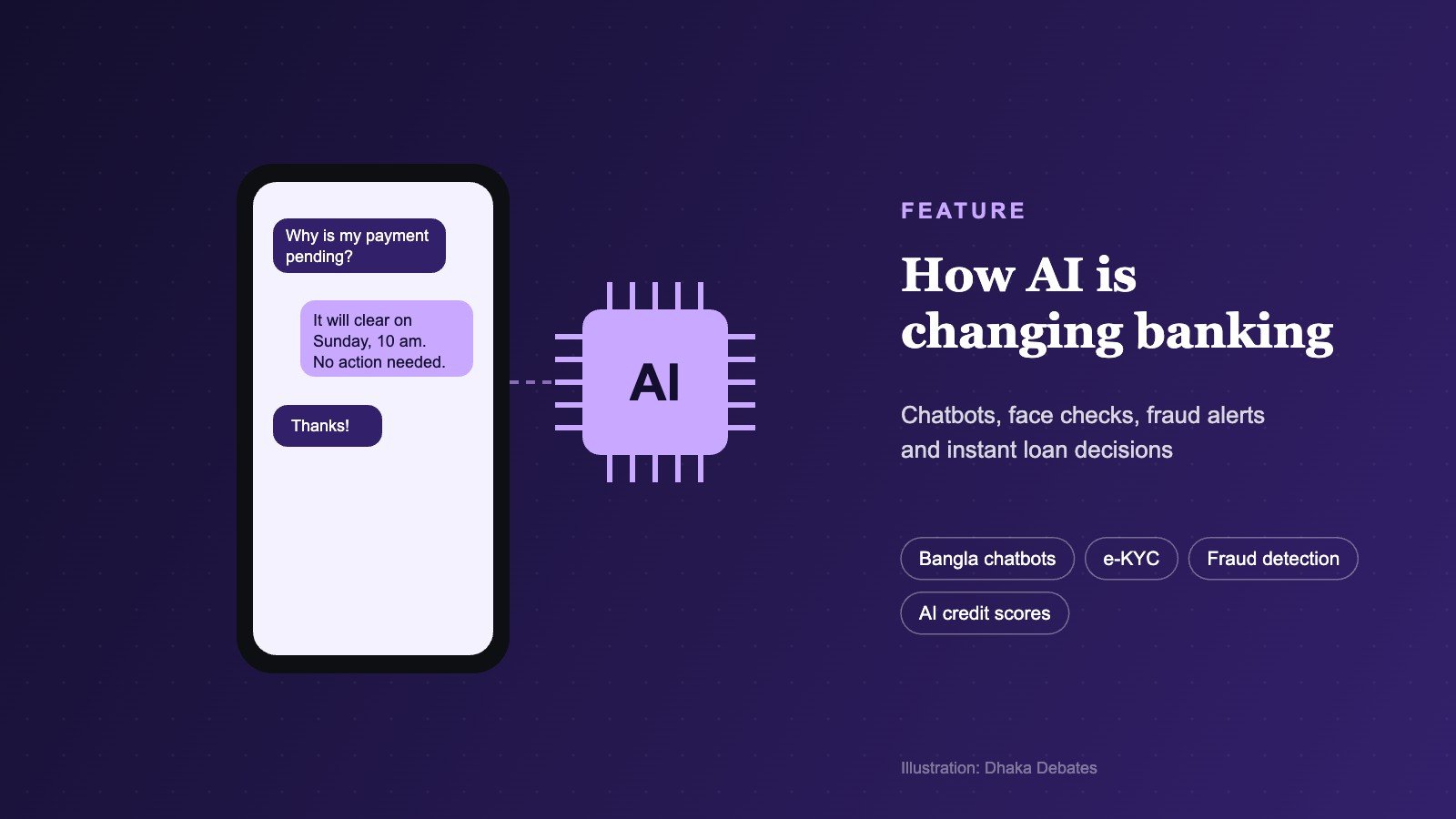
At 11:40 on a Friday night, Rakib needed to know why his credit card payment had not gone through. A year ago, that would have meant waiting on hold for a call centre agent or giving up until Sunday. This time he typed his question, half in Bangla and half in English, into his bank’s app. A chatbot understood him, checked his account, explained that his payment was pending because of a holiday cut-off, and told him exactly when it would clear. The whole exchange took two minutes.
Rakib did not think of it as artificial intelligence. He just thought the bank had become easier to deal with. That is how most people will experience AI in banking: not as robots in branches, but as small changes that make services faster, safer and, sometimes, a little unsettling.
The short answer: Artificial intelligence is changing banking in five main ways: customer service chatbots, faster digital account opening with face checks, fraud and money-laundering detection, automated credit decisions and more personal product offers. In Bangladesh this is already happening. City Bank’s Bangla-and-English chatbot handles about half of its roughly 6,000 daily customer interactions, UCB uses AI in nearly 25 banking processes, and bKash uses AI for credit scoring, face verification and recommendations, The Daily Star reported in August 2026. Globally, McKinsey estimates AI could add $340 billion a year in value to banking, though only about one in four banks is using it at scale. The risks are real: data leaks, biased lending decisions, deepfake fraud and job changes. Bangladesh Bank is drafting an AI policy and in June 2026 barred its own staff from entering confidential data into public AI tools such as ChatGPT, Gemini and Claude.
What does AI actually do inside a bank?
“Artificial intelligence” covers several different technologies. In banking, the most important are:
| Technology | What it does | Banking example |
|---|---|---|
| Machine learning | Finds patterns in large amounts of data and makes predictions | Spotting unusual transactions that may be fraud; predicting which borrowers may fall behind |
| Computer vision | Understands images and video | Matching your selfie to your NID photo during account opening; detecting fake faces |
| Natural language processing | Understands and writes human language | Chatbots that answer questions in Bangla and English |
| Generative AI and large language models | Writes text, summarises documents, answers open questions | Drafting replies for call centre staff; summarising loan files |
| Recommendation systems | Suggests products based on behaviour | Offering a loan or savings plan that matches your activity |
How are Bangladeshi banks using AI today?
A Daily Star investigation published in August 2026 gave the clearest picture so far of AI inside Bangladeshi banks and wallets:
| Institution | How it uses AI |
|---|---|
| City Bank | An LLM-based chatbot reading Bangla and English handles about 3,000 of roughly 6,000 daily customer interactions; an overnight system matches more than 30 lakh customers’ activity to products such as loans, deposits and cards |
| Eastern Bank (EBL) | Face verification for digital onboarding, real-time anti-money laundering monitoring, fraud and cyber threat detection, automated credit scoring and early warning on risky borrowers; internal staff chatbot |
| United Commercial Bank (UCB) | AI in nearly 25 processes, from onboarding to loan disbursement |
| NCC Bank | AI ATM surveillance, e-KYC, deepfake detection, liveness checks and behavioural analytics in its apps |
| Mercantile Bank | AI fraud detection being introduced; AI credit assessment for its nano-loan platform |
| Mutual Trust Bank (MTB) | MTB Neo chatbot and automated call centre support; voice banking planned |
| bKash | Credit scoring for micro-loans, ID and face verification, recommendation engine, chatbots, customer retention models and a loyalty engine |
| Nagad | AI-generated marketing content to cut costs |
“If today’s transactions indicate a financial need, the customer can receive the right recommendation the very next day,” City Bank’s head of digital banking Syed Ibrahim Saajid told the paper. UCB’s chief communication officer Zeeshan Kingshuk Huq said AI “cuts manual work and eliminates human errors.”
1. Customer service that never closes
Chatbots are the most visible change. Older chatbots could only answer fixed questions from a menu. Newer ones, built on large language models, can understand mixed Bangla and English, follow a conversation and look up account details securely. That means routine questions about balances, card blocks, transfer status or fees can be answered at any hour, freeing human staff for complex problems.
The limit is trust. A chatbot that gives a wrong answer about a fee or a loan can cost a customer money. Banks need clear routes to a human, and customers should double-check important answers.
2. Opening an account with your face
Electronic know-your-customer (e-KYC) checks use AI to compare a live selfie with the photo on your national ID card, and “liveness” checks make sure a real person is in front of the camera rather than a photo or video. This is why you can now open a bank account or wallet in minutes from your phone. It also helps bring more people into the formal financial system, a problem we looked at in why millions of Bangladeshis still don’t have access to formal banking.
The risk is deepfakes. Criminals can now create realistic fake faces and voices. That is why banks such as NCC Bank say they are adding deepfake detection to their apps.
3. Catching fraud and money laundering
Every day, banks process millions of transactions. Humans cannot check them all. AI systems learn what normal behaviour looks like for each customer and flag anything unusual: a card used in two countries within an hour, a sudden large transfer to a new beneficiary late at night, or a pattern that matches known scams. Eastern Bank told The Daily Star it uses AI for real-time anti-money laundering monitoring and to detect phishing and abnormal user behaviour.
This matters in a country where fraud through fake calls, SIM swaps and phishing links is common. AI can stop some fraud before money leaves your account, though no system catches everything.
4. Faster, data-driven loans
AI credit scoring is perhaps the most important change for Bangladesh. Traditional lending depends on collateral and paperwork, which most small borrowers lack. AI models can assess borrowers using their transaction history instead: how much flows through their wallet, whether they pay bills on time, how stable their income looks.
The bKash and City Bank nano-loan partnership shows what is possible. By July 2026, it had disbursed over $811 million across 3.19 crore small loans to about 35 lakh customers, with non-performing and written-off amounts of about 0.5% of disbursements, LightCastle Partners reported. bKash told The Daily Star it uses AI-based credit scoring for these micro-loans.
The big question is whether AI can help with larger loans to small businesses, which face the biggest finance gap. We covered that in our feature on why small businesses struggle to access finance.
5. More personal offers
Banks are using AI to decide which products to offer each customer and when. City Bank’s system, for example, refreshes customer profiles overnight and matches activity to products such as secured loans, deposits, insurance and credit cards. Done well, this means fewer irrelevant offers. Done badly, it can push people into debt they do not need. A loan offer appearing at the moment you are short of money is helpful for some and dangerous for others.
How big could the change be?
Globally, the potential is large but unevenly realised. McKinsey estimates AI could add $340 billion a year in value to the global banking industry, and has warned that agentic AI, systems that can act on a customer’s behalf, could help digital challengers compete for some $23 trillion in low-interest deposits, according to figures reported by WION in March 2026. Yet the same report cited Boston Consulting Group findings that only about one in four banks worldwide is using AI at scale for competitive advantage; the rest are stuck in pilots.
That “pilot problem” is visible in Bangladesh too. Many banks have one or two AI tools, but few have changed how the whole bank works. Old core banking systems, scattered data and a shortage of AI skills hold them back. We explored the deeper reasons in why traditional banks struggle to go digital.
What are the risks?
Data leaks
AI needs data, and banking data is among the most sensitive there is. Bangladesh Bank itself is worried. In an office order dated 28 June 2026, it told its officials not to enter confidential or sensitive information into AI tools such as ChatGPT, Gemini, Claude, Grok and DeepSeek “under any circumstances,” and to get approval before using AI for official work, The Business Standard reported. The central bank cited concern over data security and cross-border information transfer.
Unfair decisions
AI models learn from past data. If that data reflects past discrimination, for example against women or rural borrowers, the model can repeat it, refusing loans unfairly without anyone noticing. Customers also have a right to understand why they were rejected, which is hard when a complex model makes the decision.
Deepfakes and AI-powered scams
The same technology that helps banks also helps criminals. Fake voices of bank officials, fake video calls and highly convincing phishing messages are becoming easier to make. Banks are responding with liveness checks and deepfake detection, but customers need to stay alert.
Jobs
AI will change many banking jobs, especially in call centres, data entry, document checking and back-office processing. Some roles will shrink; others, such as data analysis, AI oversight and complex customer advice, will grow. Banks that retrain staff will manage the shift better than those that simply cut.
Weak governance
A Bangladesh Institute of Bank Management study found that about 60% of local banks had no AI policy for cyber security, The Daily Ittefaq reported in November 2025. Without clear rules on who approves AI systems, how they are tested and who is responsible when they fail, banks take on risks they may not understand.
What is Bangladesh Bank doing?
Bangladesh Bank has begun drafting a policy to govern AI in banking, with a seven-member team from its IT division working on it, The Daily Ittefaq reported. The aim is a unified, secure framework covering fraud prevention, risk management, forecasting, efficiency and customer service. The central bank also said it planned to build its own large language model so sensitive financial data would not need to be sent abroad, and that AI could improve its forecasts of inflation, growth and foreign currency reserves.
Meanwhile, the Dhaka Stock Exchange is preparing an AI-powered system to detect suspicious trading, The Daily Star reported, with its managing director saying the goal is for AI to support analysts, not replace them.
What should good AI banking look like?
Based on the evidence and international practice, this is our view of what customers should expect:
- A human when it matters. Easy access to a person for complaints, disputes and big decisions.
- Clear explanations. If AI turns down a loan, the customer should be told the main reasons.
- Fairness testing. Banks should check regularly that their models do not discriminate against women, rural customers or other groups.
- Data kept safe and local where needed. Customer data should not be fed into public AI tools or sent abroad without proper safeguards.
- Honest marketing. AI-driven loan offers should come with clear costs and should not target people at their most vulnerable moments.
What can you do as a customer?
- Use your bank’s official app and chatbot, never links sent by SMS or social media.
- Never share your PIN, OTP or password, even with a voice or video call that seems to be from your bank. Deepfakes can sound and look real.
- Do not paste your account statements or personal financial details into public AI chat tools.
- Read the terms of any instant loan offer carefully before accepting.
- If a chatbot’s answer affects your money, ask for confirmation from a human.
For the bigger picture of where digital finance in Bangladesh is heading, see our stories on whether Bangladesh can become South Asia’s next fintech hub, Banking as a Service and how blockchain could change financial services.
Frequently asked questions
Do Bangladeshi banks use AI?
Yes. Banks including City Bank, EBL, UCB, NCC Bank, Mercantile Bank and MTB, and wallets such as bKash, use AI for chatbots, e-KYC, fraud detection, credit scoring and product recommendations.
Is it safe to talk to a bank chatbot?
Yes, inside your bank’s official app or website. Never share your PIN or OTP, and confirm important answers with a human.
Can AI decide my loan?
Increasingly, AI helps assess loans, especially small digital ones. Larger loans usually still involve human review.
Does Bangladesh have rules on AI in banking?
Bangladesh Bank is drafting an AI policy for the sector and has restricted its own staff from putting confidential data into public AI tools.
Key words explained
| Term | What it means |
|---|---|
| Artificial intelligence (AI) | Computer systems that perform tasks that normally need human judgement. |
| Machine learning | AI that learns patterns from data to make predictions. |
| Large language model (LLM) | AI trained on huge amounts of text to understand and write language. |
| Chatbot | Software that answers questions in a conversation. |
| e-KYC | Electronic identity checks, often using face matching with your NID. |
| Liveness check | A test that confirms a real person, not a photo or video, is in front of the camera. |
| Deepfake | A fake image, video or voice created with AI. |
| Credit scoring | Estimating how likely a borrower is to repay. |
| Agentic AI | AI that can take actions on its own, such as moving money between accounts for a customer. |
How we reported this
We drew on The Daily Star’s August 2026 investigation into AI use at Bangladeshi banks and wallets, The Business Standard’s report on Bangladesh Bank’s AI data directive, The Daily Ittefaq’s reporting on the central bank’s draft AI policy, LightCastle Partners’ data on nano-loans and WION’s report on McKinsey and BCG findings. Descriptions of how bank AI systems work are general explanations. The list of what good AI banking should look like is Dhaka Debates’ analysis.
Editor’s note: Rakib is an illustrative example created for this story, not a real customer.
Sources
- The Daily Star: Money talks: Now the machines are listening · thedailystar.net
- The Business Standard: Don’t use confidential data in AI tools: Bangladesh Bank · tbsnews.net
- The Daily Ittefaq: BB formulating AI policy to boost security · en.ittefaq.com.bd
- WION: $340 billion annual growth, $23 trillion at risk: banks stuck in AI’s demo room · wionews.com
- McKinsey: Closing banking’s AI value gap · mckinsey.com
- LightCastle Partners: Financing Bangladesh’s SMEs · lightcastlepartners.com
Keep reading
What Is Bangla QR? Who Owns It, How Does It Work, and Who Runs the System?
What Bangladesh Can Learn From Singapore’s Banking System
What Is Embedded Finance? Explained With Real Examples