How to Build Long-Term Wealth in Bangladesh
Long-term wealth in Bangladesh comes from beating inflation steadily for decades: protect yourself first, avoid costly debt, save automatically, and spread money across Sanchayapatra, treasury bonds, funds, shares, gold and property. A practical, numbers-based guide.

Tanvir (not his real name; see the note at the end) is 28, works as an executive at a pharmaceutical company in Dhaka and earns ৳55,000 a month. He sends ৳10,000 home to his parents in Cumilla, pays rent in Mohammadpur and usually has a few thousand taka left at the end of the month, which vanishes into eating out and phone instalments. He wants to own a flat one day and retire without depending on his children. He does not know where to start.
This guide is for people like Tanvir: salaried, middle-income, with real family responsibilities. It does not promise quick riches. It explains how ordinary Bangladeshis can build real wealth over 20 to 30 years.
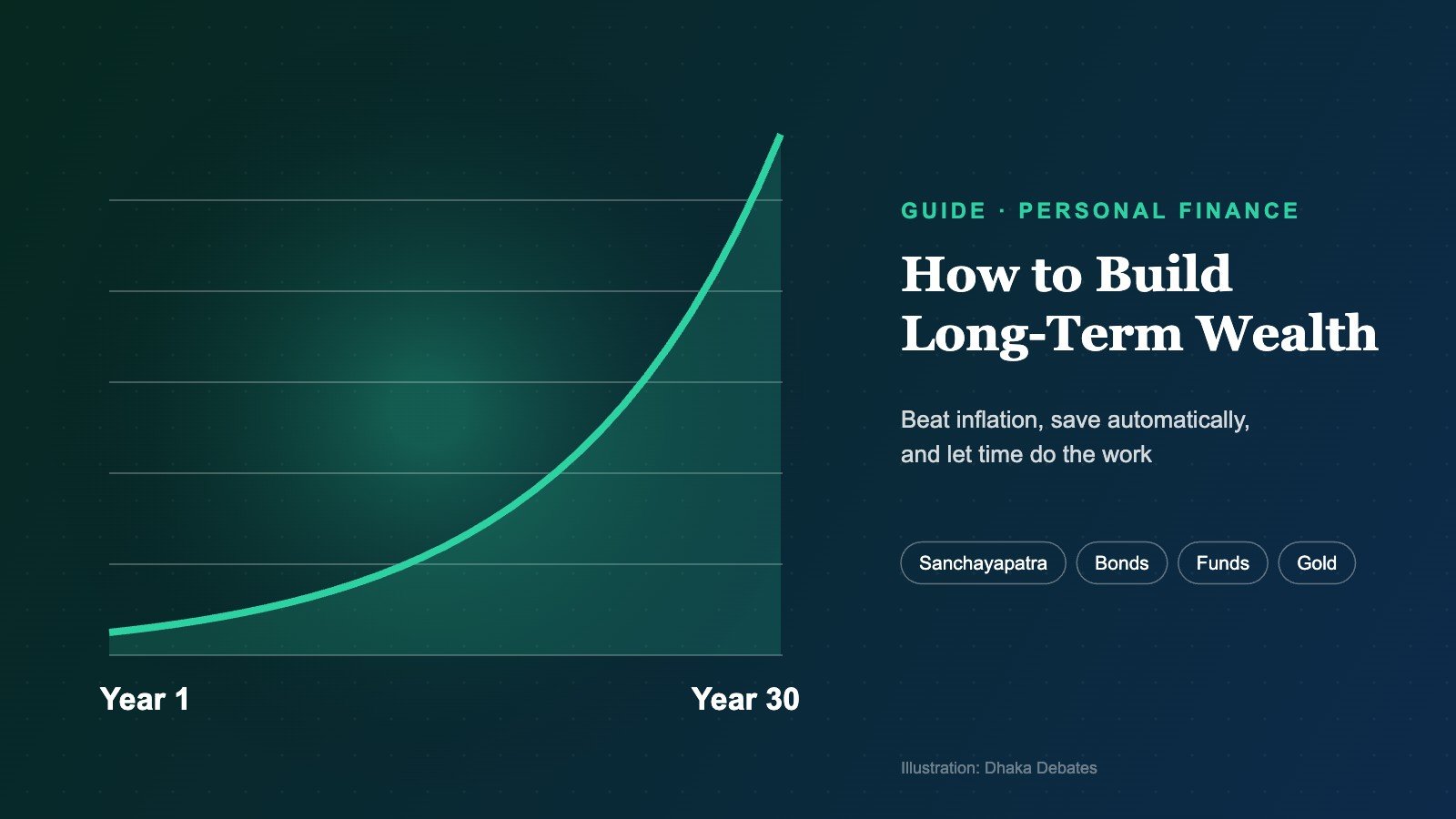
The short answer: Long-term wealth in Bangladesh is built by earning returns that beat inflation, year after year, for decades. With prices rising about 8% a year recently, money that earns 6% is quietly shrinking, while money that earns 12% doubles in real terms over a generation. The steps are simple, though not easy: protect yourself first with an emergency fund and insurance; clear expensive debt; save a fixed share of income automatically; spread long-term money across government-backed savings (Sanchayapatra pays around 11.8% to 12% in 2026), treasury bonds, mutual funds and shares, gold and, later, property; and keep going through bad years. Time does most of the work.
What does “long-term wealth” actually mean?
Wealth is not a high salary. Many high earners in Dhaka have little saved because their spending rises with their income. Wealth is what you own minus what you owe: savings, investments, property and gold, minus loans and credit card debt. Long-term wealth means that number keeps growing faster than prices, so that one day your assets can pay for your life without a salary.
Why is inflation the biggest enemy?
Prices in Bangladesh rose 8.34% in the year to September 2026, according to the Bangladesh Bureau of Statistics as reported by bdnews24.com, after running above 9% for long stretches in 2023 to 2025. When prices rise that fast, the return that matters is the “real” return: what you earn minus inflation.
Our calculation: here is what ৳1 lakh becomes after 20 years at different returns, and what it is worth in today’s money if prices rise 7% a year on average.
| Yearly return | Value after 20 years | Worth in today’s taka (7% inflation) | Result |
|---|---|---|---|
| 6% (a typical savings account or less) | ৳3.21 lakh | about ৳83,000 | You lose buying power |
| 9% | ৳5.60 lakh | about ৳1.45 lakh | Modest real growth |
| 12% | ৳9.65 lakh | about ৳2.49 lakh | Real wealth more than doubles |
The difference between 6% and 12% looks small in one year. Over 20 years, it is the difference between getting poorer and becoming genuinely better off. Read more in our explainer on how inflation is changing the value of your money in Bangladesh.
Step 1: Protect yourself before you invest
Wealth-building fails most often not because of bad investments but because of emergencies. A hospital bill, a job loss or a family crisis forces people to sell investments at a loss or borrow at high interest. So the foundation comes first.
- Emergency fund: keep three to six months of essential expenses in a safe, easy-to-reach place, such as a savings account or short FDR at a strong bank. For Tanvir, that is about ৳1.5 lakh to ৳3 lakh.
- Health cover: check what your employer provides. If it is weak, consider a personal health or hospitalisation policy, especially for parents who depend on you.
- Life cover: if others depend on your income, a simple term life policy gives large cover for a low premium. Avoid mixing insurance with investment unless you understand the costs.
Our guide on how to save your first ৳1 lakh is a good place to start building that cushion.
Step 2: Get rid of expensive debt
No investment reliably earns more than credit card interest. If you carry a credit card balance, an expensive personal loan or informal debt, paying it off is the best “investment” you can make. Be careful with easy instalment offers on phones and gadgets too; they feel small but commit future income. Borrowing to buy a home or to grow a business can make sense. Borrowing to fund lifestyle rarely does.
Step 3: Save first, spend the rest
Most people save whatever is left at the end of the month, which is usually nothing. Wealthy savers reverse this: they move a fixed share to savings on salary day and live on the rest.
- Set a target: start with 10% to 20% of take-home pay. If that is too much, start with 5% and raise it each time you get a raise.
- Automate it: a monthly DPS, a standing instruction to a separate account, or a systematic investment plan (SIP) in a mutual fund moves the money before you can spend it.
- Raise savings with income: when your salary rises, save at least half of the increase.
Our calculation: if Tanvir invests ৳5,000 a month for 25 years, he puts in ৳15 lakh. At an average 9% a year, it grows to about ৳56 lakh. At 12%, it grows to about ৳94 lakh. The extra growth comes entirely from compounding and a higher return, which is why both starting early and choosing well matter.
Step 4: Know your options and their trade-offs
Bangladesh has a narrower range of investments than richer countries, but there are enough to build a sensible mix.
Sanchayapatra (government savings certificates)
Backed by the government and paying some of the highest safe returns available. In July 2026 the government kept rates unchanged at between 11.77% and 11.98%, depending on the certificate, Prothom Alo reported. The popular Family Savings Certificate pays 11.93% for investments up to ৳7.5 lakh. There are purchase ceilings, a TIN is required above certain amounts, and tax is deducted from the profit. Early encashment pays less. For long-term savers, Sanchayapatra is one of the strongest foundations.
Treasury bonds
Government bonds with terms from 2 to 20 years. In April 2026, the five-year bond’s cut-off yield was 10.75% and the ten-year was 10.98%, The Financial Express reported. Individuals can buy them through banks or through a stockbroker using a BO account, with a minimum of ৳1 lakh. Unlike Sanchayapatra, they have no purchase ceiling, which makes them useful once you exceed certificate limits. See our explainer on what government bonds are and how to invest.
Bank FDR and DPS
Safe and simple, with recent FDR rates around 10% at many banks. After tax and inflation, the real return has been close to zero, Bangladesh Bank itself noted in 2026. Good for emergency funds and short-term goals, weaker for long-term growth. Choose strong banks and stay within the ৳2 lakh deposit insurance limit per bank where you can.
Mutual funds and shares
Over long periods, owning shares in growing companies has built the most wealth in most countries. Bangladesh’s stock market has been volatile and troubled by manipulation, but it has also had strong periods; the DSEX index reached a year high of 5,866 points in July 2026 on hopes of reform, UNB reported. A well-managed mutual fund spreads your money across many companies and is easier for beginners than picking individual shares. Invest only money you will not need for at least five to seven years, and expect falls along the way. See our guide on how to invest in mutual funds in Bangladesh.
Gold
A traditional store of value that tends to rise when the taka weakens. It has done very well since 2020 but fell about 12% between January and November 2026. Keep it to a modest share, and prefer bars or coins to jewellery for investment. Our feature on gold vs fixed deposits goes deeper.
Land and flats
Property is the dream asset for many Bangladeshi families, and land in growing areas has risen strongly over decades. But it needs a large sum, is hard to sell quickly, and carries legal risks such as disputed ownership and fraud. Rental yields on Dhaka flats are often low compared with the price. For most young savers, property is a goal for the middle of the journey, not the start.
Pension and provident funds
If your employer offers a provident fund, take full advantage of it, especially any matching contribution. Those without one, including the self-employed and informal workers, can join the government’s Universal Pension Scheme. We explain it in our guide to the Universal Pension Scheme in Bangladesh.
| Option | Recent return | Risk | Easy to sell? | Best role |
|---|---|---|---|---|
| Savings account / short FDR | About 9–10% (FDR) | Low (bank risk) | Yes | Emergency fund, short-term goals |
| Sanchayapatra | 11.77–11.98% | Very low | Yes, with reduced profit | Core long-term safe savings |
| Treasury bonds | About 10.7–11% (April 2026) | Very low if held to maturity | Yes, through market or bank | Safe savings above certificate limits |
| Mutual funds | Varies widely | Medium to high | Yes | Long-term growth |
| Individual shares | Varies widely | High | Yes | Long-term growth, for experienced investors |
| Gold | Strong since 2020; down in 2026 | Medium | Yes, but jewellery loses value | Protection against a weaker taka |
| Land and flats | Varies by location | Medium; legal risks | No, slow | Mid-life goal, family home |
Step 5: Build a mix that fits your age and goals
Spreading money across different types of assets, called diversification, protects you when one goes badly. The right mix depends on your age, income stability, family duties and how much loss you can stomach. Here is an illustrative starting point, not personal advice:
| Life stage | Safe savings (Sanchayapatra, bonds, FDR) | Growth (funds, shares) | Gold |
|---|---|---|---|
| 20s to 30s, stable job | 50–60% | 30–40% | 5–10% |
| 40s, family and home goals | 60–70% | 20–30% | 5–10% |
| 50s and nearing retirement | 75–85% | 10–15% | 5–10% |
Bangladesh’s high government savings rates mean safe options carry more weight here than in many countries. That is a sensible response to local conditions, not timidity.
Step 6: Grow your income, not just your savings
Saving 20% of ৳40,000 is ৳8,000. Saving 20% of ৳80,000 is ৳16,000. In your twenties and thirties, the biggest return often comes from investing in yourself: skills, certifications, English and digital skills, or a side business. Many Bangladeshi professionals now earn extra through freelancing. Just keep the habit of saving a fixed share as income grows.
Step 7: Stay the course and avoid traps
- Get-rich-quick schemes: e-commerce “cash back” schemes, multi-level marketing and promises of fixed monthly profits have cost Bangladeshis thousands of crores. If it sounds too good to be true, it is.
- Stock tips: buying shares on rumours in Facebook groups is gambling, not investing.
- Unregulated crypto and forex apps: high risk, often illegal for residents, and full of scams.
- Panic selling: long-term investments will fall sometimes. Selling in a panic locks in losses.
- Lifestyle creep: spending every raise on a bigger flat, car or phone instead of saving part of it.
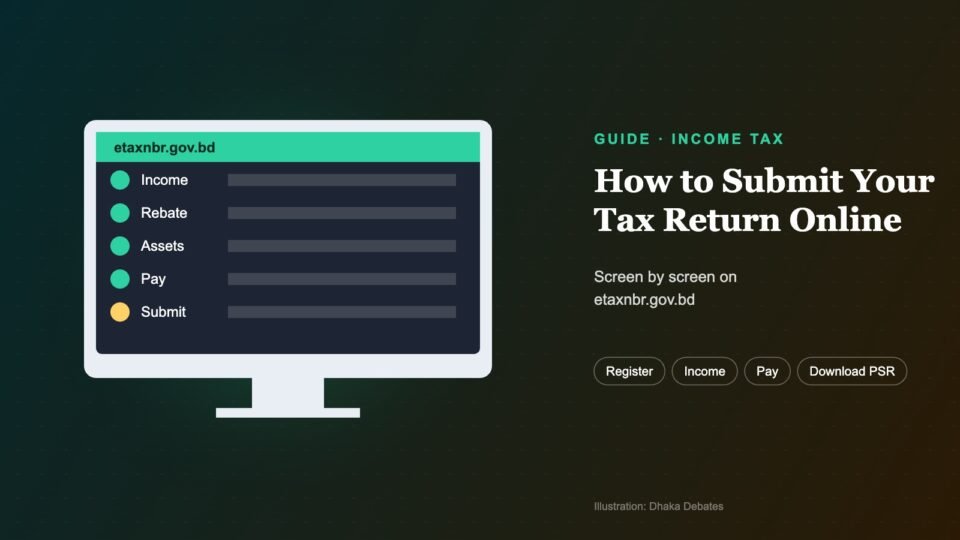
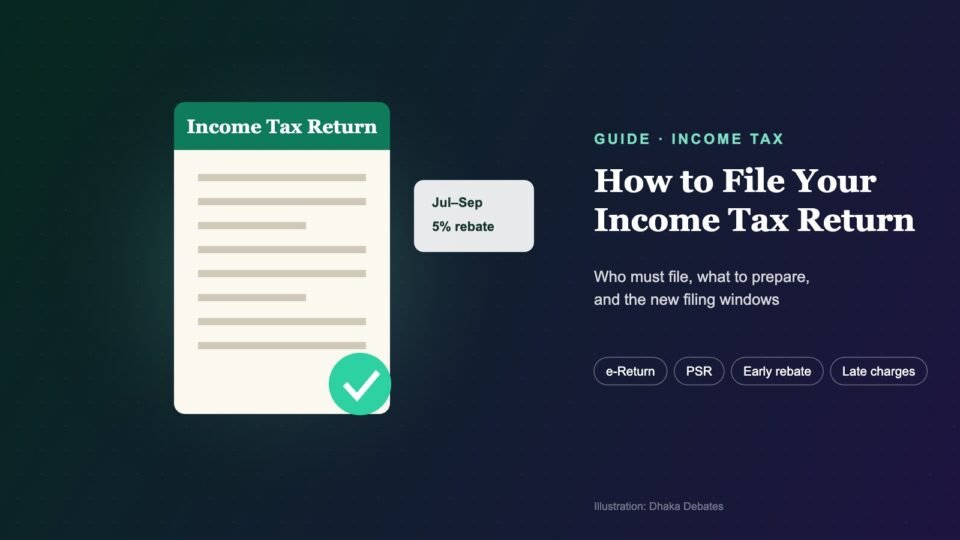
- Ignoring tax: file your return, keep records and use investment tax rebates. See our guide on filing a tax return for salaried people.
What could Tanvir’s plan look like?
- Months 1–12: build a ৳2 lakh emergency fund in a strong bank through a monthly DPS of about ৳15,000 funded by cutting restaurant spending and avoiding new instalment purchases.
- Year 2 onwards: invest ৳10,000 a month: ৳6,000 into Sanchayapatra (in lump sums as it builds up), ৳3,000 into a mutual fund SIP, and ৳1,000 into a gold savings pot.
- Every raise: increase monthly investment by half of the raise.
- Every year: review the mix, file taxes, and check insurance cover.
- In his late thirties: use part of the accumulated savings as a down payment on a flat, keeping the rest invested.
Nothing in this plan is clever. Its power comes from starting now and continuing for decades. For beginners, our guides on how to start investing with small money, where to put your first ৳1 lakh and money mistakes new graduates make go further.
Frequently asked questions
How much should I save each month?
Aim for 10% to 20% of take-home pay. If that is not possible yet, start smaller and increase with each raise. Consistency matters more than the starting amount.
What is the safest high-return investment in Bangladesh?
Government savings certificates (Sanchayapatra) and treasury bonds offer the best combination of safety and return, at around 11% to 12% in 2026, within their rules and limits.
Is it too late to start at 40?
No. You have fewer years for compounding, so you may need to save a larger share of income, but 20 years of steady saving still builds meaningful wealth.
Should I buy land or invest in the stock market?
They suit different stages. Land needs a large sum and is hard to sell; shares and funds can start small. Many families build financial investments first and buy property later.
Key words explained
| Term | What it means |
|---|---|
| Net worth | Everything you own minus everything you owe |
| Compounding | Earning returns on your past returns, which speeds up growth over time |
| Real return | Your return after subtracting inflation |
| Diversification | Spreading money across different investments to reduce risk |
| Sanchayapatra | Government savings certificates sold through post offices, banks and online |
| Treasury bond | A government loan certificate that pays regular interest |
| SIP | Systematic investment plan: investing a fixed amount in a fund each month |
| DPS | Deposit pension scheme: a monthly savings scheme at a bank |
| Emergency fund | Easy-to-reach savings for unexpected costs |
How we reported this
We used inflation data from the Bangladesh Bureau of Statistics as reported by bdnews24.com, savings certificate rates from Prothom Alo’s July 2026 report, treasury bond yields from The Financial Express (April 2026), stock market data from UNB, and deposit rate data from The Financial Express. Growth, inflation-adjusted values and the sample plan are our own calculations and examples. This guide is general information, not personal financial advice.
Editor’s note: Tanvir is an illustrative character based on the typical situation of young salaried professionals in Dhaka. He is not a real person, and his income and plan are examples only.
Sources
- September 2026 inflation (bdnews24.com) · bdnews24.com
- Profit rates on savings certificates will not be reduced (Prothom Alo) · en.prothomalo.com
- Yield on 5-year T-bonds rises (The Financial Express) · today.thefinancialexpress.com.bd
- 10-year bond yields jump on weak demand (The Financial Express) · thefinancialexpress.com.bd
- DSE benchmark index climbs to year's peak (UNB) · unb.com.bd
- Real returns on fresh bank deposits fall to near zero (The Financial Express) · thefinancialexpress.com.bd