How to Receive International Payments as a Bangladeshi Business
From SWIFT transfers and ERQ accounts to Payoneer, marketplaces and the new rules for PayPal-style platforms, here is how Bangladeshi businesses can get paid from abroad legally, cheaply and with the incentives they are entitled to.

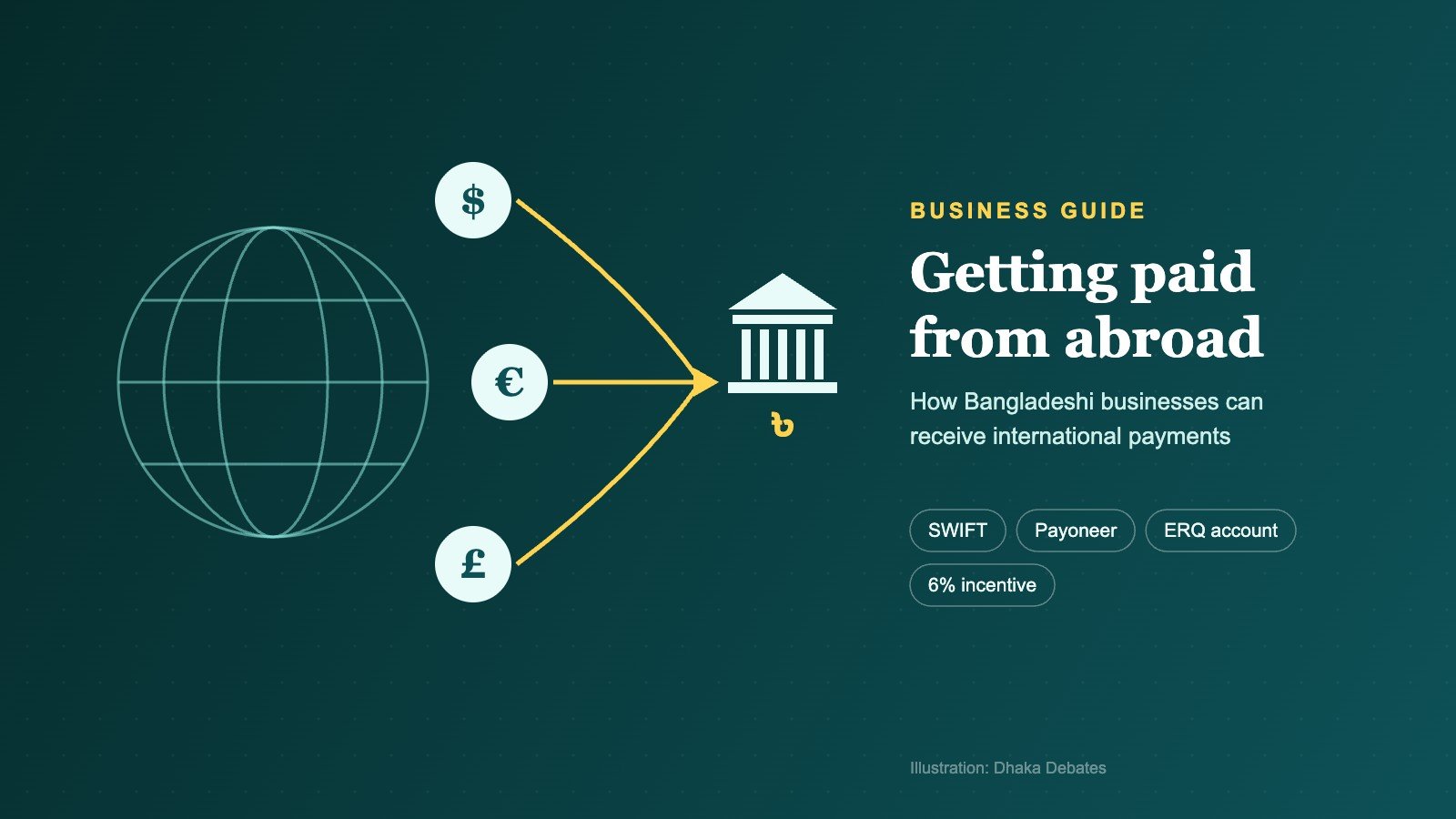
Short answer: A Bangladeshi business can receive money from foreign clients in four main ways: a direct bank transfer (SWIFT) into a business account at an authorised dealer bank, a cross-border payment service such as Payoneer that pays out to your local bank, an online marketplace that pays you through one of those channels, or, for physical goods, standard export banking such as letters of credit. Whatever route you choose, the money must come in through formal channels so your bank can record it as export income. That record is what lets you keep part of it in US dollars in an Exporters’ Retention Quota (ERQ) account, claim the government’s cash incentive (6% for software and IT-enabled services exports in FY2026-27) and use income tax exemptions for IT income. Bangladesh Bank also cleared the way in July 2026 for local banks to partner with global platforms such as PayPal and Payoneer, but each partnership needs central bank approval.
Tanim runs a six-person web development company in Mirpur. Most of his clients are small businesses in the UK, Canada and Australia. When he started, he asked clients to send money “any way that works”. Some paid by bank transfer, some through a friend’s foreign account, and one through a payment app his bank had never heard of. At the end of the year his accountant asked a simple question: “Where are your export documents?” Tanim had none. He had earned real foreign currency, but on paper he could not prove most of it, so he could not claim the cash incentive or show his income properly.
This guide is for business owners like Tanim: software firms, design studios, digital agencies, small manufacturers, e-commerce sellers and growing freelancers who now operate as businesses. It explains the main ways to receive international payments, the rules you must follow, the benefits you can claim, and the mistakes to avoid.
Why does the payment route matter so much?
In Bangladesh, money earned from abroad by selling goods or services is treated as export income. Foreign exchange is controlled by Bangladesh Bank, and every legal inflow has to pass through an authorised dealer (AD) bank, meaning a bank licensed to handle foreign currency, or through a channel that ends at one.
When money comes in properly, three good things happen:
- Your income is documented. Your bank issues a certificate showing the foreign currency you received. This is proof of export income for tax, loans and visa applications.
- You can keep part of it in dollars. A share can go into an ERQ account to pay for software subscriptions, hosting, travel and other foreign costs.
- You can claim incentives. Cash incentives and tax benefits depend on export income being received through banking channels.
When money comes in informally, through hundi, a relative’s foreign account or cash carried home, you lose all three, and you also take on legal risk. Hundi is illegal in Bangladesh, and we do not recommend it under any circumstances.
What are the main ways to receive international payments?
| Method | Best for | How money reaches you | Main downsides |
|---|---|---|---|
| Direct bank transfer (SWIFT) | Larger invoices, corporate clients, long-term contracts | Client’s bank sends money to your AD bank account in Bangladesh | Fees from sending, intermediary and receiving banks; can take several working days; client needs your bank’s SWIFT details |
| Payoneer and similar payment services | Clients and marketplaces that prefer card or local-currency payments | Client pays into your account with the service; you withdraw to your Bangladeshi bank | Service and currency conversion fees; account reviews can delay funds |
| Online marketplaces (e.g. Upwork, Fiverr, app stores) | Freelance-style service work, apps, digital products | Platform pays out through bank transfer or a payment service | Platform commission; you depend on the platform’s rules |
| International card payments via a local payment gateway | Online stores and booking sites selling to foreign customers | Gateway settles to your local bank | Gateway fees; needs merchant approval for international cards |
| Letters of credit and documentary collections | Physical goods exports, especially large orders | Banks handle documents and payment between buyer and seller | Paperwork, bank charges; slower |
| Small-value e-commerce export channels | Small shipments of goods sold online to foreign buyers | Through approved MFS or PSP providers, or international marketplaces, then to your account | Value limits per shipment |
How do you receive money by direct bank transfer?
A direct SWIFT transfer is the most traditional and most widely accepted way to get paid from abroad. Almost every business client in the world can make one.
What you need
- A business current account at an AD bank, in the exact legal name of your business.
- Your trade licence, TIN and incorporation documents (for companies), which the bank needs to open the account.
- Your bank’s SWIFT code, branch address and your full account number. Some banks also give you a specific routing for US dollar transfers through their correspondent bank.
- A contract or invoice for each payment. Your bank may ask for these to classify the payment as export income rather than a gift or remittance.
Tips to avoid problems
- Put the invoice number in the payment reference. It helps your bank match the payment to your invoice.
- Tell your bank what the payment is for. Service exports need the correct purpose code. If the bank wrongly treats your payment as a personal remittance, you may lose incentive eligibility.
- Agree who pays the fees. SWIFT transfers can lose money to the sending bank, intermediary banks and your own bank. Ask the client to choose the “OUR” option if they will cover all fees, or build the expected deduction into your price.
- Submit the right forms. For ICT and service receipts above US$10,000, banks typically require a Form C (ICT) or similar declaration. Ask your bank which forms apply.
How do payment services like Payoneer work?
Payment services give you “receiving accounts” in foreign currencies such as US dollars, euros and pounds. Your client pays into that account as if paying a local supplier in their own country, often by bank transfer or card. You then withdraw the money to your bank account in Bangladesh, where it arrives as export income.
Payoneer is the most widely used service of this kind among Bangladeshi freelancers and small IT firms. It is also connected to many international marketplaces. Open a Payoneer account if you do not have one yet. Another option some Bangladeshis use is nsave, which offers a US dollar account for people in countries with limited access to foreign banking. Try nsave.
Disclosure: the Payoneer and nsave links above are referral links. If you sign up through them, Dhaka Debates may receive a reward at no extra cost to you. It does not affect our reporting.
When choosing a payment service, compare these points:
- Receiving fees: some charge a percentage on incoming payments from clients, others only on card payments.
- Withdrawal fees and exchange rates: the biggest hidden cost is often the exchange rate used when you withdraw to taka. Compare the amount that lands in your account, not just the headline fee.
- Business accounts: if you operate as a company, open a business account in the company’s name, not a personal one. It keeps your records clean.
- Account reviews: sudden large payments can trigger reviews that freeze funds for days. Keep invoices and contracts ready.
We compared Payoneer, nsave and other options in detail in our guide to the best Wise alternatives in Bangladesh.
What about PayPal?
PayPal is the payment method foreign clients ask about most, and for years Bangladeshi businesses have had to say no. That may be changing. In July 2026, Bangladesh Bank’s Foreign Exchange Policy Department cleared the way for authorised dealer banks to sign operational agreements with foreign digital payment providers, international payment gateways and aggregators, naming PayPal and Payoneer as examples, The Daily Ittefaq reported. The framework covers freelancer payments, service fees, e-commerce transactions and remittances. Each agreement needs prior approval from the central bank.
In June 2026, Finance Minister Amir Khosru Mahmud Chowdhury said “PayPal and three or four others” were on their way, The Financial Express reported. As of November 2026, no full launch date had been announced. Until then, avoid paying third parties to receive PayPal funds on your behalf. It breaks PayPal’s rules, puts your money at risk and leaves no legal record of your export income.
What is an ERQ account, and how much can you keep in dollars?
An Exporters’ Retention Quota (ERQ) account is a foreign currency account where an exporter can keep part of their export earnings in dollars instead of converting all of it to taka. The rest is converted and credited to your taka account.
ERQ money can be used for approved business costs abroad, such as:
- software subscriptions, cloud hosting, domain registration and server costs
- payments to overseas vendors and contractors
- business travel, conferences and professional fees
- imports of raw materials or equipment for goods exporters
- card payments using an international card issued against the ERQ balance
How much you can keep depends on what you export, and Bangladesh Bank changes the limits from time to time. In July 2026, it doubled the limit for merchandise exporters of goods with high import content from 7.5% to 15% of repatriated FOB value, The Daily Ittefaq reported. Service exporters, including ICT and software firms and freelancers, have had access to ERQ accounts since February 2023, The Financial Express reported. Payment company nsave’s guide lists a retention limit of 35% for ICT, software and freelance service exporters, but ask your bank for the current rate before you plan around it.
ERQ accounts do not pay interest, and you cannot keep 100% of your earnings in dollars. But for a business with regular foreign costs, an ERQ account saves the double conversion loss of turning dollars into taka and then back into dollars every month.
What incentives can you claim?
Cash incentive on exports
For shipments and services between 1 July 2026 and 30 June 2027, Bangladesh Bank has set the cash incentive at:
| Exporter | Cash incentive |
|---|---|
| Software, hardware and IT-enabled services (ITES) exports | 6% |
| Individual freelancers exporting software and ITES | 2.5% |
Claims go through your AD bank and are subject to audits by external audit firms. You need proper records: contracts, invoices, bank certificates for each inflow and any declaration forms your bank requires. Several other sectors also have cash incentives under the same circular, so check whether your product qualifies if you export goods.
Income tax benefits
Income from IT and IT-enabled services is currently exempt from income tax under conditions set by the National Board of Revenue. That exemption is scheduled to end on 30 June 2027, The Daily Star reported in July 2026, and industry groups are asking the government to extend it. The FY2026-27 budget also proposed making all freelancing income and content creation income tax-free, and cutting turnover tax to 0% for startups and technology-driven businesses, The Financial Express reported. The minister said freelancers and content creators would be able to bring in up to $5,000 without formalities.
Tax rules have conditions, and budget proposals can change before they become law. Talk to a tax adviser before relying on any exemption.
What if you sell physical products online to foreign buyers?
Small sellers of handicrafts, clothing, jute products and other goods have historically found export paperwork too heavy for small orders. Bangladesh Bank has eased the rules in steps:
| When | What changed |
|---|---|
| November 2025 | Licensed MFS and PSP providers can handle export proceeds for cross-border e-commerce sales of goods up to US$1,000, with no EXP form needed (BSS). |
| March 2026 | Exporters with at least $1 million in export proceeds over three years can send shipping documents directly to importers for shipments up to $100,000 (The Daily Ittefaq). |
| June 2026 | New guidelines for business-to-consumer exports through international online marketplaces: up to $5,000 per shipment, no EXP form up to $1,000 if fully paid in advance, EXP within 14 days for larger shipments, and up to $5,000 a year allowed for platform subscriptions (BSS). |
To use these, you need a merchant agreement with the marketplace or provider, and your bank must onboard you. Export proceeds still have to arrive within the time limit Bangladesh Bank sets, and the bank credits your ERQ and taka accounts once it has the documents.
A worked example: a software firm earning $5,000 a month
Back to Tanim. This year he moved every client to two routes: larger clients pay by SWIFT into his company’s account at an AD bank, and smaller ones pay into his company’s Payoneer account, which he withdraws to the same bank account each week.
| Item | Per month (our calculation) |
|---|---|
| Export income received through banking channels | $5,000 |
| Kept in ERQ, if his bank applies a 35% limit | $1,750 |
| Converted to taka | $3,250 |
| Cash incentive at 6%, once claimed and approved | $300 equivalent in taka |
| Cash incentive over a year | About $3,600 equivalent |
He uses the ERQ balance to pay for cloud hosting, design software and a freelancer in Vietnam, without converting money twice. The bank certificates also helped him get a small business loan, because the bank could see steady, documented export income.
What mistakes should you avoid?
- Using personal accounts for business income. If you run a company, money should go to the company. Mixing them causes tax and audit problems.
- Accepting money through hundi or “agents”. It is illegal, risky and leaves you with no proof of income.
- Letting the bank treat export income as a remittance. Check the purpose code on every inflow.
- Losing paperwork. Keep contracts, invoices and bank certificates for every payment. You need them for incentives, tax and audits.
- Ignoring the exchange rate. A provider with a lower fee but a worse rate can cost more. Compare the taka amount you actually receive.
- Waiting too long to withdraw. Leaving large balances on foreign platforms exposes you to account freezes and policy changes.
Step-by-step: setting up to receive international payments
- Register your business properly: trade licence, TIN and, if you are a company, incorporation with RJSC. Our guide on how to set up a company in Bangladesh covers the documents.
- Open a business current account at an AD bank that is experienced with service exports. Ask about ERQ accounts and export certificates.
- Open an ERQ account at the same bank.
- Set up one or two payment services, such as Payoneer, in the business’s name, linked to your business bank account.
- Create a standard invoice template with your bank’s SWIFT details, the payment service details and clear payment terms.
- Sign a written contract or order with every client.
- Every month, collect bank certificates for all inflows and file them with the matching invoices.
- Apply for the cash incentive through your bank, and work with a tax adviser on your annual return.
Frequently asked questions
Can a Bangladeshi business receive money from abroad legally?
Yes. Payments for goods and services exported must come through an authorised dealer bank, directly or through approved payment services, so they are recorded as export income.
Is PayPal available for Bangladeshi businesses?
Not yet as a normal service. Bangladesh Bank allowed banks to partner with platforms like PayPal in July 2026, subject to approval, but no launch date had been announced as of November 2026.
What is the cash incentive for software and IT exports?
6% for software, hardware and ITES exports, and 2.5% for individual freelancers, for July 2026 to June 2027.
Can I keep my export earnings in dollars?
Part of them, in an ERQ account. The share depends on your export type and current Bangladesh Bank rules. The rest is converted to taka.
Do I pay tax on IT export income?
IT and ITES income is currently tax-exempt under conditions, with the exemption due to end on 30 June 2027 unless extended. Check with a tax adviser.
Key words explained
| Term | What it means |
|---|---|
| AD bank | Authorised dealer bank: a bank licensed by Bangladesh Bank to handle foreign exchange. |
| SWIFT transfer | An international bank transfer sent through the SWIFT messaging network. |
| ERQ account | Exporters’ Retention Quota account: a foreign currency account where exporters keep part of their earnings. |
| Repatriation | Bringing export earnings back into Bangladesh through formal channels. |
| EXP form | The export declaration form for goods exports. |
| Form C (ICT) | A declaration banks may require for ICT and service export receipts above certain amounts. |
| Cash incentive | A government payment, as a percentage of export income, to encourage certain exports. |
| Purpose code | A code that tells the bank why money was received, such as service export or family remittance. |
| Hundi | An illegal informal money transfer system. |
How we reported this
We based this guide on Bangladesh Bank circulars and decisions as reported by The Financial Express, The Daily Ittefaq, BSS and The Daily Star, and on payment company nsave’s published guide to ERQ accounts, which we flag where we rely on it. Foreign exchange rules, ERQ limits, incentives and tax exemptions change often, and banks apply them in slightly different ways, so confirm the current position with your bank and a tax adviser before acting. Figures marked “our calculation” are our own arithmetic. This guide is general information, not legal or tax advice.
Editor’s note: Tanim is an illustrative example created for this guide, not a real business owner.
Sources
- The Daily Ittefaq: BB doubles exporters’ retention quota to 15pc · en.ittefaq.com.bd
- The Daily Ittefaq: BB clears way for PayPal, other global digital payment services · en.ittefaq.com.bd
- The Daily Ittefaq: BB simplifies export trade · en.ittefaq.com.bd
- The Financial Express: BB announces export incentives for 43 sectors for FY26-27 · thefinancialexpress.com.bd
- The Financial Express: Budget allows freelancers, content creators to remit $5,000 without paperwork · thefinancialexpress.com.bd
- The Financial Express: Budget offers tax-free status for content creators, startups · thefinancialexpress.com.bd
- The Financial Express: Service exporters to enjoy foreign currency retention quota facility · thefinancialexpress.com.bd
- The Daily Star: IT sector experts call for extended tax holiday · thedailystar.net
- BSS: BB issues new guidelines to expand B2C export facility via online marketplaces · bssnews.net
- BSS: BB eases rules for small-value e-commerce export proceeds · bssnews.net
- nsave: ERQ account in Bangladesh · nsave.com
Keep reading
Best Accounting Software for Small Businesses in Bangladesh
Why Do Small Businesses Struggle to Access Finance?
Can Bangladesh Become South Asia’s Next Fintech Hub?