What Is Banking as a Service?
Banking as a Service lets apps that are not banks offer accounts, cards, payments and loans by plugging into a licensed bank. Here is how it works, where you already see it in Bangladesh, and what open banking rules could change.

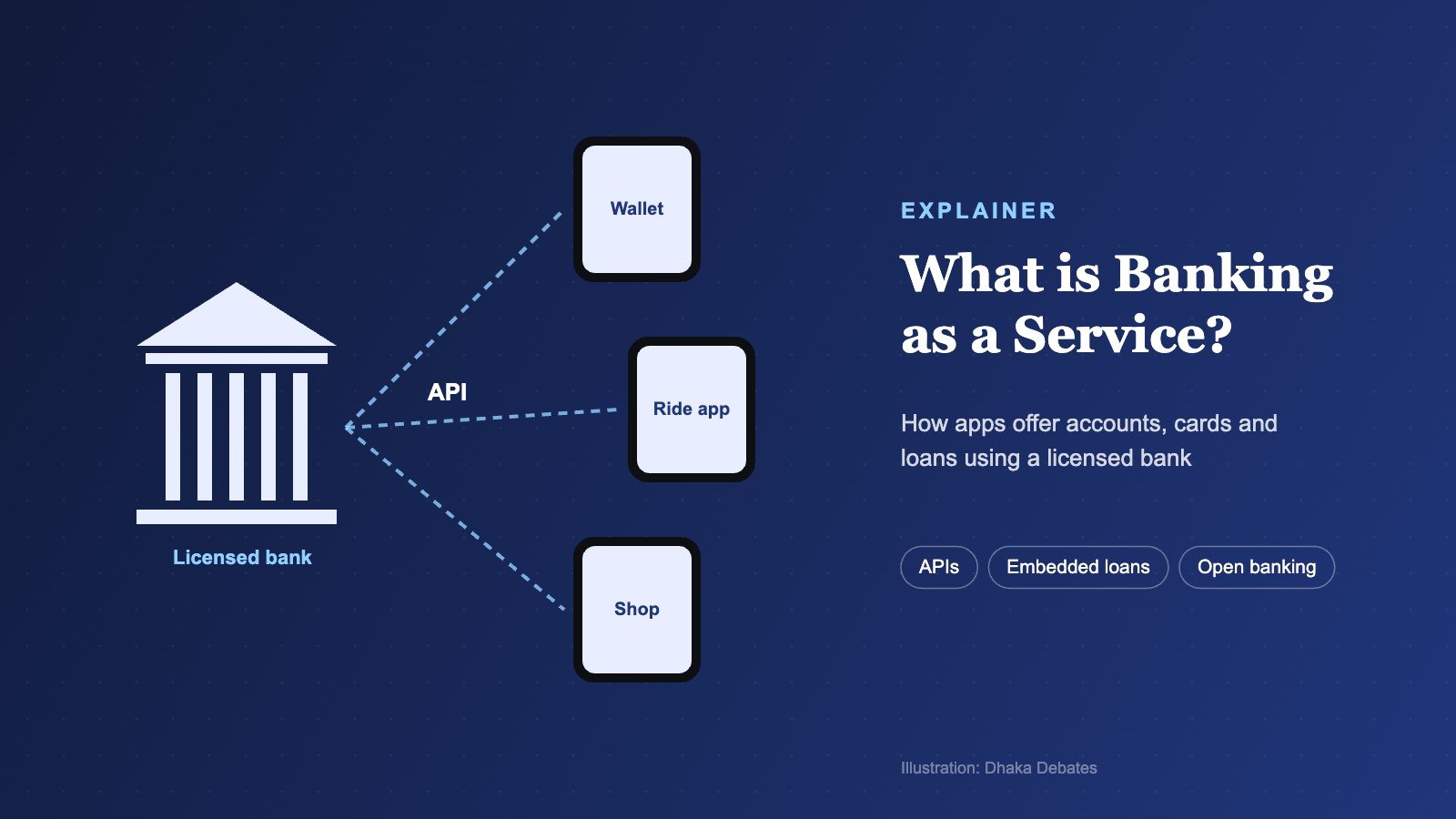
Short answer: Banking as a Service (BaaS) is a model where a licensed bank lets other companies, such as fintech apps, wallets, e-commerce platforms or ride-hailing apps, offer banking products to their own customers. The bank holds the licence, the money and the regulatory responsibility; the partner company builds the app and the customer experience, connecting to the bank through software links called APIs. You already see versions of it in Bangladesh: the Pathao Pay prepaid Mastercard is issued with Mutual Trust Bank, and the bKash nano-loans that reached about 35 lakh customers are funded by City Bank. Bangladesh Bank planned to issue open banking guidelines and standard APIs by June 2026, but as of mid-2026 there was still no formal framework, which limits how far BaaS can grow here.
When you take a small loan inside a wallet app, or pay with a card branded by a ride-hailing company, you may not realise a bank is doing most of the work behind the scenes. That hidden partnership is Banking as a Service. It is one of the biggest changes in finance worldwide, and it is slowly arriving in Bangladesh.
What does Banking as a Service mean in simple words?
Think of a bank as a kitchen. Traditionally, the bank cooks the food and serves it in its own restaurant: its branches and its app. With Banking as a Service, the bank’s kitchen also cooks for other restaurants. A wallet app, an online shop or a ride-hailing company serves the food to its own customers, under its own name, while the bank does the cooking: holding deposits, issuing cards, moving money and following banking rules.
The “service” is offered through APIs, or application programming interfaces. An API is a secure digital connection that lets one company’s software ask another company’s software to do something, such as open an account, check a balance, issue a card or send a payment.
Who does what in a BaaS partnership?
| Player | Role | Example in Bangladesh |
|---|---|---|
| Licensed bank | Holds the banking licence, customer money and regulatory duties; issues cards and makes loans | Mutual Trust Bank (for the Pathao Pay Card); City Bank (for bKash nano-loans) |
| Brand or fintech partner | Owns the customer relationship and the app; designs the product and handles marketing | Pathao; bKash |
| Card network or payment rails | Moves the money between banks and merchants | Mastercard, Visa, NPSB, Bangla QR |
| Regulator | Sets the rules and supervises the bank | Bangladesh Bank |
| Customer | Uses the product through the partner’s app | You |
What kinds of products can BaaS power?
- Accounts and wallets: deposit accounts opened inside a non-bank app.
- Cards: debit or prepaid cards carrying an app’s brand but issued by a bank.
- Payments: sending and receiving money, collecting bills, paying suppliers.
- Loans: small personal or business loans offered inside an app at the moment you need them, often called embedded lending.
- Buy now, pay later: instalment payments at checkout, financed by a bank or finance company. See our guide to buy now, pay later.
- Savings and insurance: savings pots or micro-insurance sold through non-financial apps.
Where do you already see BaaS in Bangladesh?
Bangladesh does not yet use the term widely, but several services follow the same model:
Bank-funded loans inside bKash
bKash users can take small digital loans that are actually made by City Bank. By July 2026, the partnership had disbursed over $811 million across 3.19 crore loans to about 35 lakh customers, with non-performing and written-off amounts of about 0.5% of disbursements, LightCastle Partners reported. The average loan was about $24. bKash provides the app, the data and the customers; City Bank provides the lending licence and the money. That is embedded lending, one of the most common forms of BaaS.
The Pathao Pay Card
Pathao Pay’s prepaid Mastercard is issued with Mutual Trust Bank and linked directly to the user’s Pathao Pay wallet balance. Pathao designs the card and the app experience; the bank issues the card and the Mastercard network carries the payments. We explain the card’s fees in our Pathao Pay review.
The bank-led MFS model
Bangladesh’s mobile financial services follow a “bank-led” model, in which a bank must own a majority stake in an MFS provider. bKash, for example, is a subsidiary of BRAC Bank. This is not BaaS in the strict sense, but it reflects the same idea: banking services delivered through a technology company’s platform under a bank’s umbrella.
How is BaaS different from open banking and digital banks?
These three ideas are often confused:
| Term | What it means | Who leads |
|---|---|---|
| Banking as a Service | A bank lets other companies build banking products on its licence and systems | The bank sells its capabilities to partners |
| Open banking | Customers can allow third parties to see their bank data or start payments from their accounts, through standard APIs | Usually the regulator sets the rules |
| Digital bank | A fully licensed bank with no branches, serving customers through an app | The digital bank itself holds the licence |
They work well together. Open banking rules make it easier for fintechs to connect to many banks. BaaS lets a fintech offer products through one partner bank. And digital banks, such as the four approved by Bangladesh Bank in September 2026, can either compete with fintechs or act as BaaS providers for them. We explored digital banks in our story on the future of digital banking in Bangladesh.
What are the benefits?
- For customers: banking services inside apps they already use, often simpler and faster than a branch.
- For fintechs and brands: they can offer financial products without spending years and large sums getting their own licence. A digital bank licence in Bangladesh now needs Tk 300 crore in capital.
- For banks: new customers and fee income without building every app themselves. Prime Bank’s chief technology officer A Y M Mostafa argued in The Business Standard that banks should “pursue BaaS partnerships” as part of an open banking strategy.
- For financial inclusion: people who would never visit a branch can get savings, credit and insurance through apps they trust.
What are the risks?
- Who is responsible? Customers may not know which company holds their money or whom to complain to when something goes wrong. Clear disclosure is essential.
- Weak oversight of partners: banks must supervise their fintech partners’ compliance, including know-your-customer checks and anti-money-laundering controls. In other countries, regulators have penalised partner banks for failing to do this.
- Data and privacy: more companies handling customer data means more chances for leaks or misuse. Bangladesh approved a Personal Data Protection Ordinance in 2025, but detailed rules for financial data sharing are still needed, the TBS column noted.
- Cyber security: every API connection is a possible entry point for attackers.
- Easy credit: loans offered with one tap can lead people to borrow more than they can repay.
What is holding BaaS back in Bangladesh?
The biggest gap is rules. Bangladesh Bank officials said in November 2025 that the central bank planned to issue open banking guidelines and standard API protocols by June 2026, The Business Standard reported. But in a June 2026 column, Prime Bank’s A Y M Mostafa wrote that Bangladesh still lacked “a formal Open Banking framework and a structured API economy.” The Financial Express described open banking here as being at an “early stage of development.”
Without common standards, every fintech must build a separate connection with each bank, which is slow and expensive. Other barriers include:
- old core banking systems at many banks that are hard to connect to modern APIs
- split oversight between Bangladesh Bank, the securities regulator, the insurance regulator and the microcredit regulator
- a credit bureau system still being developed, which limits data-driven lending
- banks’ caution after a period of heavy bad loans
We looked at why many traditional banks find technology change hard in our feature on why traditional banks struggle to go digital.
How do other countries handle it?
Speakers at the 5th Bangladesh FinTech Summit in Dhaka described three broad models, The Business Standard reported. The UK requires banks to share data through common APIs. India uses a state-backed Account Aggregator framework for consent-based data sharing. Singapore takes a market-led, hybrid approach, supported by a shared platform called APIX. Writers in The Financial Express suggested a hybrid model for Bangladesh, with Bangladesh Bank setting API standards and phased rules while leaving room for competition.
What does BaaS mean for you?
- Know who holds your money. When an app offers an account, card or loan, check which bank or institution is behind it.
- Read the terms. Interest, fees and late penalties apply even if the app feels casual.
- Protect your data. Only allow apps you trust to access your financial information.
- Expect more choice. As rules arrive, you are likely to see more banking products inside the apps you use every day.
Frequently asked questions
Is Banking as a Service legal in Bangladesh?
Partnerships between banks and fintechs are allowed under Bangladesh Bank’s rules, but there is no dedicated BaaS or open banking framework yet. Each partnership must follow existing banking and payment regulations.
Is my money safe in a BaaS product?
Money held by a licensed bank is subject to banking regulation. Check which institution holds your funds and how deposits are protected.
What is an API?
An application programming interface is a secure digital link that lets one company’s software request services or data from another’s, such as opening an account or sending a payment.
Key words explained
| Term | What it means |
|---|---|
| BaaS | Banking as a Service: a bank providing its licence and systems so other companies can offer banking products. |
| API | A secure software connection that lets systems talk to each other. |
| Embedded finance | Financial services built into non-financial apps, such as loans at checkout. |
| Open banking | Rules that let customers share their bank data with trusted third parties. |
| Sponsor or partner bank | The licensed bank behind a BaaS product. |
| KYC | Know your customer: checks to confirm a customer’s identity. |
How we reported this
We used reporting by The Business Standard and The Financial Express on open banking plans, a June 2026 opinion piece by Prime Bank’s chief technology officer, LightCastle Partners’ data on bKash nano-loans and Pathao’s published information about the Pathao Pay Card. Descriptions of BaaS models are our explanation of how the industry generally works.
Sources
- The Business Standard: Bangladesh plans to introduce open banking system · tbsnews.net
- The Business Standard: How Open Banking could be Bangladesh’s next frontier of financial innovation · tbsnews.net
- The Financial Express: Open banking, a new era for the banking industry in Bangladesh · today.thefinancialexpress.com.bd
- LightCastle Partners: Financing Bangladesh’s SMEs · lightcastlepartners.com
- Pathao blog: Meet Pathao Pay Card · pathao.com
- Prothom Alo: bKash, Robi among four entities receive initial approval for digital banks · en.prothomalo.com
Keep reading
How Blockchain Could Change Financial Services
Why Millions of Bangladeshis Still Don’t Have Access to Formal Banking
Why Do Small Businesses Struggle to Access Finance?