How Blockchain Could Change Financial Services
Blockchain is already speeding up letters of credit in Bangladesh, while crypto remains banned. We explain what blockchain actually does, where it helps banks and trade, the stablecoin debate, and what it could mean for Bangladeshi customers.

Short answer: Blockchain is a shared, tamper-resistant digital record that several organisations can update and trust at the same time. In finance, its most useful role so far is not cryptocurrency but paperwork: banks use it to process letters of credit, trade documents and cross-border settlements faster and with less fraud. In Bangladesh, banks such as Standard Chartered, HSBC, City Bank and Prime Bank have already run blockchain-based letter of credit transactions, and Bangladesh Bank encouraged fully electronic LC handling in January 2025. Cryptocurrency, however, remains outside the law: Bangladesh Bank says virtual currencies are not recognised under foreign exchange rules, and dealing in them is not permitted. Globally, regulators such as the Bank for International Settlements warn that stablecoins fall short as money and favour “tokenised” bank and central bank money instead. For Bangladeshi customers, the near-term changes are likely to be faster trade finance, cheaper cross-border payments in future and better record-keeping, not crypto in your wallet.
Say “blockchain” in Dhaka and most people think of Bitcoin, get-rich-quick schemes or a friend who lost money on a crypto app. That reputation hides a quieter story. Inside banks, blockchain is being used to fix some of the slowest, most paper-heavy parts of finance, including the letters of credit that keep Bangladesh’s import and export trade moving.
What is blockchain, in simple words?
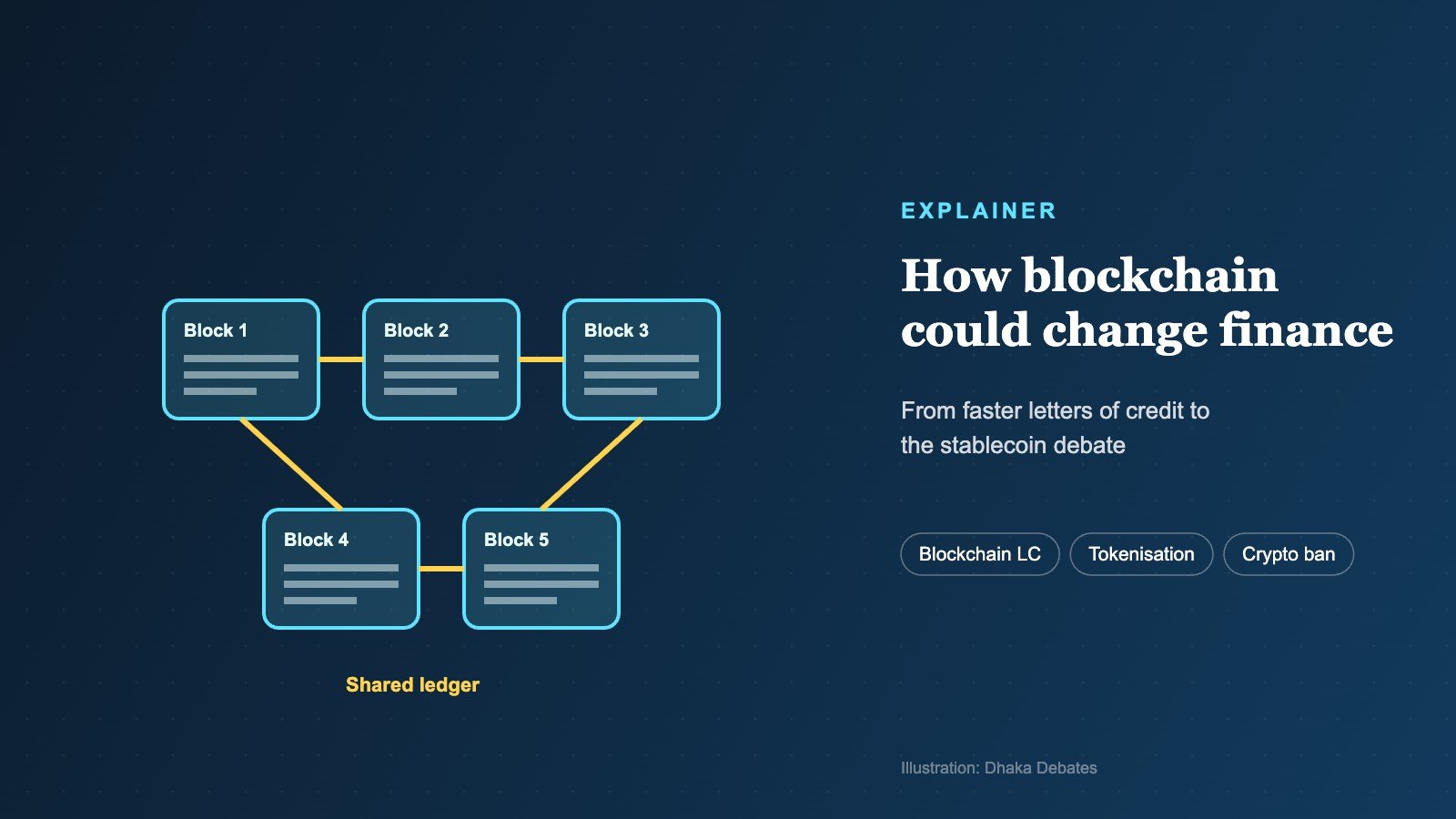
Imagine a ledger, a book of records, that is copied to many computers at once. Every time a new transaction is added, all the copies update together. Each new page is mathematically linked to the previous one, so changing an old entry would mean changing every copy and every later page, which is extremely hard. That is a blockchain: a shared record that many parties can trust without relying on one central keeper.
There are two broad kinds:
| Type | Who can join | Typical use |
|---|---|---|
| Public (permissionless) | Anyone | Cryptocurrencies such as Bitcoin and Ethereum, and most stablecoins |
| Private (permissioned) | Only approved members, such as banks | Trade finance, interbank settlement, document sharing |
Banks almost always use private, permissioned blockchains. The members are known, regulated institutions, and the system follows normal banking rules.
Where is blockchain already used in Bangladesh?
Letters of credit
A letter of credit (LC) is a bank’s promise to pay an exporter once the right shipping documents arrive. Traditionally, LCs involve piles of paper sent by courier between banks in different countries, which takes days and creates room for forgery. Blockchain lets all parties see and approve the same digital documents in real time.
Bangladesh has been experimenting for several years:
| Milestone | Details |
|---|---|
| First blockchain LC transactions (2020) | Standard Chartered and HSBC carried out Bangladesh’s first blockchain-based LC transactions, including a cross-border LC, The Daily Star and The Business Standard reported. |
| Shariah-based blockchain LC | City Bank, with the International Islamic Trade Finance Corporation, executed a cross-border Shariah-based blockchain LC, The Daily Star reported. |
| Electronic LC circular (14 January 2025) | Bangladesh Bank’s FE Circular No. 06 advised banks to offer electronic options for LC transmission, advising, presentation, acceptance and follow-up. |
| Local blockchain platform | Prime Bank executed Bangladesh’s first LC on a locally developed blockchain platform, with Spectrum Software and Consulting as technology partner and Dhaka Bank as beneficiary bank, The Daily Star reported. |
For a country whose economy depends on garment exports and imported raw materials, faster and safer LCs matter. Fewer paper delays mean goods clear sooner, and shared digital records make it harder to forge documents or over-invoice, a common way of moving money out of the country illegally.
Government and trade systems
Bangladesh has a National Blockchain Strategy that supports the technology for e-government and trade-related finance, banking specialist Monzur Morshed Patwary noted in The Financial Express in May 2026. He also pointed to a real-time digital link between Bangladesh Bank’s foreign exchange transaction system and the customs ASYCUDA World system, designed to replace manual invoice checks and curb trade-based money laundering. That link is not itself a blockchain, but it shows the same push towards shared, verifiable digital trade records.
What about cryptocurrency in Bangladesh?
Cryptocurrency is a different matter. Bangladesh Bank’s FE Circular No. 24 of 15 September 2022 states that virtual currencies are not recognised under the Foreign Exchange Regulation Act, 1947, are not approved foreign exchange or investment instruments, and that transactions to or from Bangladesh to obtain virtual assets are not permitted, according to The Financial Express. Keeping export earnings abroad in crypto may also breach foreign exchange rules. The Business Standard has reported repeated central bank warnings to banks to monitor and stop crypto-related transactions.
Despite this, many young Bangladeshis trade crypto through foreign apps, international media have reported. They take serious legal and financial risks: their money is not protected by any Bangladeshi regulator, prices swing wildly, and scams are common. Dhaka Debates does not recommend buying or trading cryptocurrency from Bangladesh while it remains outside the law.
What are stablecoins, and why are regulators worried?
A stablecoin is a crypto token designed to keep a fixed value, usually one US dollar, backed by reserves such as cash and short-term government bonds. Supporters say stablecoins make cross-border payments fast and cheap. The total stablecoin market was worth about $320 billion at the end of May 2026, with more than 99% of fiat-backed supply tied to the US dollar, according to the Bank for International Settlements (BIS), as reported by The Block.
But in its June 2026 annual report, the BIS, often called the central bank of central banks, argued that stablecoins fall short as money because they lack what it calls “singleness, elasticity, interoperability, and integrity.” It warned that in emerging economies, households holding dollar tokens could weaken control over their own currency, a risk it called “stablecoin dollarization,” and that stablecoins account for a significant share of illicit on-chain activity.
For Bangladesh, which manages its foreign exchange tightly and depends on remittances flowing through formal channels, those concerns are especially relevant. Patwary recommended in The Financial Express that Bangladesh prohibit uncontrolled crypto settlement for exports, imports, remittances and freelancer earnings, while testing tightly controlled options in a regulatory sandbox.
What is tokenisation?
Instead of private stablecoins, central banks favour “tokenisation”: putting regulated money and assets, such as bank deposits, central bank reserves, bonds or trade documents, onto shared digital ledgers. The BIS proposes a “unified ledger” holding tokenised central bank reserves and commercial bank money, with central bank money as the anchor. It points to Project Agora, a cross-border payments prototype involving eight central banks, the BIS and more than 40 private institutions, as evidence this can work.
In plain terms, tokenisation aims to get the speed and programmability of blockchain while keeping money inside the regulated banking system. For ordinary customers, it could eventually mean cross-border payments that settle in seconds rather than days, at lower cost, without leaving the protection of regulated banks.
How could blockchain change financial services?
| Area | How blockchain could help | Relevance for Bangladesh |
|---|---|---|
| Trade finance | Digital LCs, bills of lading and invoices shared in real time | High: already in use; supports garment exports and imports |
| Cross-border payments | Faster settlement between banks in different countries | High: remittances and export proceeds, if done through regulated channels |
| Anti-fraud and anti-money laundering | Tamper-resistant records make forged documents and over-invoicing harder | High: trade-based money laundering is a known problem |
| Identity and KYC | Shared, reusable verified identity records between institutions | Medium: could cut repeated paperwork for customers |
| Land and asset records | Tamper-resistant property registries | Medium: could support lending against land and other assets |
| Tokenised bonds and savings | Smaller, easier-to-trade investment units | Longer term: needs securities rules |
| Cryptocurrency | Peer-to-peer digital currency | Not permitted under current rules |
What are the limits and risks?
- It needs everyone on board. A blockchain LC only helps if the exporter’s bank, the importer’s bank, insurers, shipping lines and customs all use compatible systems.
- Legal recognition. Electronic trade documents must be legally valid in every country involved.
- Cost and skills. Banks need new technology, trained staff and compliance systems before pilots can scale, Patwary noted.
- Garbage in, garbage out. A blockchain records data permanently, but it cannot check that the data was true when it was entered.
- Scams using the word. Fraudsters often use “blockchain” to sell fake investment schemes. Real banks do not promise guaranteed high returns from blockchain.
What should Bangladesh do next?
Patwary’s recommendations in The Financial Express offer a sensible path, and we broadly agree:
- Keep uncontrolled crypto settlement out of trade, remittances and freelancer earnings.
- Promote regulated blockchain trade finance: digital LCs, electronic bills and invoices, and automated customs checks.
- Create a Bangladesh Bank-led regulatory sandbox to test bank-supervised digital LCs, tokenised trade documents and e-invoice verification.
- Build in anti-money laundering reporting, KYC and sanctions screening from the start.
Blockchain also fits into Bangladesh’s wider push for better payment infrastructure. We covered that in our stories on whether Bangladesh can become South Asia’s next fintech hub and what Banking as a Service means. If you earn from abroad, see our guide on receiving international payments legally.
Frequently asked questions
Is blockchain the same as Bitcoin?
No. Bitcoin runs on a blockchain, but blockchain is a general technology for shared records. Banks use private blockchains for trade finance without any cryptocurrency.
Is cryptocurrency legal in Bangladesh?
No. Bangladesh Bank says virtual currencies are not recognised under foreign exchange law, and transactions to obtain them are not permitted.
Do Bangladeshi banks use blockchain?
Yes, mainly for letters of credit. Standard Chartered, HSBC, City Bank and Prime Bank have carried out blockchain-based LC transactions.
Will blockchain make remittances cheaper?
Potentially, through faster bank-to-bank settlement in regulated systems. That depends on banks and central banks adopting compatible platforms, which will take time.
Key words explained
| Term | What it means |
|---|---|
| Blockchain | A shared digital ledger copied across many computers, very hard to alter. |
| Permissioned blockchain | A blockchain only approved members can join, such as a group of banks. |
| Letter of credit (LC) | A bank’s guarantee to pay an exporter once agreed documents are presented. |
| Cryptocurrency | A digital currency that runs on a public blockchain, such as Bitcoin. |
| Stablecoin | A crypto token designed to hold a fixed value, usually one US dollar. |
| Tokenisation | Representing money or assets as digital tokens on a shared ledger. |
| BIS | Bank for International Settlements, an organisation of central banks based in Basel. |
| Trade-based money laundering | Moving illicit money by misstating the price or quantity of traded goods. |
How we reported this
We used reporting by The Daily Star, The Business Standard and The Financial Express on blockchain letters of credit and Bangladesh Bank’s rules, a May 2026 analysis by trade finance specialist Monzur Morshed Patwary in The Financial Express, and The Block’s report on the BIS Annual Economic Report 2026. The table of possible uses and our view of next steps are Dhaka Debates’ analysis. This article is not investment advice.
Sources
- The Financial Express: Crypto payments and blockchain trade finance: where Bangladesh stands · thefinancialexpress.com.bd
- The Daily Star: Prime Bank launches blockchain-powered LC on local platform · online91.thedailystar.net
- The Daily Star: StanChart executes Bangladesh’s first-ever blockchain LC transaction · thedailystar.net
- The Daily Star: HSBC executes country’s first cross-border blockchain LC transaction · thedailystar.net
- The Daily Star: City Bank executes cross-border Shariah blockchain LC · thedailystar.net
- The Business Standard: Refrain from dealing in virtual assets, currencies: BB · tbsnews.net
- The Block: BIS says stablecoins fall short as money · theblock.co
Keep reading
What Is Banking as a Service?
Why Millions of Bangladeshis Still Don’t Have Access to Formal Banking
Why Do Small Businesses Struggle to Access Finance?