Why India Is Leading the Digital Payments Revolution
India now handles about half of the world's real-time payments, with UPI at 82 crore transactions a day. Here is how a free, open payment network built on public rails changed a cash economy, what it costs, where it is weak, and what Bangladesh can learn.

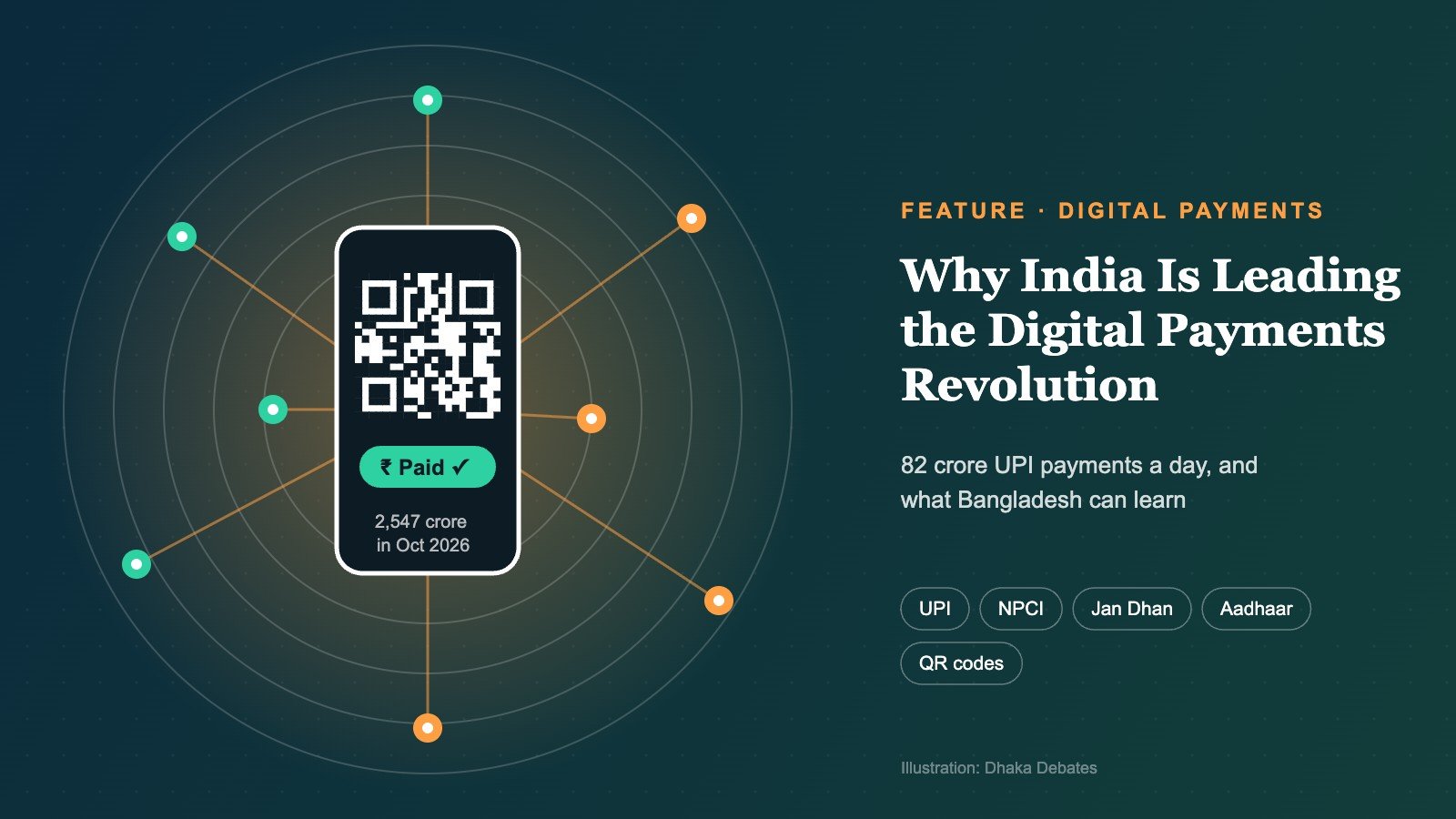
It is a little after seven in the morning at a fruit stall near New Market in Kolkata. The man behind the counter, whom we will call Ramesh, is stacking guavas into a pyramid. A laminated square of paper hangs from a nail above his head. It has a black-and-white QR code on it, his name, and the logos of half a dozen apps. A college student picks up four bananas, holds her phone up to the square, types “40”, enters a four-digit PIN and walks away. A small speaker next to the scale says, in a flat robot voice, “Received forty rupees.” Ramesh does not even look up.
Ten years ago this scene would have looked like science fiction. Ramesh would have kept a cloth bag of coins and notes, worried about change, and closed early on days when he had too much cash to carry home safely. Today a large part of his sales arrives straight into his bank account. He does not pay the bank a single paisa for it. He did not fill in a merchant form. He did not buy a card machine. He simply printed a QR code.
Multiply Ramesh by tens of millions of shopkeepers, rickshaw pullers, tea sellers, tuition teachers and landlords, and you have the story of how India became the world’s biggest digital payments market. Bangladeshi visitors to Kolkata, Delhi or Chennai notice it at once: the QR codes are everywhere, from five-star hotel counters to the man who sells peanuts on the train.
The short answer: India leads the digital payments revolution because it built one shared, government-backed payment network, the Unified Payments Interface (UPI), and let every bank and app plug into it for free. Cheap phones, cheap mobile data, a national digital ID (Aadhaar) and a huge push to open bank accounts (Jan Dhan) gave almost everyone the tools to use it. Demonetisation in 2016 and the pandemic in 2020 pushed people to try it, and zero fees kept them using it. In October 2026 UPI handled about 2,547 crore transactions worth ₹31.5 lakh crore, roughly 82 crore payments a day. India alone now makes close to half of all the real-time digital payments in the world. The model has weak spots, too: it earns almost no money, two apps control most of it, fraud is rising, and cash has not disappeared.
This is a long story, so here is the map. First we explain what UPI is in plain words. Then we go back to how India built it, step by step, and why the timing worked. After that we look at the numbers, at why UPI beat cards and wallets, at who makes money from it (mostly nobody, which is a problem), at fraud and outages, at UPI’s push into other countries, and at the honest criticisms. We end with what Bangladesh, which has its own fast-growing mobile money market, can and cannot copy.
What exactly is UPI, in simple words?
UPI stands for Unified Payments Interface. Think of it as a public road that connects every bank in India. The road is owned and run by the National Payments Corporation of India (NPCI), a not-for-profit company set up by the Reserve Bank of India (RBI) and the Indian Banks’ Association. Banks build “entry and exit ramps” onto the road. Apps such as PhonePe, Google Pay, Paytm, BHIM, Amazon Pay and WhatsApp Pay are like cars that drive on it.
When you pay someone through UPI, the money does not sit in the app. It moves straight from your bank account to the other person’s bank account, in a few seconds, at any hour of any day. The app is only the steering wheel. That is the single most important design choice behind UPI’s success, and we will come back to it many times.
How does a UPI payment actually work?
Let us follow the forty rupees for bananas from the student’s phone to Ramesh’s account:
- Scan. The student scans Ramesh’s QR code. The code holds his “virtual payment address” (VPA), something like ramesh.fruits@okbank. It works like an email address for money. The student never sees Ramesh’s account number.
- Request. Her app (say, PhonePe) sends the request to her bank through NPCI’s central switch.
- Authorise. She types her UPI PIN. The PIN is checked by her own bank, not by the app.
- Debit and credit. Her bank takes ₹40 from her account. NPCI tells Ramesh’s bank, which adds ₹40 to his account.
- Confirm. Both phones get a message. Ramesh’s speaker reads it out loud. The whole thing usually takes two to five seconds.
Behind the scenes, banks settle the net amounts with each other several times a day through accounts at the central bank. Ordinary users never see that part.
Why does “interoperable” matter so much?
Interoperable is a big word for a simple idea: any app can pay any other app. A Google Pay user can pay a PhonePe QR code. A Paytm user can send money to a BHIM user. A customer of State Bank of India can pay a customer of a small cooperative bank in Assam. Nobody has to ask “which app do you use?”
Bangladeshi readers will see why this matters. For years, a bKash user could not easily send money to a Nagad user, and a shopkeeper often needed separate QR codes or numbers for each service. Bangladesh is now fixing this with Bangla QR and the Binimoy platform, but India designed UPI to be open from the first day. In 2025 the International Monetary Fund (IMF) published a paper that credited exactly this feature, interoperability, as the main reason UPI grew so fast. When all apps share one road, a new app does not have to build its own customer network from scratch. It just joins the road.
Is UPI a wallet like bKash?
No, and this difference is easy to miss. bKash, Nagad and Rocket in Bangladesh are mobile financial services (MFS). You load money into an account held by the MFS provider, and it stays there as electronic money until you cash it out or spend it. UPI, by contrast, is a bank-to-bank system. Your money stays in your normal bank account until the moment you pay. That means UPI payments can earn interest in a savings account, are covered by India’s deposit insurance, and do not need a separate cash-in and cash-out network of agents.
India did have mobile wallets too. Paytm’s wallet was huge around 2016 and 2017. But wallets were closed systems: Paytm wallet money could only be spent where Paytm was accepted. Once UPI took off, most wallets shrank into side features. We look at why in a later section.
| Feature | UPI (India) | MFS wallet (e.g. bKash) | Debit or credit card |
|---|---|---|---|
| Where the money sits | Your bank account | E-money account with the provider | Your bank account or credit line |
| Who runs the network | NPCI (not-for-profit, owned by banks) | The MFS company itself | Visa, Mastercard, RuPay and the banks |
| Can any app pay any other? | Yes, by design | Only recently, through national switches | Yes, through card networks |
| Fee for a shop to accept | Mostly zero (small fee planned on bigger payments) | Usually a percentage charge | Usually 1% to 3% |
| Equipment needed by a shop | A printed QR code | A QR code or a number | A card machine (POS) |
| Fee to send money to a friend | Free | Free up to a limit, then charged; cash-out is charged | Not usually possible |
How did India build UPI, step by step?
UPI did not appear out of nowhere in 2016. It sits on top of almost two decades of quiet plumbing work. The order of events matters, because each step made the next one possible.
2008 to 2010: a national switch and instant transfers
NPCI was set up in 2008 under the Payment and Settlement Systems Act, 2007. Its first job was boring but vital: take over the national network of ATMs so that a card from any bank worked at any other bank’s machine. In 2010 it launched IMPS, the Immediate Payment Service, which let people send money between banks instantly, 24 hours a day. IMPS was a real breakthrough, but it was clunky. You needed the other person’s account number and IFSC bank code, or a special mobile money identifier. Most people never bothered.
In 2012 NPCI launched RuPay, India’s own card network, as a domestic alternative to Visa and Mastercard. RuPay would later matter because the government could give RuPay debit cards to millions of new account holders and set its fees by policy.
2009 to 2014: a digital identity for everyone
In 2009 India created the Unique Identification Authority of India (UIDAI) to issue Aadhaar, a 12-digit identity number linked to a person’s fingerprints, iris scan and face. Enrolment was free. Within a few years it reached most adults. UIDAI says there are now about 134 crore live Aadhaar holders, making it the largest biometric ID system in the world.
Aadhaar matters for payments because it made “know your customer” (KYC) checks cheap. Before Aadhaar, opening a bank account meant photocopies, proof of address and a visit to a branch. With Aadhaar-based electronic KYC (e-KYC), a bank could confirm who you were in seconds with a fingerprint. That cut the cost of opening an account for a poor customer, who might only ever deposit a few hundred rupees, from something banks avoided to something they could afford.
2014: Jan Dhan opens bank accounts for the poor
In August 2014, the newly elected government of Prime Minister Narendra Modi launched the Pradhan Mantri Jan Dhan Yojana, a campaign to give every household a basic bank account. Accounts could be opened with zero balance. Each came with a RuPay debit card and accident insurance. Banks held account-opening camps in villages. In its first week the scheme claimed a Guinness World Record for the most accounts opened in a week.
By August 2026, when the scheme turned twelve, the government said 59.09 crore Jan Dhan accounts had been opened, holding about ₹3.17 lakh crore in deposits. Not all of these accounts are active, as we will see later. But the scheme did something UPI needed: it put a bank account in the hands of people who had never had one. UPI is a bank-to-bank system. Without accounts, there is nothing to connect.
What is the “JAM trinity”?
Indian policy makers like to describe this foundation as the JAM trinity: Jan Dhan accounts, Aadhaar identity and Mobile phones. Each one alone is useful. Together they let the government pay subsidies, pensions and scholarships straight into people’s accounts (a system called Direct Benefit Transfer), and they let people pay each other digitally.
The “M” got a sudden boost in September 2016, when Reliance Jio launched a 4G mobile network with free calls and extremely cheap data. Within a couple of years, mobile data in India became among the cheapest in the world, and tens of crores of people bought their first smartphone. The timing could not have been better for UPI, which had gone live just five months earlier.
April 2016: UPI goes live
UPI was formally launched on 11 April 2016 by then RBI Governor Raghuram Rajan in Mumbai, with 21 banks at first. It took the instant engine of IMPS and added three things people actually needed: a simple address instead of account numbers (the VPA), a single PIN for all payments, and the ability for third-party apps to build on top of it. The first few months were slow. In the whole financial year 2016-17, UPI handled only about 2 crore transactions. Then came a shock nobody had planned for.
November 2016: demonetisation forces people to try digital
On the evening of 8 November 2016, Prime Minister Modi announced on television that ₹500 and ₹1,000 notes would stop being legal tender at midnight. Those two notes made up about 86% of the cash in circulation by value. The stated goals were to fight black money, fake notes and terror financing. Whether it achieved those goals is still hotly debated. Most of the cancelled money came back into the banks, and the cash shortage hurt small businesses and daily wage workers badly for months.
But for digital payments, demonetisation was a forced trial. Suddenly nobody had enough cash. People queued for hours at ATMs. Shopkeepers who had never accepted anything but notes started putting up Paytm signs. The government launched its own UPI app, BHIM (named after B. R. Ambedkar), on 30 December 2016. Usage of digital payments jumped. When cash came back, a lot of people went back to it, but a habit had started, and many shopkeepers kept their QR codes.
2017 to 2019: Big Tech arrives
In September 2017, Google launched an app called Tez in India, built entirely on UPI. It was later renamed Google Pay. Walmart bought Flipkart, which owned PhonePe, in 2018. Amazon Pay and later WhatsApp Pay joined. These companies spent huge sums on cashback offers and scratch cards to win users. They did the expensive work of marketing UPI to India’s middle class, while the actual money movement ran on NPCI’s public rails. By the end of 2019, UPI was handling more than 100 crore transactions a month.
2020: zero fees and a pandemic
From 1 January 2020, the government banned the merchant discount rate (MDR), the fee a shop pays to accept a digital payment, on UPI and RuPay debit cards. This made UPI completely free for both sides. A few months later, the Covid-19 pandemic arrived. People did not want to touch cash or card machines. “Scan and pay” was contact-free. Small shops, vegetable sellers and pharmacies that had resisted digital payments finally gave in.
The combination of zero cost and a reason to avoid cash turned UPI from a city habit into a national one. By the financial year 2021-22, UPI was processing about 4,596 crore transactions a year, roughly double the year before.
| Year | Milestone | Why it mattered |
|---|---|---|
| 2008 | NPCI set up | A neutral, bank-owned operator for national payments |
| 2009 | Aadhaar programme begins | Cheap identity checks for account opening |
| 2010 | IMPS launched | The 24×7 instant engine that UPI later used |
| 2012 | RuPay card network launched | A home-grown card the government could steer |
| 2014 | Jan Dhan accounts scheme | Bank accounts for crores of first-time users |
| April 2016 | UPI launched | Simple addresses, one PIN, open to apps |
| September 2016 | Jio cheap 4G launched | Affordable mobile data for the mass market |
| November 2016 | Demonetisation | A cash shortage forced people to try digital |
| December 2016 | BHIM app launched | A government app to show UPI to the public |
| 2017–2018 | Google Pay (Tez), PhonePe scale up | Big marketing budgets and cashback offers |
| January 2020 | Zero MDR on UPI and RuPay debit | Free for shops to accept |
| 2020–2021 | Covid-19 pandemic | Contactless payment became a health choice |
| 2022 | UPI 123PAY, UPI Lite, RuPay credit on UPI | Feature phones, small payments and credit join |
| 2023 onward | Links with Singapore, UAE, France and others | UPI starts to go abroad |
| 2026 | UPI turns ten; merchant fee on larger payments announced | The question of who pays becomes urgent |
How big is India’s digital payments system today?
The short version: bigger than anyone expected, and still growing by around a fifth to a third every year. Numbers this large are hard to picture, so we will give them in the units Indian and Bangladeshi readers use (crore and lakh crore) and then turn them into everyday terms.
What did UPI do in October 2026?
October 2026 was a festival month, with Durga Puja, Dussehra and the run-up to Diwali. According to NPCI data reported by the business press, UPI processed 2,547 crore transactions that month, worth ₹31.53 lakh crore. Both were all-time records. On average, UPI handled about 82.2 crore transactions every day, and for the first time the average daily value crossed ₹1 lakh crore (₹1,01,707 crore). Compared with October 2025, the number of transactions was up 23% and the value up 16%.
Our calculation: 82.2 crore transactions a day works out to roughly 9,500 payments every second, around the clock. And the average payment in October was about ₹1,240. That small average tells you something important. UPI is not mainly a tool for big transfers. It is used for tea, vegetables, auto-rickshaw fares, phone recharges and splitting a restaurant bill.
How fast has it grown year by year?
India’s financial year runs from April to March. The table below shows UPI’s yearly totals since launch, based on NPCI and government figures.
| Financial year | Transactions (crore) | Value (₹ lakh crore) |
|---|---|---|
| 2016-17 | about 2 | 0.07 |
| 2017-18 | about 92 | 1.1 |
| 2018-19 | about 535 | 8.8 |
| 2019-20 | about 1,252 | 21.3 |
| 2020-21 | about 2,233 | 41.0 |
| 2021-22 | 4,596 | 84.2 |
| 2022-23 | 8,371 | 139 |
| 2023-24 | 13,113 | 200 |
| 2024-25 | 18,587 | 261 |
| 2025-26 | 24,162 | 314 |
Our calculation: from 2024-25 to 2025-26, the number of UPI transactions grew by about 30%, and the value by about 20%. The volume is growing faster than the value, which means the average payment is getting smaller. That is a sign of UPI reaching deeper into small, daily spending rather than just replacing large bank transfers. Over the full decade the government says volume rose almost 12,000 times and value more than 4,000 times. The number of banks live on UPI went from 44 in the first year to 703.
Our calculation: 24,162 crore transactions in 2025-26 divided by India’s population of roughly 146 crore gives about 165 UPI payments per person per year, or a little more than three a week for every man, woman and child. Of course, babies do not pay with UPI and many elderly people still do not, so active users make far more payments than that.
Is it true India makes half of the world’s real-time payments?
Close to it. Real-time payments are payments that reach the receiver within seconds, at any time, rather than in batches. Payment software company ACI Worldwide, which tracks these systems across dozens of countries, has for several years ranked India first by a wide margin. Its research, cited by the IMF in a June 2025 note on retail digital payments, put India’s share of global real-time payment volume at about 49%. Brazil, with its Pix system, came a distant second. China, Thailand and South Korea follow.
One caution: “volume” counts the number of payments, not their value. Because UPI payments are small on average, India’s share of global value is much lower. China’s mobile payment giants, Alipay and WeChat Pay, still move larger sums. But in sheer number of daily digital transactions, no other country comes close.
How much of India’s digital payments now go through UPI?
Most of them, by count. The RBI’s payment systems report for the second half of 2025 found that UPI accounted for 85.5% of all digital payment transactions in India by volume. But big-ticket payments between companies and banks still go through RTGS (Real Time Gross Settlement), which handled about two-thirds of the value. In plain words: UPI wins the daily small payments; the old bank systems still carry the giant ones.
Cards have lost ground in relative terms. Debit card use at shops has fallen as people switched to scanning QR codes. Credit cards are still growing, partly because they offer reward points and interest-free credit, and partly because, since 2022, RuPay credit cards can be linked to UPI, as we explain later.
If UPI is so popular, why is there still so much cash in India?
This surprises many people. According to research by the State Bank of India (SBI) published in February 2026, currency in circulation hit a record of about ₹40 lakh crore at the end of January 2026, growing 11.1% in a year. So the amount of cash in India is still going up.
But the same research shows the other side. As a share of the economy, cash is shrinking. The cash-to-GDP ratio fell from 14.4% in 2020-21 (inflated by Covid, when people hoarded cash) to about 11% in 2025-26. SBI’s economists put it neatly: new growth in the economy is now being paid for “less by cash and more through UPI.” In other words, cash is not disappearing, but the extra spending that comes with a growing economy is increasingly digital. People still keep cash for emergencies, for savings in rural areas, for weddings and festivals, and for some payments they would rather keep off the record.
This is an important lesson for Bangladesh. As we argued in our story on whether Bangladesh can become a cashless economy, “cashless” is a direction, not a destination. Even India, the world’s real-time payments leader, is a “less cash” economy, not a cashless one.
Why did UPI win when so many other systems failed?
Many countries have tried to build national instant payment systems. Most are useful but not life-changing. So why did UPI become a daily habit for hundreds of millions of Indians? Our reporting points to seven reasons that worked together.
1. Public rails, private apps
The government, through the RBI and NPCI, built and owns the core network. But it did not try to be the main app. Instead, it let private companies, including global giants like Google, Walmart (through PhonePe) and Amazon, compete to build the best app on top. Those companies spent billions of rupees on marketing and cashback to win users, which taught India to use UPI at no cost to the taxpayer. Meanwhile, because the rails were public, no single company could lock users in or charge a toll.
Compare this with China, where Alipay and WeChat Pay are both the rails and the apps, owned by private giants. Or with Bangladesh, where for many years bKash was both the network and the main app. Many economists now call India’s approach “digital public infrastructure” (DPI): the state builds open, shared systems, and the market builds services on them.
2. It is free for everyone
Since January 2020, neither the customer nor the shop has paid anything for a normal UPI payment. For a vegetable seller whose profit margin is a few rupees per kilo, a 2% card fee would wipe out the gain from going digital. Zero fees removed that objection. Zero fees are also the source of UPI’s biggest long-term problem, as we will see. But for adoption, nothing beats free.
3. A shop needs nothing but a printed QR code
Card machines cost money, need electricity and a network connection, and require a merchant agreement with a bank. A UPI QR code is a piece of paper. Many apps hand out free QR stickers and small “soundbox” speakers that read out each payment, which solved a real problem: shopkeepers do not have time to check their phone for every ₹20 sale. The soundbox, rented for a small monthly fee, became one of the most important pieces of hardware in Indian retail.
4. It works across every bank and app
We explained interoperability above. Its practical effect is that network effects work for the whole country, not just for one company. Every new user makes UPI more useful for every existing user, whatever app they use. A shop that puts up one QR code can be paid by anyone.
5. The government pushed hard, and paid
The Indian government treated digital payments as a national project. Ministers talked about UPI in speeches. Government departments started accepting it. Railways, toll roads, electricity boards and tax offices added QR codes. To keep banks and apps interested despite zero fees, the government also paid incentives from the budget. In March 2025, for example, the Union Cabinet approved ₹1,500 crore to reward banks for low-value UPI payments to small merchants. The money was useful but, as banks and payment companies kept complaining, far below what it costs to run the system.
6. Cheap phones and cheap data
UPI arrived just as India’s smartphone and data boom began. When a gigabyte of data costs less than a cup of tea and a basic Android phone costs a few thousand rupees, an app-based payment system can reach poor and rural users. For people with basic “feature phones,” NPCI later added UPI 123PAY (more on that below).
7. Shocks that forced people to try it
Habits are hard to change. Demonetisation in 2016 and the pandemic in 2020 were two shocks, one political and one natural, that made cash inconvenient at exactly the moment UPI was ready. Neither shock was a good thing for ordinary people. But both pushed tens of crores of people to try a digital payment for the first time, and many never went back.
| Factor | What India did | Effect on adoption |
|---|---|---|
| Design | One open network run by a not-for-profit | No company could lock users in |
| Cost | Zero merchant fee since 2020 | Small shops had no reason to refuse |
| Hardware | Printed QR code plus a cheap soundbox | Any stall could accept payments in a day |
| Identity | Aadhaar e-KYC | Cheap, fast account opening |
| Accounts | Jan Dhan zero-balance accounts | Crores of new bank customers |
| Connectivity | Very cheap 4G data | App payments reached villages |
| Competition | Google, PhonePe, Paytm, Amazon allowed in | Private money spent on marketing |
| Shocks | Demonetisation, Covid-19 | Forced first-time trial |
Why did cards and wallets lose out to UPI?
Before UPI, India’s digital payment hopes rested on two things: debit and credit cards, and mobile wallets. Both had real weaknesses for a country of small shops and small payments.
Cards needed machines. In 2016 India had only a few lakh card machines for a country of well over a hundred crore people, and most were in cities. Each machine cost money to buy or rent, needed a bank agreement, and charged the shop a fee on every swipe. A tea seller earning a few rupees per cup had no reason to sign up. Many card holders also used their debit cards mainly to withdraw cash at ATMs, not to pay in shops.
Wallets solved the machine problem, since a shop only needed a QR code, but they created a new one. Each wallet was its own island. A Paytm wallet could not pay a MobiKwik shop. Customers had to load money into the wallet first, and taking it back out to a bank account often cost a fee. When the RBI tightened identity rules for wallets in 2017 and 2018, many users did not bother to complete the paperwork.
UPI took the best of both. Like a card, it took money straight from a bank account, with no loading step. Like a wallet, it needed only a QR code and a phone. And unlike either, it was free for the shop and worked with every bank and app. Faced with that choice, shopkeepers and customers moved. Wallet companies such as Paytm and PhonePe, which had started as wallets, quickly rebuilt themselves as UPI apps. The lesson for any country is that people do not choose payment systems for their technology. They choose whatever is cheapest, simplest and most widely accepted, and UPI was all three at once.
Who controls UPI, and why are two apps a worry?
Here is the irony at the heart of India’s payment story. The network was built to be open and shared, yet the apps on top of it became highly concentrated. For years, two apps, PhonePe and Google Pay, handled more than four out of every five UPI payments.
PhonePe is majority-owned by the US retailer Walmart. Google Pay belongs to the US tech giant Alphabet. This means that a payment system India proudly calls “home-grown public infrastructure” has, in practice, been dominated at the user end by two American-owned companies. Indian politicians, regulators and commentators have raised this point many times.
What does the market look like now?
There are signs of slow change. In May 2026, according to NPCI figures reported by Outlook Business, the combined share of PhonePe and Google Pay fell below 80% for the first time, to 79%. The top three apps, including Paytm, held 87%, down from about 95% in January 2024. Newer players such as Navi and super.money (owned by Flipkart) together took about 5.5%. The government’s own app, BHIM, had only about 1%.
| App or group | Approximate share of UPI volume, May 2026 | Owner |
|---|---|---|
| PhonePe and Google Pay together | 79% | Walmart; Alphabet (Google) |
| Paytm | about 8% | One 97 Communications (listed Indian company) |
| Navi and super.money together | about 5.5% | Navi Technologies; Flipkart |
| BHIM | about 1% | NPCI (government-backed) |
| All others (bank apps, Amazon Pay, WhatsApp, CRED etc.) | the rest | Various |
What is the 30% market cap, and why keeps it being delayed?
In November 2020, NPCI announced that no single third-party app should handle more than 30% of UPI volume. The idea was to reduce “concentration risk”: if one huge app crashed or was hacked, a large part of the country’s payments would stop. Apps over the limit were supposed to slow down onboarding new users.
But enforcing the cap is hard. How do you tell a customer they cannot use the app they like? So the deadline has been pushed back again and again. In December 2024, NPCI extended it to 31 December 2026. That date is now less than two months away. As of our reporting, NPCI had not announced whether the cap would finally be enforced, delayed again or replaced. Whatever it decides will be watched closely across the industry.
What happened to Paytm?
Paytm was once the face of Indian digital payments. Its wallet boomed during demonetisation, and its blue logo was on shop counters across the country. But in January 2024, the RBI ordered Paytm Payments Bank, a related bank that held Paytm’s wallets and many of its customers’ UPI handles, to stop accepting new deposits and top-ups, citing persistent compliance failures. The ban took full effect in March 2024. Paytm had to move its UPI users to partner banks such as Axis Bank, HDFC Bank, SBI and Yes Bank.
Paytm survived, and its UPI share has partly recovered, but it lost its position as a challenger to the top two. Its story is a warning that in payments, regulators’ trust matters as much as technology. It also showed a strength of the UPI design: because the money sat in banks, not in Paytm’s app, customers were able to move to other apps with little disruption.
Can Bangladesh avoid the same concentration?
Bangladesh has the opposite starting point. Instead of an open network that became concentrated at the app level, Bangladesh had one dominant closed provider, bKash, which still holds a very large share of mobile money. Our bKash vs Nagad comparison shows how the two biggest MFS providers differ. New entrants such as Pathao Pay are trying to break in. India’s experience suggests that open rails help new players enter, but they do not by themselves stop a few apps from winning. Rules on data sharing, fair access and real competition matter too.
Who pays for UPI if it is free?
Nothing is truly free. Every UPI payment uses servers at NPCI, at the sender’s bank and at the receiver’s bank. It needs fraud checks, customer support, staff and backup systems. Apps like PhonePe and Google Pay employ thousands of engineers. Somebody has to pay for all of it.
Since January 2020, the honest answer has been: mostly the banks and the apps themselves, with some help from the government. The Payments Council of India, an industry group, has estimated that running UPI costs the ecosystem around ₹10,000 crore a year. Government incentive schemes have covered only part of that. A parliamentary panel also reportedly found that the incentives do not cover the real cost of keeping the system running.
How do the apps make money at all?
Mostly by selling other things to the users that UPI brings them. PhonePe, Paytm and others earn from:
- Soundbox rentals for shopkeepers, at a monthly fee.
- Loans to customers and merchants, where they earn a commission from partner banks and finance companies.
- Insurance and mutual funds sold inside the app.
- Bill payments and recharges, where billers pay a small fee.
- Payment gateway services for online businesses, where card and other payment fees still apply.
- Advertising and promoted offers.
This model works for large companies with deep pockets. It is much harder for smaller players and for banks, which carry the heaviest technical load. Several bank executives have publicly said they lose money on UPI.
What is the new UPI merchant fee in 2026?
After years of debate, India decided in 2026 to bring back a merchant discount rate on some UPI payments. Here is what has happened so far, in order:
- The law. Parliament passed an amendment that let the central government decide which digital payment modes must stay free.
- The notification. On 14 September 2026, the Finance Ministry issued a notification saying no bank or payment provider may charge anything on UPI payments up to ₹2,000, or on RuPay debit card payments. That left the door open for a fee on bigger UPI payments to merchants.
- The framework. The UPI and Services Steering Committee, led by NPCI, then set the details: a fee of 0.4% on certain person-to-merchant payments above ₹2,000, capped at ₹300 per transaction; a flat ₹5 fee for payments above ₹2,000 in essential sectors such as railways, telecoms, insurance, fuel, utilities and education; and no fee for small merchants who collect up to ₹1 lakh a month through their existing QR codes. Payments between people (person-to-person) stay free at any amount.
- The delay. The fee was due to start on 15 October 2026. On 13 October, NPCI said it would be deferred until “immediately post Diwali”, on a date still to be announced. Diwali fell on 8 November this year, so the fee could start any day now.
The Finance Ministry has said about 96% of person-to-merchant UPI payments will not be affected. It also stressed that the fee is not a tax: it goes to banks and payment apps, not to the government or NPCI. Reports suggest the money will be shared between the customer’s bank, the shop’s bank and the app, though the final split has not been officially published.
| Type of UPI payment | Fee under the 2026 framework |
|---|---|
| Person to person, any amount | Free |
| Person to merchant, ₹2,000 or less | Free (by law) |
| Small merchant collecting up to ₹1 lakh a month on existing QR | Free |
| Person to merchant above ₹2,000, essential sectors | Flat ₹5 |
| Person to merchant above ₹2,000, other merchants | 0.4%, capped at ₹300 |
Our calculation: on a ₹10,000 purchase at a big electronics store, a 0.4% fee would be ₹40. On a ₹50,000 phone it would be ₹200. Above ₹75,000, the ₹300 cap kicks in. For comparison, the same store would typically pay 1% to 2% on a credit card payment, or ₹500 to ₹1,000 on that phone.
Will the fee hurt UPI’s growth?
Opinions differ. Supporters say a small fee on big payments is fair, keeps the system healthy and gives banks a reason to invest in better security and uptime. Critics worry that some merchants will add a surcharge, push customers back to cash, or ask them to pay as “person to person” to dodge the fee. Some analysts have also argued that the fee will mostly help the biggest apps and banks, which handle the most large merchant payments.
The first months after the fee starts will be a real-world test of a question every payments system eventually faces: can you keep a service both universal and financially sustainable? Bangladesh, where MFS cash-out and merchant fees have long been a sore point, will want to watch the result closely.
How serious is UPI fraud?
Every payment system attracts thieves, and a system with crores of new, first-time digital users attracts more than most. UPI fraud is a real and growing problem, although it is small compared with the total money moving through the system.
In March 2026, Minister of State for Finance Pankaj Chaudhary gave the Rajya Sabha (India’s upper house of Parliament) the following figures, based on RBI data:
| Financial year | UPI fraud cases reported | Amount involved (₹ crore) |
|---|---|---|
| 2021-22 | 4.07 lakh | 242 |
| 2022-23 | 7.25 lakh | 573 |
| 2023-24 | 13.42 lakh | 1,087 |
| 2024-25 | 12.64 lakh | 981 |
| 2025-26 (up to 15 March 2026) | 16.29 lakh | 1,226 |
Our calculation: in 2025-26, about ₹1,226 crore of fraud against more than ₹314 lakh crore of UPI payments works out to roughly ₹4 lost for every ₹10 lakh paid, or 0.0004%. By that measure, UPI is very safe. But fraud is not spread evenly. It falls hardest on poor, elderly and first-time users, for whom losing ₹5,000 can mean losing a month’s income. And the numbers above count only reported cases. Many victims never report small losses. Broader cyber fraud, including fake investment schemes and “digital arrest” scams where criminals pose as police, is much larger.
What kinds of UPI scams are common?
- “Collect request” tricks. A scammer sends a request for money but tells the victim it is a payment they will receive. The victim enters the PIN and money leaves their account. Key rule: you never need a PIN to receive money.
- Fake QR codes. A fraudster sticks their own QR code over a shop’s code, or sends a QR “to receive a refund”.
- Screen-sharing apps. Victims are persuaded to install an app that lets the scammer see their screen and PIN.
- Fake customer care numbers found through internet searches.
- Mule accounts. Criminals rent or buy bank accounts, often Jan Dhan accounts of poor people, to receive stolen money.
Regulators have responded. Banks and NPCI use machine learning to flag unusual payments. Large first-time payments between strangers can be delayed. NPCI has restricted “collect” requests between people, which were behind many scams. The RBI has worked on tools to detect mule accounts. The government’s Sanchar Saathi portal lets people report fraud calls and block stolen phones. These are similar to the problems Bangladesh faces with MFS fraud, where “wrong number” scams and fake agent calls are common.
What happens when UPI goes down?
When a country depends on one network for most of its daily payments, an outage is a national event. India learned this in spring 2025. On 26 March, 2 April and 12 April 2025, UPI suffered major disruptions. Millions of payments failed or were delayed. Shopkeepers turned customers away, and social media filled with complaints.
NPCI later said the problems were caused by a surge in “check transaction status” requests from some banks’ systems, which flooded the network. It then told banks and apps to limit such automated calls and set caps on how often users could check their balance through apps. Those rules took effect later in 2025.
The outages were short by global standards. But they exposed the flip side of success. When cash was king, a bank’s computer failure affected only that bank’s customers. Now a problem at the central switch, or at a few large banks, can stop payments for the whole country. This is one reason the RBI wants more competition among apps, backup systems, and the ability to pay offline.
What new features have kept UPI growing?
UPI is not a finished product. NPCI keeps adding features to reach new users and new uses. These are the most important.
UPI 123PAY: payments without a smartphone
Launched by the RBI in March 2022, UPI 123PAY lets people with basic feature phones make UPI payments, either by calling an interactive voice number, using a missed call, or through an app built into the phone. At launch, the RBI said it was aimed at India’s roughly 40 crore feature phone users. In September 2026, PhonePe partnered with phone makers Lava and itel to put UPI payments on feature phones that do not need internet at all. Uptake of 123PAY has been slower than smartphone UPI, but it matters for older people and the rural poor.
UPI Lite: small payments without a PIN
Launched in 2022, UPI Lite is a small on-device balance for tiny payments, such as a ₹10 tea, that do not need a PIN every time. It reduces the load on banks’ servers and works faster in poor network areas. Limits have been raised over time; check your app for the current amounts.
Credit on UPI: from paying to borrowing
This is the change that could matter most in the long run. In 2022 the RBI allowed RuPay credit cards to be linked to UPI, so people could scan a shop’s QR code and pay from a credit card. In 2023 it went further, allowing banks to offer pre-approved credit lines on UPI. This means a shopkeeper’s QR code can now accept both debit and credit payments without a card machine.
For banks, this offers a way to make money, because credit payments carry fees. For customers, it brings both opportunity and risk: easy credit at a tap of a phone can help a small business manage cash flow, but it can also lead to debt problems. Our explainer on buy now, pay later in Bangladesh covers similar risks.
Other features worth knowing
- UPI AutoPay: recurring payments for subscriptions, insurance premiums and loan instalments.
- UPI Circle: lets a main account holder allow a family member, such as an elderly parent or a college student, to pay from their account within set limits.
- Biometric approval: NPCI has begun allowing fingerprint or face checks on supported phones as an alternative to typing a PIN.
- Conversational payments: pilots allowing payments by voice in Indian languages, aimed at people who cannot read well.
Is UPI going global?
India wants UPI to become one of its exports, much like software services. In 2020 NPCI set up a subsidiary, NPCI International Payments Limited (NIPL), to take UPI abroad. It follows three approaches:
- Acceptance abroad: letting Indian tourists pay with their UPI apps at shops in other countries, by scanning local QR codes or UPI codes.
- Linking with other countries’ systems: the first big example was a link between UPI and Singapore’s PayNow in February 2023, which lets people send money between the two countries from their phones within seconds.
- Building UPI-like systems for others: offering India’s technology and know-how to countries that want their own national instant payment systems. Namibia, Trinidad and Tobago and others have signed such agreements.
Government statements now say UPI is available in some form in about a dozen countries. A list compiled by Business Today in July 2026 named nine where Indian travellers can pay: Bhutan, Singapore, France, Mauritius, Nepal, Sri Lanka, the UAE, Qatar and Cambodia. In most of these, acceptance is still limited to tourist spots, certain shops or a few partner banks.
| Country | Year UPI acceptance or link began | Typical use |
|---|---|---|
| Bhutan | 2021 | Shops and tourism |
| Singapore | 2023 | UPI–PayNow transfers between people |
| France | 2024 | Tourist sites, starting with the Eiffel Tower |
| Mauritius | 2024 | Payments and RuPay cards |
| Nepal | 2024 | Shops via local QR network |
| Sri Lanka | 2024 | Shops for Indian visitors |
| UAE | 2024 | Shops and retailers |
| Qatar | 2025 | Retail and duty-free |
| Cambodia | 2026 | QR payments |
Can a Bangladeshi visitor use UPI in India?
Not in the normal way. Regular UPI needs an Indian bank account and an Indian mobile number. NPCI has introduced “UPI One World,” a prepaid wallet for foreign visitors, offered at some airports and through partner companies, which lets tourists load money with a foreign card or cash and then scan UPI codes. Availability changes, so check before you travel. Bangladesh is not yet on the list of countries with a UPI link. Most Bangladeshi visitors still rely on cash rupees, international cards or local friends who pay for them by UPI and get paid back in cash.
Why does global UPI matter to Bangladesh?
Millions of Bangladeshis travel to India each year for medical treatment, education, business and tourism. Linking Bangladesh’s systems (NPSB, Bangla QR, or MFS wallets) with UPI could make those trips easier and cheaper, and could also help small traders on both sides of the border. Such links need agreements between the two central banks and careful work on foreign exchange rules and anti-money-laundering checks. The Singapore–India link shows it is technically possible. Whether the politics and economics line up is a separate question.
For Bangladeshi freelancers and businesses that already receive money from abroad, the more immediate tools remain services like Payoneer and bank transfers. Our guide on how to receive international payments as a Bangladeshi business covers the practical options.
Is UPI only about payments?
No. UPI is the most famous part of a wider set of digital tools that Indian officials call the “India Stack.” Together, they aim to make it cheap to prove who you are, share your documents and financial data with your permission, and buy and sell online. A few examples:
- DigiLocker: a government app where citizens keep official copies of documents such as driving licences, school certificates and vehicle papers.
- Account Aggregator: a system, regulated by the RBI, that lets you share your bank statements and other financial records with a lender with one click and your consent, instead of printing and stamping pages. This helps small businesses get loans based on their actual cash flow, including their UPI receipts.
- ONDC (Open Network for Digital Commerce): an attempt to do for online shopping what UPI did for payments, by letting buyers on one app order from sellers on another.
- Direct Benefit Transfer: government payments sent straight to beneficiaries’ Aadhaar-linked bank accounts, cutting out middlemen.
The link to payments is direct. Once Ramesh’s sales go through UPI, he has a digital record of his income. A lender can see, with his permission, that he takes in around ₹8,000 a day, every day. That record can help him get a small working-capital loan without collateral, something almost impossible when everything was cash. This is the same problem we described in our feature on why small businesses in Bangladesh struggle to access finance: lenders cannot lend to businesses whose income they cannot see.
India’s fintech industry has grown on this base. Lending apps, investment platforms, insurance sellers and “neo-banks” have all built products that rely on UPI and the wider stack. Not all of them have been well behaved. India has struggled with predatory digital lending apps, and the RBI has tightened rules on digital lending several times. But the overall effect has been to make financial services cheaper and easier to reach.
What are the main criticisms of India’s model?
Celebrations of UPI often skip the hard parts. A fair account has to include them.
Many bank accounts are empty or unused
Opening an account is not the same as using one. In September 2026, information obtained through a Right to Information request and reported by several news outlets showed that about 15.36 crore Jan Dhan accounts were inoperative, roughly one in four, and 5.72 crore had a zero balance. Some people opened accounts only to receive a one-time government payment. Others had duplicate accounts. Some are used as “mule” accounts by fraudsters. The headline count of 59 crore accounts overstates how many people are really part of the formal financial system.
The digital divide is real
Women, older people, the rural poor and people with little education are less likely to own a smartphone or feel confident using payment apps. In many families, a woman’s phone is shared or controlled by a male relative. Studies by India’s own researchers have found clear gaps by gender and income in digital payment use. UPI 123PAY and voice payments are attempts to close this gap, but they are still small.
Aadhaar and exclusion
When fingerprints fail to match, which happens more often for manual labourers and elderly people with worn fingertips, people can be denied rations, pensions or banking services that require Aadhaar authentication. Rights groups have documented such cases for years. India’s Supreme Court in 2018 upheld Aadhaar but limited its compulsory use, ruling that private companies could not demand it as a condition of service.
Privacy and data
Every UPI payment creates a data trail: who paid whom, how much, when and where. For years India had no comprehensive data protection law. The Digital Personal Data Protection Act was passed in 2023, and its rules are being phased in. Critics say it gives the government wide exemptions. As payment data increasingly feeds lending and marketing decisions, how it is protected and used will be a growing issue.
The tax worry
Some small traders avoid UPI for larger sales because digital records make income visible to tax authorities. Periodic rumours about tax notices for UPI income, sometimes true and sometimes false, have caused shopkeepers in some cities to put up “cash only” signs. This is a reminder that payments policy and tax policy cannot be separated.
A single point of failure
As the 2025 outages showed, the success of one central network makes the whole economy depend on its uptime and its security. A serious cyberattack on NPCI or on large banks connected to it would hit far more people than a similar attack would have in the cash era.
How does India compare with Bangladesh and its neighbours?
Bangladesh took a different road. It grew digital payments mainly through mobile financial services, starting with bKash in 2011. MFS reached the unbanked quickly through a huge agent network, and became central for sending money from cities to villages. Bangladesh Bank’s data show well over 20 crore registered MFS accounts, though many people hold more than one and a large share are inactive.
On the bank side, Bangladesh has the National Payment Switch Bangladesh (NPSB) for instant transfers between banks and BEFTN for batch transfers; our explainer on BEFTN vs NPSB explains the difference. In 2021 Bangladesh Bank introduced Bangla QR, a single national QR standard, and later launched Binimoy, a platform meant to connect banks and MFS providers. These are steps toward the same “one network, many apps” model that UPI uses, but they arrived later and have not yet reached UPI’s everyday scale.
Pakistan launched its own instant payment system, Raast, run by the State Bank of Pakistan, in 2021. It is free for people and has grown quickly, though from a lower base. Further away, Brazil’s central bank launched Pix in November 2020. Pix is the closest rival to UPI in speed of adoption: it is also free for individuals, also run by a public body, and is now used by most Brazilian adults.
| Feature | India (UPI) | Bangladesh | Pakistan (Raast) | Brazil (Pix) |
|---|---|---|---|---|
| Main digital payment route | Bank-to-bank via apps | Mobile money (MFS) wallets | Bank-to-bank instant system | Bank-to-bank instant system |
| Run by | NPCI (bank-owned not-for-profit) | Private MFS firms plus Bangladesh Bank’s switches | State Bank of Pakistan | Central Bank of Brazil |
| Launched | 2016 | MFS from 2011; Bangla QR 2021 | 2021 | 2020 |
| Open to third-party apps | Yes | Limited | Mainly banks | Yes, banks and fintechs |
| Fee for individuals | Free | Free sends up to limits; cash-out charged | Free | Free |
| National QR standard | Yes | Yes (Bangla QR) | Yes | Yes |
| Digital ID behind KYC | Aadhaar | National ID (NID) | CNIC (NADRA) | CPF tax number |
What can Bangladesh learn from India?
Bangladesh does not need to copy UPI. It has strengths India lacked, such as a mature MFS network and a strong habit of mobile money among rural families. But several lessons stand out. We discussed some of these in our feature on whether Bangladesh can become South Asia’s next fintech hub.
- Open the rails. The single biggest lesson is interoperability. Every bank, every MFS wallet and every licensed app should be able to pay every other one instantly through one national switch, with one QR code at every shop. Bangla QR and Binimoy are the right ideas; they need to become the default, not an option.
- Make small payments free or nearly free for shops. As long as accepting digital money costs a tea seller more than taking cash, he will prefer cash. But India’s own experience shows that “free forever” is not sustainable, so the fee design must be careful from the start.
- Let competition in, but watch concentration. India let global tech firms build on its rails, which sped up adoption but led to a duopoly. Bangladesh should welcome new players while setting clear rules on fair access and data.
- Use digital ID to make KYC cheap. Bangladesh’s National ID can do for account opening what Aadhaar did, if the systems for checking it are reliable, affordable and protect privacy.
- Turn payment data into credit. The real prize is not payments but what they unlock. A consent-based data-sharing system, like India’s Account Aggregator, could help Bangladesh’s small businesses borrow based on their digital sales records.
- Invest in fraud protection and resilience from day one. Fast growth brings fast fraud. Strong customer education, mule account detection and backup systems are cheaper to build early than to fix later.
- Do not expect cash to vanish. India shows that even a world-leading digital system lives alongside a growing stock of cash. Policy should aim for choice and convenience, not forced cashlessness.
There are also things Bangladesh should not copy. A sudden shock like demonetisation caused real hardship, and it would be a mistake to see it as a model. Banks in Bangladesh, as we described in our story on why traditional banks struggle to go digital, will need investment and better technology before they can carry the load that Indian banks carry. And financial inclusion has to mean real use, not just account numbers, as the inactive Jan Dhan accounts show. Our report on why millions of Bangladeshis still lack formal banking looks at this from the Bangladeshi side.
What comes next for India?
The next few months will answer several open questions. Will the merchant fee on larger payments start smoothly after Diwali, and will merchants accept it? Will NPCI finally enforce its 30% market cap at the end of December 2026, or delay it again? Will credit on UPI become a big business, and will it be done responsibly? Can fraud be brought down even as volumes climb? And will UPI’s international links move beyond tourist acceptance into real cross-border trade and remittances?
What is already clear is that India changed how the world thinks about payments. A decade ago, the idea that a developing country could build a public payment network used for most daily transactions by hundreds of millions of people, at no cost to them, would have seemed unrealistic. Today, central bankers from Africa, Latin America and Asia travel to Mumbai to study how it was done.
Back at the fruit stall near New Market, Ramesh closes for lunch. He checks his phone. Most of the morning’s sales are already in his bank account. He keeps a few hundred rupees in cash in a tin, for the porters and for customers whose phones have run out of battery. The robot voice says “Received sixty rupees” one more time as a last customer pays for oranges. The revolution, for him, is not a policy or a statistic. It is simply how money moves now.
Frequently asked questions
What does UPI stand for?
Unified Payments Interface. It is India’s real-time payment network that lets people send money between bank accounts using a phone, a simple address or a QR code.
Who owns UPI?
UPI is run by the National Payments Corporation of India (NPCI), a not-for-profit company promoted by the Reserve Bank of India and owned by banks. Apps like PhonePe and Google Pay only provide the interface.
Is UPI really free?
For customers, yes. Payments between people are free, and by law there is no charge on payments to merchants up to ₹2,000. A merchant fee of 0.4% (capped at ₹300) on some larger merchant payments was announced in 2026, with a start date due after Diwali. Customers do not pay it directly.
How many UPI transactions happen in a day?
In October 2026, UPI averaged about 82.2 crore (822 million) transactions per day, according to NPCI data.
Which country is second after India in real-time payments?
Brazil, with its Pix system, is the clear second by number of real-time transactions. India’s share of global real-time payment volume is about 49%.
Can I use UPI in Bangladesh?
Not at the moment. Bangladesh has no UPI link. Inside Bangladesh you use MFS apps, bank apps, NPSB transfers and Bangla QR instead.
Is UPI safe?
The system itself is secure, and reported fraud is a tiny share of total value. But scams that trick users into entering their PIN are common. Never enter your PIN to receive money, never share it, and never install screen-sharing apps at a stranger’s request.
Has UPI made India cashless?
No. Cash in circulation reached a record of about ₹40 lakh crore in January 2026. But cash is shrinking as a share of the economy, from 14.4% of GDP in 2020-21 to about 11% in 2025-26, according to SBI Research.
Key words explained
| Term | What it means |
|---|---|
| UPI | Unified Payments Interface, India’s instant bank-to-bank payment network |
| NPCI | National Payments Corporation of India, the not-for-profit that runs UPI, RuPay and other systems |
| VPA | Virtual payment address, a simple ID like name@bank used instead of an account number |
| Interoperable | Able to work across different banks and apps |
| MDR | Merchant discount rate, the fee a shop pays to accept a digital payment |
| P2P / P2M | Person-to-person payments / person-to-merchant payments |
| Aadhaar | India’s 12-digit biometric identity number |
| Jan Dhan | India’s 2014 scheme to open basic bank accounts for all |
| JAM | Jan Dhan, Aadhaar and Mobile, the foundation of India’s digital finance |
| DPI | Digital public infrastructure: shared, open digital systems built by the state for others to use |
| Demonetisation | The cancellation of ₹500 and ₹1,000 notes in November 2016 |
| Real-time payment | A payment that reaches the receiver within seconds, at any time |
| MFS | Mobile financial services, such as bKash and Nagad in Bangladesh |
| NPSB | National Payment Switch Bangladesh, which connects banks for instant transfers |
| Mule account | A bank account used by criminals to receive and move stolen money |
How we reported this
We used official data from the National Payments Corporation of India, the Reserve Bank of India, India’s Press Information Bureau and replies given in India’s Parliament, as reported by national news agencies and business publications. We used the IMF’s 2025 work on retail digital payments and ACI Worldwide’s global real-time payments research for international comparisons. We read reporting from Business Today, Outlook Business, Free Press Journal, Entrepreneur India, Khaleej Times, Inc42 and others for recent developments, including the 2026 merchant fee framework and its deferral, app market shares, fraud figures and Jan Dhan account data. Where we worked out averages, per-person figures, fees or ratios ourselves, we have marked them “our calculation.” Figures are the latest we could confirm as of 9 November 2026 and may change.
Editor’s note: Ramesh, the fruit seller at the start and end of this story, is an illustrative character based on the common experience of small vendors in Indian cities. He is not a real person, and his sales figures are examples, not reported data. All other figures in this story come from the sources listed below.
Sources
- UPI hits record 25.47 bn transactions in October, daily value crosses ₹1 lakh crore (Entrepreneur India) · india.entrepreneur.com
- UPI transactions fall 1.8% in September to 24.07 billion ahead of MDR rollout (Free Press Journal) · freepressjournal.in
- UPI transaction value exceeds Rs 314 lakh crore in FY26 (The Week / PTI) · theweek.in
- 10 years of UPI: transaction value surges 4,000-fold (Business Today) · businesstoday.in
- UPI goes global: list of countries (Business Today) · businesstoday.in
- UPI accounts for 85.5% of digital payment volume in H2 2025: RBI (Free Press Journal) · freepressjournal.in
- PhonePe, Google Pay combined UPI share drops below 80% (Outlook Business) · outlookbusiness.com
- NPCI extends 30% UPI market share cap deadline to December 2026 (Business Today) · businesstoday.in
- Govt notifies new rules: no MDR for UPI transactions under ₹2,000 (Inc42) · inc42.com
- India defers UPI charges on some merchant transactions to after Diwali (Khaleej Times) · khaleejtimes.com
- UPI frauds Rs 3,867 crore, cases cross 53 lakh since 2022: Rajya Sabha reply (Kashmir Life) · kashmirlife.net
- Currency in circulation hits record ₹40 lakh crore despite UPI: SBI Research (Free Press Journal) · freepressjournal.in
- PM Jan Dhan Yojana turns 12: over 59 crore accounts (Free Press Journal) · freepressjournal.in
- Every fourth Jan Dhan account inoperative; 5.72 crore have zero balance: RTI (DT Next) · dtnext.in
- Aadhaar is the world's largest biometric identity system with about 134 crore live holders (UIDAI) · uidai.gov.in
- UPI outage attributed to surge in API calls from banks, says NPCI (Outlook Money) · outlookmoney.com
- UPI 123PAY product overview (NPCI) · npci.org.in
- PhonePe brings internet-free UPI payments to feature phones (Business Today) · businesstoday.in
Keep reading
How Blockchain Could Change Financial Services
What Is Banking as a Service?
Why Millions of Bangladeshis Still Don’t Have Access to Formal Banking